
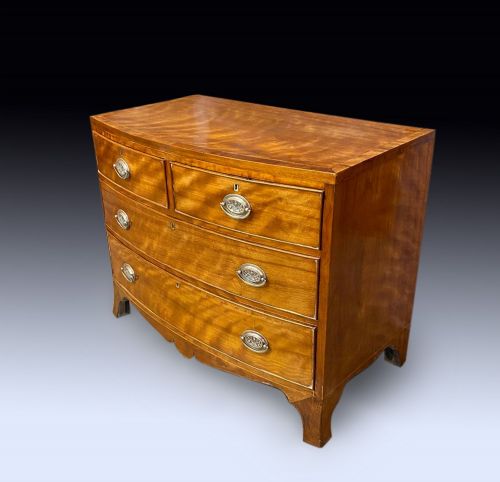


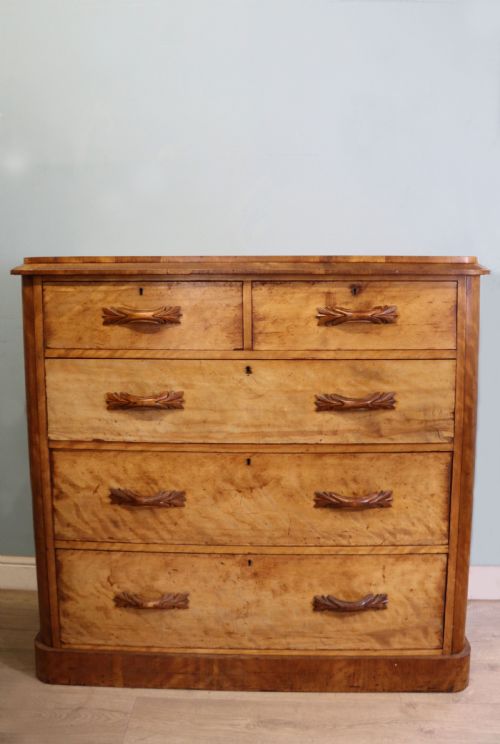
Honey Satinwood Chest of Drawers
These honey satinwood chest of drawers items bring warm timber tones and refined grain patterns into a room, offering practical storage with distinct period character.
Honey Satinwood Chest of Drawers
When you search for a honey satinwood chest of drawers, you are looking at timber case furniture designed for domestic storage across multiple eras. The pieces span from the 18th Century through the Victorian and Edwardian periods up to the 1930s.
The versions you are most likely to meet on this page include standard chests of drawers alongside bow fronted formats, secretaire chests, and smaller bedside cabinets. Their origins range across British and continental workshops, incorporating styles from George III to French Transitional and Art Deco.
Makers utilised the distinctive golden timber either as solid wood or fine veneer, sometimes pairing it with contrasting elements like ebony inlay or marble tops. The selection offers a clear view of how cabinet makers adapted the form from Georgian proportions to later Victorian and Edwardian requirements.
How they were made
Makers constructed these pieces primarily from satinwood and satin birch, often applying timber veneers over secondary woods to display the luminous grain. Cabinets frequently incorporate brass handles and escutcheons to complement the pale golden surface.
More elaborate examples utilise decorative techniques such as ebony inlay and ormolu mounts, while French pieces occasionally integrate marble tops. The joinery and timber selection reflect the standards of the George III, Victorian, and Edwardian periods in which they were produced.
A secretaire chest hides a tiny desk inside, perfect for writing letters when digital screens become tiresome.
What varies in quality
The standard of timber selection and veneer matching defines the visual impact of each piece, distinguishing simple utility items from high-status cabinet work. Grain orientation and the precision of contrasting elements like ebony inlay reveal the skill of the original maker.
Proportion and decorative restraint separate disciplined period designs from later or heavier interpretations. The integration of mounts, marble tops, and brass hardware dictates the overall refinement of the cabinet.
The Honey Satinwood Chest of Drawers Glossary
- Satinwood
- A dense, durable timber known for its natural golden sheen and smooth grain. It was widely utilised by 18th and 19th Century cabinet makers for high-end furniture.
- Bow fronted
- A convex, curved front profile popular in Georgian and later furniture design. This shape softens the corners of a room and showcases figured veneers.
- Secretaire chest
- A dual-purpose case piece featuring a fitted writing drawer that drops down to reveal small compartments and pigeonholes. It combines storage with a compact desk facility.
- Ormolu
- Gilded bronze ornamentation applied to furniture, particularly common in French-influenced pieces. It adds metallic contrast to the timber surface.
- Ebony inlay
- Contrasting dark wood inserted into the lighter satinwood surface to create geometric borders or decorative motifs. This technique highlights the edges and panels of the cabinet.
Honey Satinwood Chest of Drawers: Frequently Asked Questions
What periods do these satinwood chests come from?
The listings encompass items produced from the 18th Century through the Victorian and Edwardian eras, extending into the 1930s.
Styles range from George III and Regency designs to French Transitional and Art Deco forms.
How were secretaire chests used?
A secretaire chest combines a standard drawer configuration with a drop-front writing surface concealing internal compartments.
This allowed owners to manage correspondence without needing a separate standalone desk.
Are these pieces solid satinwood or veneer?
Cabinet makers utilised both solid timber and fine wood veneers depending on the specific piece and period.
Veneering allowed workshops to display striking grain patterns across large drawer fronts without risking timber movement.
What materials accompany the satinwood?
Construction frequently involves secondary woods augmented by brass hardware, ebony inlay, and occasionally marble tops.
Some examples also feature satin birch or ormolu mounts depending on the regional style.