
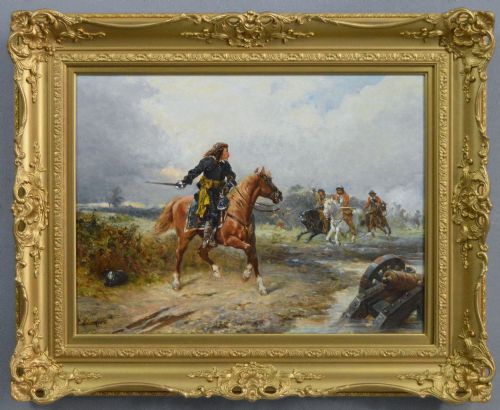


Historical Equestrian Wall Art
Historical equestrian wall art brings the drama of mounted battles, hunting parties and royal portraits straight into a room.
Historical Equestrian Wall Art
Historical equestrian wall art covers oil paintings, pen and ink drawings, photographic prints and wall tapestries depicting horses and riders. These works range from seventeenth-century Flemish Baroque scenes to Victorian narratives and twentieth-century traditional pieces.
The most common examples on this page are oil paintings on canvas and framed prints. Subjects span cavalry skirmishes, battle scenes, landscape hunts and royal portraits from periods such as the seventeenth, eighteenth and nineteenth centuries.
Materials and construction
Works in this category rely primarily on oil paint applied to canvas, supported by wooden stretchers and housed in giltwood or plain wood frames. Pen and ink drawings on paper provide a lighter medium, often preserved under glass.
Larger decorative pieces incorporate woven textiles for wall hangings and tapestries. Photographic prints from the early twentieth century utilise paper mounted behind glass within traditional frames.
The listings span multiple centuries, ranging from seventeenth-century Flemish canvases to mid-twentieth-century photographic prints and tapestries.
Judging quality in equestrian art
Quality rests on the handling of anatomy and movement in both horse and rider, distinguishing skilled academic draughtsmanship from stiffer workshop output. Compositional balance within complex battle scenes or landscape vistas further separates finer canvases from simpler decorative works.
The condition of the canvas, the preservation of the original paint layers and the integration of period frames influence the overall character of each piece. Finer examples retain their original pigments and surface tension without excessive later retouching.
Jean Sobieski·Pieter Bout·Adriaen Frans Boudewyns·Heywood Hardy·Abraham Cooper RA
The Historical Equestrian Wall Art Glossary
- Oil on Canvas
- Pigments suspended in a drying oil medium applied to a woven fabric support. This surface allows for rich colour blending and deep tonal graduation.
- Giltwood
- Timber carved and coated with a thin layer of gold leaf or metallic gilt finish. It is commonly found on traditional frames from the seventeenth to nineteenth centuries.
- Wall Tapestry
- A heavy hand-woven textile designed to be hung directly on a wall. These large pictorial hangings often depict historical or mythological equestrian processions.
- Flemish Baroque
- An artistic style originating in Flanders during the seventeenth century. It is characterised by dramatic movement, rich colour and dynamic compositions.
Historical Equestrian Wall Art: Frequently Asked Questions
How do I hang heavy oil paintings safely?
Heavy oil paintings require sturdy picture hooks fixed directly into wall studs or solid masonry using appropriate wall anchors. The weight of large canvases and giltwood frames demands secure fixings distributed evenly.
Ensure the hanging wire or D-rings on the reverse are structurally sound before mounting the piece at eye level. Avoid placing framed works in areas subject to direct sunlight or damp conditions.
What is the difference between an oil painting and a print?
An oil painting is a unique handmade work created by applying wet paint directly onto a canvas or panel. Brush texture and pigment depth distinguish these original pieces from mass-produced items.
Prints are mechanical or photographic reproductions on paper, often framed under glass for protection. Photographic prints capture existing imagery through light exposure rather than manual brushwork.
How can I identify a nineteenth-century work?
Nineteenth-century works often display specific stylistic traits such as Romantic or Victorian realism, focusing on dramatic historical narratives and military engagements. Frame construction and canvas preparation methods from this era provide additional clues.
Examining the stretcher frames, nails and paper backs helps confirm the age of the piece. Written inscriptions or signatures on the reverse of the canvas also offer historical context.