





Historic Watercolour
Historic watercolour works capture centuries of landscapes, architecture, and portraits through delicate pigment on paper.
Historic Watercolour
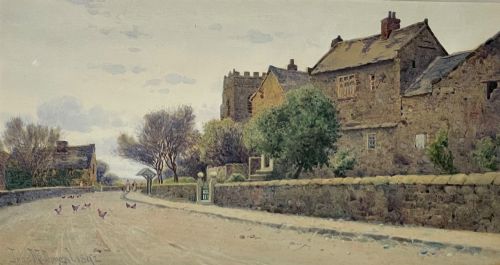
A historic watercolour represents a traditional painting technique executed on paper surfaces, often depicting architectural views, detailed portraits, and expansive landscapes. These works span multiple centuries, capturing domestic scenes, street views, and historic buildings across Britain and Europe.
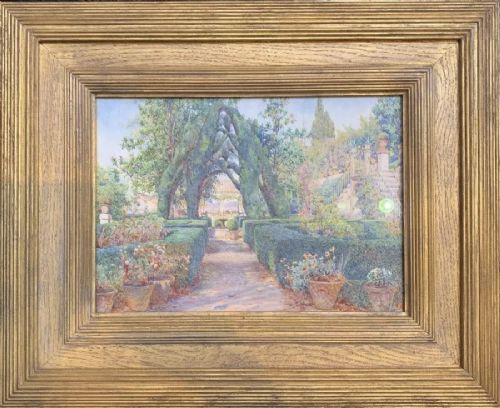
The pieces on this page most frequently emerge from the nineteenth and early twentieth centuries, including Victorian cityscapes, Edwardian garden scenes, and Regency studies. Buyers encounter framed artworks that preserve the original pigments and paper supports used by period artists.
Subjects range from grand historic interiors and coastal lighthouses to intimate portrait miniatures and military illustrations. Each historic watercolour offers a direct window into past architectural forms, social attire, and topographical views.
Materials and Techniques
These works rely on water-soluble pigment applied to paper supports, occasionally supplemented with ink or pen lines to define architectural details and figures. Artists used gum arabic binders to increase the luminosity and depth of the washes applied to the sheet.
Framed watercolours typically sit behind protective glass within wood or gilt wood frames that safeguard the fragile paper from atmospheric damage. The integration of sepia tones and layered washes allows the natural white of the paper to function as highlights within the composition.
The inventory includes architectural elevations of Dutch buildings, British Impressionist landscapes, and detailed portraits of historical figures.
Markers of Quality
The standard of a watercolour rests upon the precision of the brushwork and the stability of the pigment against fading over time. Master hands achieve remarkable architectural detail and atmospheric depth using minimal washes, while lesser examples rely on heavy, rigid line work.
The preservation of the original paper support and the clarity of the underlying ink or pigment significantly influence the visual impact of the painting. Strong provenance and documented exhibition histories further separate standard topographical records from superior artistic accomplishments.
Bruce Bairnsfather·John McDougal·Ernest Arthur Rowe·Percy Robertson·John Augustus Atkinson·Rowland Henry Hill·Henry Barlow Carter·Thomas Rowlandson·David Small·Fred Stead·Noel Harry Leaver·WF Mitchell·Robert Anderson·Beatrice Parsons·Tom Dudley·John Thirttle
The Historic Watercolour Glossary
- Watercolour
- A painting method where natural pigments are suspended in a water-soluble vehicle and applied to paper. This medium allows for transparent washes and luminous layering.
- Gilt wood
- Wood carved and coated with a thin layer of gold leaf or metallic gilt. This material frequently frames historic watercolours to provide a decorative border.
- Topographical
- Pertaining to the accurate representation of specific places, buildings, and landscapes. Such works serve as visual records of historic towns and rural scenes.
- Miniature
- A small-scale portrait painting executed with meticulous detail on paper or ivory. These intimate works often capture notable historical figures with fine precision.
- Sepia
- A brownish pigment derived from the ink sac of the cuttlefish, widely used for monochromatic drawings and wash paintings. Artists utilised this tone to create warm, unified shadow effects.
Historic Watercolour: Frequently Asked Questions
How should I hang a historic watercolour?
Protect the piece by placing it away from direct sunlight, which causes fragile pigments to fade over time. Ensure the room maintains stable humidity levels to prevent damage to the paper support and frame.
Utilise UV-filtering glass when framing to provide an additional layer of conservation. Professional framing protects the delicate surface from dust and environmental pollutants.
What subjects appear in these watercolours?
The subjects range from bustling city streets and historic architectural facades to tranquil rural landscapes and coastal lighthouses. Artists also recorded grand domestic interiors and detailed portrait studies.
Many works document specific towns, rivers, and notable buildings as they appeared during the nineteenth and early twentieth centuries. This variety offers collectors distinct glimpses into historical architecture and daily life.
How do I identify the period of a painting?
Examine the artistic style, framing materials, and clues within the subject matter, such as Regency fashion or Edwardian architectural details. Signatures, dates inscribed by the artist, and framing inscriptions often provide concrete chronological markers.
Paper characteristics and ink types also offer evidence regarding the era of execution. Comparing works by documented artists helps narrow down the precise decade of creation.
Are these works always framed?
Many historic watercolours arrive ready to hang in period wood or gilt wood frames that complement the aesthetic of the era. Original frames help preserve the integrity of the paper and provide historical context.
Some pieces are acquired unmounted or require conservation framing to ensure long-term preservation. Buyers should check individual listing details regarding the current framing status.