

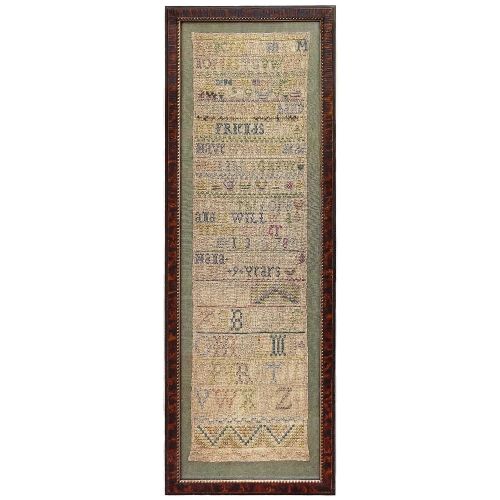


Historic Stitched Sampler
These historic stitched sampler pieces are intimate textile exercises worked by young hands, offering a direct window into domestic education across the Georgian and Victorian periods.
Historic Stitched Sampler
A historic stitched sampler presents a disciplined needlework exercise worked by young makers, often recording a name, age, and date alongside alphabets, numerals, and moral verses. The examples on this page primarily date from the Georgian and Victorian eras, spanning the early nineteenth century up to eighteen ninety.
The format ranges from simple alphabets and numbering grids to more ambitious pictorial compositions, religious texts like the commandments, and structured verses on education. Surviving pieces frequently include maker details such as Margaret Ann Blackow aged twelve or Ann Hodson aged thirteen, preserving personal milestones in thread.
Most pieces appear as framed textile wall art, encased behind glass in wooden frames, sometimes with gilded highlights. While many examples bear individual signatures, others survive anonymously without a name, yet maintain the same characteristic needlework execution.
Materials and construction
The foundation of these works is woven linen, which provided a stable grid for counting threads and executing precise stitches. Makers worked across this fabric using wool and silk thread to form letters, borders, and pictorial motifs.
Finished works are typically housed in wooden frames, often complemented by protective glass to shield the delicate textiles from environmental damage. Some frames feature gilded wood moulding, adding a formal finish to the domestic needlework.
Historic Stitched Sampler Retail Price Guide 2026
Typical asking prices for historic stitched sampler among the pieces listed under this phrase on Sellingantiques today, from the lower quarter to the upper quarter. They describe what is for sale here now, not the wider market.
Listings span the nineteenth century, including specific dates from eighteen ten to eighteen ninety, alongside Victorian folk art examples.
Judging quality and execution
Quality rests in the precision of the stitching and the ambition of the design, where disciplined execution of complex alphabets or pictorial verses elevates a piece above standard exercises. The inclusion of detailed inscriptions, such as specific dates, ages, and named makers, adds distinct historical depth.
The harmony of the colour palette achieved through surviving wool and silk thread also defines the visual appeal. Additionally, the preservation of the original linen ground and the character of the contemporary wooden framing contribute to the overall integrity of the textile.
The Historic Stitched Sampler Glossary
- Sampler
- A piece of needlework produced as a demonstration or test of skill in various stitches. These textile exercises were traditionally worked by young girls to practice alphabets, numbers, and decorative motifs.
- Linen
- A strong, durable fabric woven from flax fibres. This material served as the standard foundation ground for needlework due to its visible thread count.
- Silk thread
- A fine, lustrous protein fibre used for intricate embroidery work. It provides a smooth finish and subtle sheen to specific motifs within the textile.
- Gilded wood
- Wood treated with a thin layer of gold leaf or metallic gilt finish. This material is frequently found on the decorative frames enclosing period wall art.
Historic Stitched Sampler: Frequently Asked Questions
What is a historic stitched sampler?
A historic stitched sampler is a traditional textile work created to practise and demonstrate needlework proficiency. These pieces typically display alphabets, numbers, verses, and maker details.
Originating primarily in the Georgian and Victorian periods, they serve as tangible records of early domestic education and needlecraft skill.
How were these samplers used originally?
Young makers created these textiles as learning exercises under the instruction of schools or family members. They served to master essential stitches, lettering, and arithmetic layouts.
Once completed, many were framed and displayed in domestic interiors as evidence of a young person's accomplishments and moral instruction.
How do I date a historic sampler?
Dating relies heavily on inscribed dates, maker ages, and stylistic indicators present in the lettering, verse subjects, and framing materials. The pieces on this page span the Georgian and Victorian eras.
Examinations of the linen ground, thread types, and framing style also help place a piece within the nineteenth century.
How should I display a textile sampler?
These framed textiles require placement away from direct sunlight to prevent the silk and wool threads from fading. Maintaining stable indoor humidity protects the fragile linen ground and wooden frames.
Glass fronts already shield the fabric surface from dust and handling, making wall mounting straightforward.