
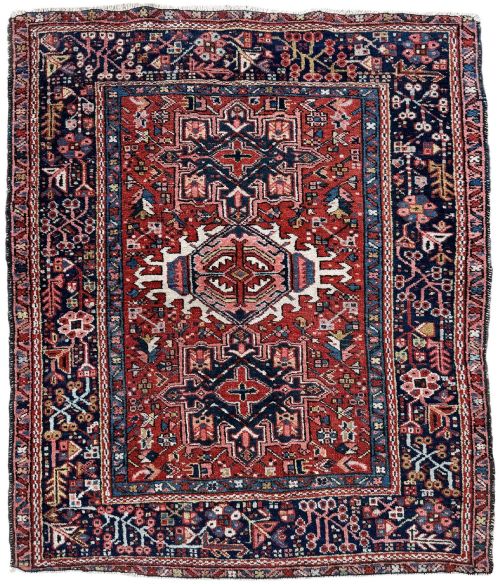


Heriz Style Area Rug
A heriz style area rug brings bold geometric motifs and rich wool texture into a room, offering the robust character of Northwest Persian weaving.
Heriz Style Area Rug
A heriz style area rug represents a distinct tradition of Northwest Persian carpet production, known for substantial scale and strong architectural medallions. When searching for a heriz style area rug, buyers encounter pieces originating from village workshops across the Heriz region and neighbouring districts like Karaja and Bakshaish.
The inventory on this page spans the late nineteenth century through the early twentieth century, capturing decades of traditional hand-knotting. Rugs and carpets appear in formats ranging from small scatter sizes to large room dimensions, accommodating various spatial requirements.
Village weavers in this Northwest Persian tradition interpret classical patterns with geometric precision, resulting in sturdy floor coverings suited to everyday use. These pieces connect modern interiors directly to historical weaving districts through durable materials and distinctive tribal designs.
Determinants of Quality
Quality in these floor coverings rests upon the crispness of the geometric drawing and the density of the wool pile. Finer examples display balanced proportions within the central medallion and deliberate saturation in the secondary motifs.
The integrity of the foundation and the uniformity of the weave distinguish superior village production from standard utility carpets. Material resilience and the clarity of natural dye palettes separate exceptional weaving from simpler commercial output.
Some village weavers inserted small, accidental stray knots of bright yellow wool into dark borders, leaving a personal signature in the wool.
The Heriz Style Area Rug Glossary
- Heriz
- A region in Northwest Persia renowned for producing durable carpets featuring large geometric medallions and rectilinear floral patterns. These rugs often utilise a distinctive brick-red or navy colour scheme.
- Karaja
- A village in the Heriz district known for smaller rugs featuring repeated geometric figures, often arranged in vertical chains or distinct medallions. The palette tends towards rich terracottas and deep blues.
- Bakshaish
- An older village weaving tradition associated with the Heriz area, characterised by more open, whimsical field designs and softer, earthy tones. These pieces predate many standard production styles of the later period.
- Medallion
- The central ornamental motif dominating the field of the carpet, typically rendered in geometric or angular forms in this regional style.
- Hand-knotted
- A construction method where individual lengths of wool yarn are tied by hand to the warp threads of the foundation, ensuring long-term durability.
Heriz Style Area Rug: Frequently Asked Questions
How do I clean a wool rug?
Vacuum gently without a rotating brush roll to remove loose debris from the pile. Professional specialist cleaning is recommended for deep maintenance.
Avoid soaking the cotton foundation or using harsh chemical detergents that strip natural lanolin from the wool fibres.
Where were these rugs made?
These pieces originate from village workshops and regional districts in Northwest Persia, specifically around the town of Heriz and nearby settlements like Karaja and Bakshaish.
Local weavers utilised traditional methods passed down through generations, incorporating regional motifs into each handmade carpet.
How do I identify a Heriz design?
Look for a prominent rectilinear central medallion flanked by stylised corner spandrels and bold geometric palmettes. The drawing is typically architectural and angular rather than curved.
Colour palettes frequently feature brick red, navy blue, and ivory accents derived from natural dye sources.
Can I place these rugs in high traffic areas?
The dense hand-knotted wool pile and sturdy cotton foundations make these floor coverings exceptionally durable for daily use. Hallways, living rooms, and dining spaces easily accommodate their robust construction.
Use a quality rug pad underneath to prevent slipping and reduce friction against the floorboards.