

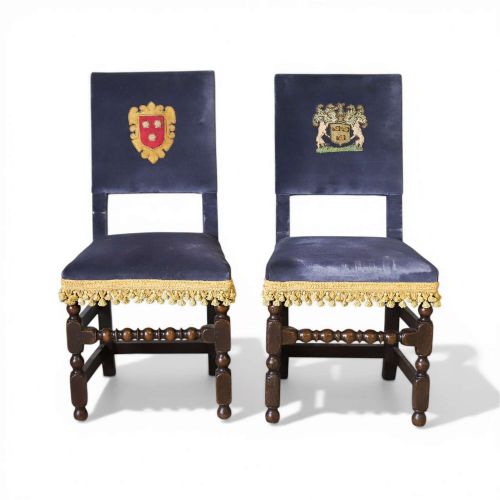
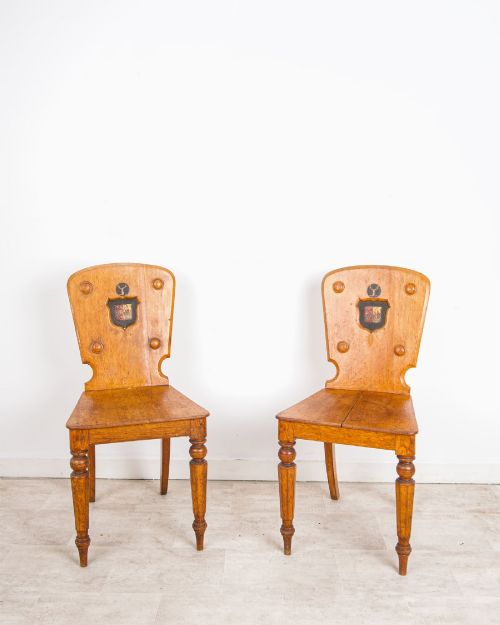


Heraldic Crest Seat
These heraldic crest seat pieces bring centuries of carved armorial heritage straight into your hall, offering bold coats of arms and sturdy timber frames.
Heraldic Crest Seat
When you search for a heraldic crest seat, you are looking at substantial wooden chairs designed to display family coats of arms, crests or carved shields directly on the backrest. The examples you meet on this page span the seventeenth, eighteenth and nineteenth centuries, taking the form of hall chairs, side chairs and armchairs.
The nineteenth-century pieces dominate the selection, including Victorian and late-century interpretations alongside earlier seventeenth-century Scottish examples. These seats typically serve as striking hallway furniture or reception seating, combining utilitarian timber construction with prominent heraldic display.
Materials and construction
The makers relied primarily on dense hardwoods like mahogany and oak, shaping the timber through traditional carpentry and carving techniques. These woods provided the necessary strength for upright hall chairs and allowed carvers to execute crisp heraldic shield backs and armorial motifs.
Heraldic Crest Seat Retail Price Guide 2026
Typical asking prices for heraldic crest seat among the pieces listed under this phrase on Sellingantiques today, from the lower quarter to the upper quarter. They describe what is for sale here now, not the wider market.
Listings span from the seventeenth century through the Victorian era, utilising mahogany, oak, brass, and velvet.
Distinctions in quality
Quality rests in the crispness and depth of the carved armorial work, where sharper chisel marks distinguish superior heraldic crest seats from simpler production. The choice of timber also dictates the standard, with richly figured mahogany and well-seasoned oak commanding greater visual presence than utilitarian alternatives.
Cohesion between the chair frame and the upholstery elevates the piece, particularly where velvet or tapestry complements the carved woodwork. Proportion and structural integrity complete the hierarchy, separating standard seating from grander architectural examples.
The Heraldic Crest Seat Glossary
- Armorial
- Adorned with heraldic bearings or a coat of arms. This term describes chairs featuring carved or painted family crests.
- Hall chair
- A rigid wooden seat traditionally placed in a grand entrance hall. These pieces prioritise display and durability over comfort.
- Gothic Revival
- An architectural and decorative style drawing inspiration from medieval design. It appears in pointed arches and heavy timber framing.
- Regency
- A British design period spanning the early nineteenth century. Furniture from this era often incorporates classical lines and dark mahogany.
Heraldic Crest Seat: Frequently Asked Questions
What is a heraldic crest seat?
A heraldic crest seat is a wooden chair, most commonly a hall chair or armchair, featuring a carved or painted coat of arms upon the backrest.
These pieces were historically commissioned by landed families to display lineage and status in entrance halls and reception rooms.
How were these chairs used?
They served primarily as formal seating in grand hallways, waiting areas and law chambers rather than for lounging.
Guests and visitors would sit on them briefly, while the prominent armorial backrests reinforced the identity and heritage of the household.
How do I live with a hall chair?
These chairs function best placed flat against a hallway wall or within a reception room where their carved shield backs remain visible.
Because they feature upright wooden or lightly upholstered seats, pairing them with a quiet corner rather than a primary seating area works best.
How do I tell periods apart?
Seventeenth-century pieces typically display rugged Scottish oak construction and deep, archaic carving styles.
Nineteenth-century Victorian and Gothic Revival examples often utilise smoother mahogany or oak with crisper, more symmetrical armorial details.