

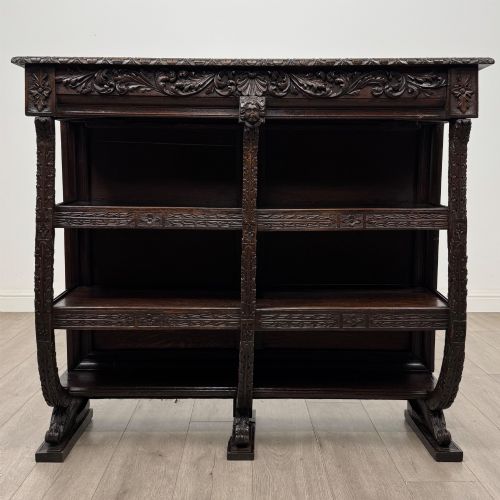


Heavy Oak Shelving
Heavy oak shelving brings sturdy timber character and immense practicality to a room, offering the robust support needed for heavy volumes and display collections.
Heavy Oak Shelving
Heavy oak shelving primarily appears in the form of substantial bookcases, open library shelving, and wall-mounted shelves dating from the seventeenth to the nineteenth century. These pieces serve demanding domestic and institutional storage needs through thick timber construction.
Victorian examples dominate the selection, often featuring deep carved ornamentation, breakfront proportions, or Renaissance Revival details. Earlier seventeenth-century wall shelves also emerge, showing simpler forms executed in dense native timber.
Buyers encounter everything from tall, adjustable library bookcases to lower breakfront units and simpler wall-hung plate racks. Each version provides the structural rigidity inherent in solid oak architecture.
Materials and construction
Makers utilised solid oak throughout these pieces, often selecting quartersawn timber that reveals distinctive medullary rays and grain patterns. This dense hardwood provides the exceptional load-bearing capacity required for heavy book collections.
Carving serves as the principal decorative technique, ranging from modest edge moulding to elaborate Renaissance Revival and Gothic motifs executed by hand. Joinery relies on traditional methods to support the significant weight of the timber and its contents.
Heavy Oak Shelving Retail Price Guide 2026
Typical asking prices for heavy oak shelving among the pieces listed under this phrase on Sellingantiques today, from the lower quarter to the upper quarter. They describe what is for sale here now, not the wider market.
Miskin Manor lends its historic provenance to a Victorian breakfront bookcase on this page, connecting domestic library shelving to Welsh architectural heritage.
Assessing quality and craftsmanship
The standard of carving distinguishes standard utility furniture from pieces commissioned for country houses and libraries. Crisp relief work and balanced architectural proportions indicate a higher tier of workshop production.
Timber selection and board width also dictate quality, with wide, unjoined planks and well-figured grain marking the superior examples. The integration of adjustable shelving mechanisms reveals thoughtful design execution in the taller Victorian bookcases.
The Heavy Oak Shelving Glossary
- Breakfront
- A cabinet or bookcase whose central section projects forward from the recessed wings. This architectural arrangement creates depth and visual interest in large library pieces.
- Renaissance Revival
- A nineteenth-century design style that draws inspiration from sixteenth-century classical architecture and ornament. Pieces in this style frequently display heavy carved details and symmetrical proportions.
- Quartersawn
- A method of timber milling where the log is quartered before cutting, producing stable boards with straight grain lines. This technique enhances the durability and appearance of oak furniture.
- Medullary rays
- The radial cellular ribbons visible in quartersawn oak timber that appear as distinct flecks across the grain. Their presence signifies quality timber selection.
Heavy Oak Shelving: Frequently Asked Questions
What is heavy oak shelving?
Heavy oak shelving comprises robust bookcases, open library units, and wall shelves built from solid oak. These pieces date from the seventeenth to the nineteenth century and provide sturdy storage for large libraries.
The category encompasses both large breakfront bookcases designed for country houses and smaller wall-mounted shelves. Their defining characteristic is the heavy timber construction necessary to support extensive book collections.
How do I date these pieces?
Dating relies on examining the construction methods, tool marks, and stylistic ornament present on the timber. Seventeenth-century wall shelves show simpler hand-worked joinery, whereas Victorian pieces often incorporate mechanical adjustments and revival styles.
Secondary woods, backboards, and carving motifs also assist in placing a piece within the nineteenth century or earlier periods. Stylistic cues such as Renaissance Revival details point firmly to Victorian manufacture.
Can these shelves hold heavy books?
Solid oak construction provides exceptional natural strength, making these shelves well suited for heavy volumes. Many Victorian examples include adjustable shelving systems specifically engineered for library use.
The density of mature oak prevents the sagging common in softer timbers. This structural integrity allows the furniture to perform its original function reliably in modern spaces.
Where were these pieces used?
Original locations included estate libraries, country house studies, and institutional spaces requiring extensive book storage. Large breakfront bookcases stood against the walls of grand rooms to house private collections.
Smaller wall shelves served more functional roles in kitchens or domestic parlours for displaying ceramics and smaller volumes. Their robust build suited rooms dedicated to study and administration.