



Heavy Oak Court Cupboard
A heavy oak court cupboard brings monumental presence and rich carved detail to a room, offering robust storage built to last generations.
Heavy Oak Court Cupboard
The versions most commonly met on this page date from the Victorian period, specifically around eighteen eighty, and often incorporate revival styles such as Jacobean, Renaissance, and Gothic.
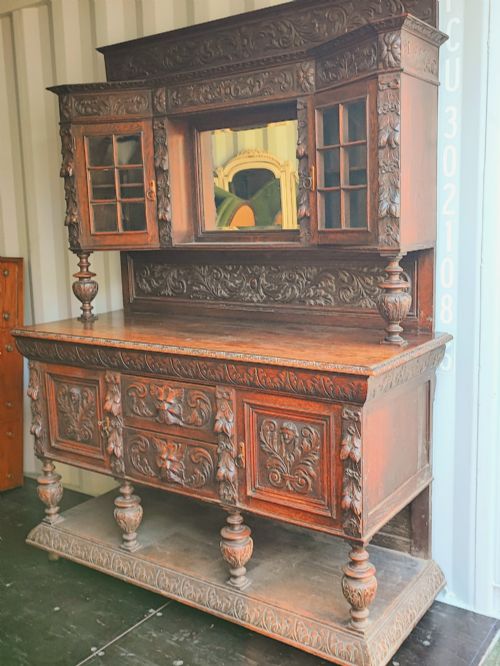
Makers utilised dark timber and expressive carving to create imposing storage items intended for grand interiors, featuring prominent panels, mirror backs, and figural details like Green Man motifs.
How they were made
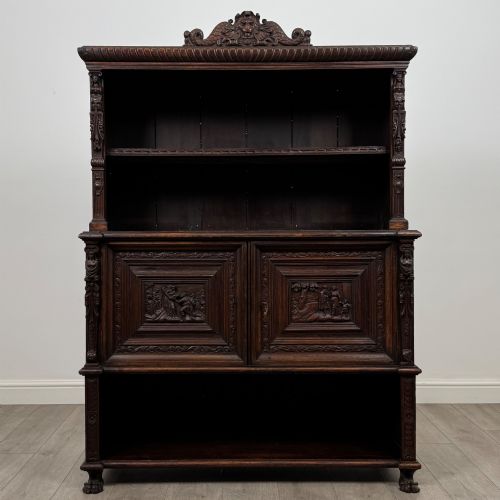
Construction relies upon solid oak timbers, chosen for strength and grain, assembled with iron and brass hardware. Cabinetmakers employed deep relief carving by hand to articulate panels, friezes, and architectural mouldings.
Glass elements, including bevelled glass and mirror plates, appear alongside the primary wood structure in cabinets and mirror back sideboards. Metal hinges and pulls secure heavy doors and drawers built for domestic utility.
Heavy Oak Court Cupboard Retail Price Guide 2026
Typical asking prices for heavy oak court cupboard among the pieces listed under this phrase on Sellingantiques today, from the lower quarter to the upper quarter. They describe what is for sale here now, not the wider market.
Materials recorded across the inventory include bevelled glass, brass hardware, and mirror plates alongside heavy timber.
What varies in quality
Depth and crispness of the hand carving separate standard production from superior examples, with finer pieces displaying expressive figures and intricate strapwork. The choice of golden or deeply patinated oak also alters the visual weight of the timber.
Integration of secondary materials like mirror glass and brass hardware dictates the refinement of a piece. Well-balanced proportions across large three-door cupboards and mirrored sideboards demonstrate superior design execution.
The Heavy Oak Court Cupboard Glossary
- Renaissance Revival
- A nineteenth-century design movement drawing inspiration from sixteenth-century European architecture and ornament. It manifests in heavy architectural mouldings and symmetrical carved panels.
- Gothic Revival
- An architectural and decorative style mimicking medieval forms. This appears in pointed arches, trefoils, and solemn ecclesiastical motifs applied to domestic cabinetry.
- Green Man
- A sculptural motif representing a face surrounded by or sprouting from foliage. It symbolises rebirth and occurs frequently in nineteenth-century architectural wood carving.
- Bevelled glass
- Glass panes with edges cut and polished at an angle. This technique adds refractive detail to cabinet doors and mirrors.
Heavy Oak Court Cupboard: Frequently Asked Questions
What is a heavy oak court cupboard?
A heavy oak court cupboard is a substantial nineteenth-century storage piece constructed from solid timber with extensive carving.
These items reflect revivalist architectural styles popular during the Victorian era.
How were these cupboards used?
Victorian households utilised these large cabinets for displaying and storing dining silver, linens, and provisions in reception rooms.
Their robust construction and shelving provided both decorative presence and practical utility.
How do I identify Victorian oak pieces?
Victorian oak furniture exhibits characteristic revival motifs such as Renaissance strapwork, Gothic tracery, and deep panel moulding.
The use of machine-sawn timber combined with hand finishing helps date these items to the nineteenth century.
Where do Green Man carvings appear?
Green Man faces are integrated into the wooden panels and friezes of large sideboards and cupboards.
Carvers sculpted foliage directly from the oak to frame these symbolic figures.