

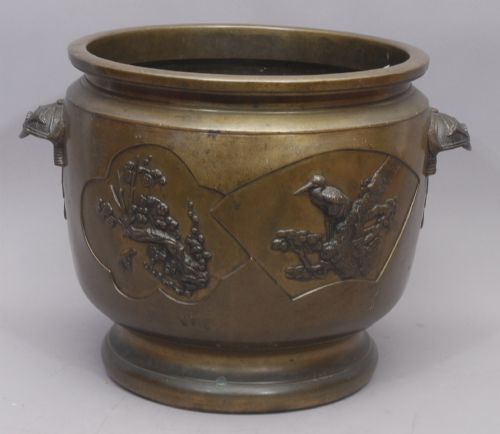


Heavy Bronze Burner
A heavy bronze burner brings substantial weight and deep ritual history to a room.
Heavy Bronze Burner
A heavy bronze burner is a substantial vessel designed for burning incense, typically taking the form of a tripod censer, ritual bowl, or lidded container. These objects carry a significant physical presence, often weighing several kilograms and featuring cast handles shaped like animal masks or dragons.
The pieces available here span from the sixteenth century through to the nineteenth century, with strong representation from the Ming and Qing Dynasties. Buyers frequently encounter scholars censers and archaistic designs that draw on ancient ritual forms while serving as decorative works.
Originating largely from Chinese traditions, these heavy bronze vessels include tripod configurations complete with matching stands and covers. Alongside censers, the selection encompasses related forms such as decorative bowls and jardinières fashioned from copper alloy and bronze.
What varies in quality
Quality rests in the precision of the casting and the density of the metal, where sheer weight often signals superior craftsmanship. Master-cast examples display a clear bell-ring resonance when struck, marking the purity and density of the bronze alloy.
Surface decoration and applied finishes separate standard vessels from exceptional pieces. The careful placement of gilt-splash work and the crispness of archaistic reliefs or mask handles demonstrate the skill applied by the workshop.
Heavy Bronze Burner Retail Price Guide 2026
Typical asking prices for heavy bronze burner among the pieces listed under this phrase on Sellingantiques today, from the lower quarter to the upper quarter. They describe what is for sale here now, not the wider market.
A fine master-cast censer rewards an appreciative tap by ringing like a church bell, proving that bronze can sing after four centuries.
Wu Bangzuo
The Heavy Bronze Burner Glossary
- Censer
- A vessel used for burning incense. These containers often feature covers and tripod legs.
- Archaistic
- A style that consciously imitates ancient ritual bronzes from earlier dynasties. This design approach appears frequently on scholarly vessels.
- Taotie
- A mythical zoomorphic mask motif commonly cast onto the sides of ancient and later ritual bronzes. It serves both a decorative and symbolic function.
- Gui
- An ancient Chinese ritual bronze vessel shape characterised by a bowl form with loop handles. Later censers frequently adopt this specific silhouette.
- Jardiniere
- A decorative pot or container used to hold plants or flowers. These items appear alongside lidded censers in the broader category of heavy metal vessels.
Heavy Bronze Burner: Frequently Asked Questions
How do I care for a heavy bronze burner?
Dust the surface gently with a soft, dry cloth to protect the metal and any applied gilt-splash details.
Avoid using chemical polishes or water, which can damage the historic patina and surface treatments built up over centuries.
Were these vessels used for burning incense?
Yes, these censers were designed primarily to hold burning incense in scholarly settings or ritual spaces.
Many retain traces of their original function, while others serve purely as decorative works of art today.
What indicates a Qianlong period piece?
Qianlong period vessels often feature sophisticated surface work, including rich gilt-splash details and refined archaistic forms.
They reflect the imperial tastes and high manufacturing standards of the eighteenth-century Chinese court.
Why do some censers include stands?
Matching stands protect delicate furniture surfaces from the heat generated during the burning of incense.
They also provide a visual base that elevates the proportions of heavy tripod vessels and lidded censers.