




Hanging Wood Barometer
These hanging wood barometer examples bring practical domestic science and rich cabinet-making into a room.
Hanging Wood Barometer
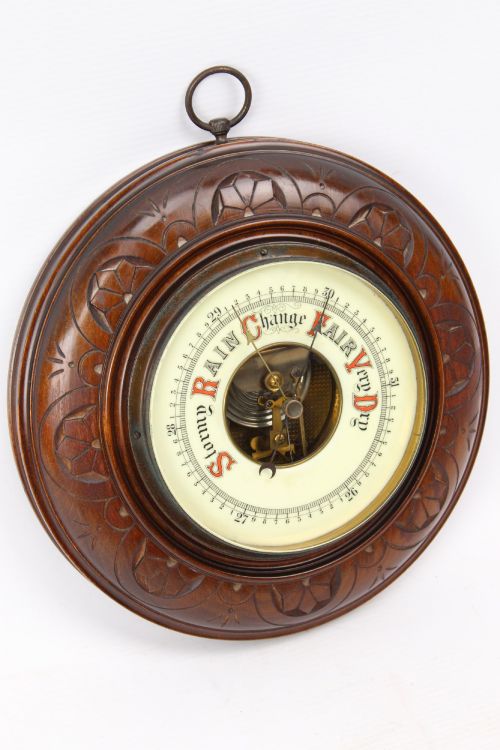
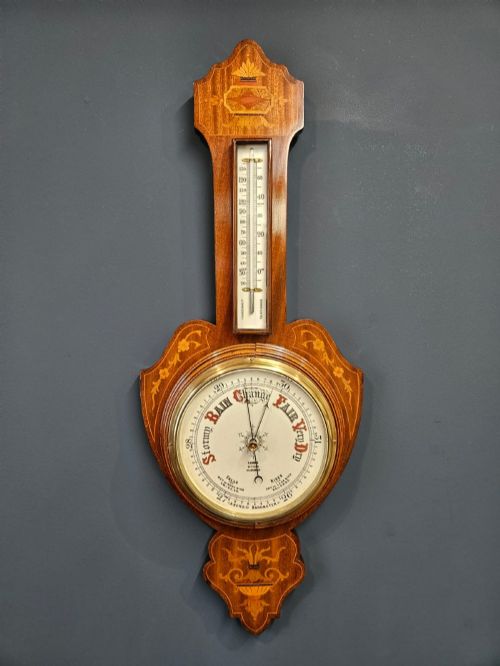
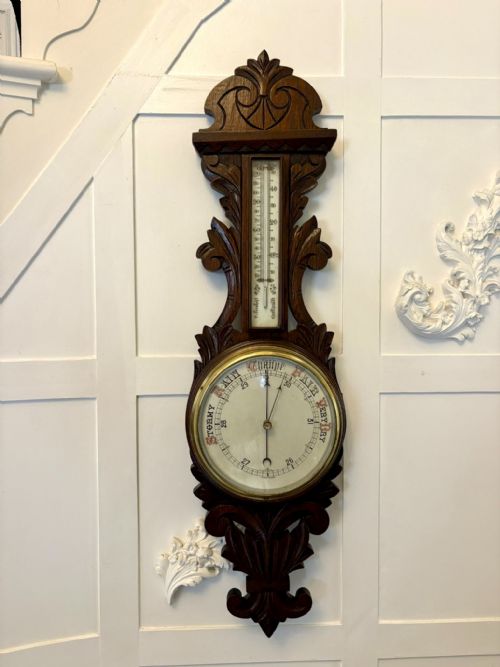
A hanging wood barometer serves both as a functional weather-measuring instrument and as a piece of wall furniture. When searching for a hanging wood barometer, buyers encounter traditional forms ranging from tall stick designs to wide banjo and wheel layouts.
The pieces listed on this page span the Georgian, Victorian, and Edwardian periods. Oak and mahogany dominate the offerings, appearing alongside rosewood, walnut, beech, and satinwood.
Among these choices, carved oak aneroid examples and mahogany banjo shapes appear most frequently. Makers such as JB Bergna, Maple & Co, and James Pitkin London add notable provenance to specific items.
Materials and construction
Cabinet-makers shaped dense hardwoods like mahogany, oak, and rosewood to house fragile glass barometer tubes and delicate silvered metal dials. Many cases feature detailed carving, while others rely on smooth veneers and subtle satinwood inlay.
Makers integrated mercury columns in stick barometers and mechanical aneroid movements in dial instruments. Brass bezels protect the glass faces, and mother-of-pearl accents occasionally decorate the wealthiest wheel barometer layouts.
Hanging Wood Barometer Retail Price Guide 2026
Typical asking prices for hanging wood barometer among the pieces listed under this phrase on Sellingantiques today, from the lower quarter to the upper quarter. They describe what is for sale here now, not the wider market.
Listings feature four distinct timber varieties: oak, mahogany, rosewood, and walnut, spanning the eighteenth to the twentieth centuries.
Evaluating craftsmanship
Quality rests in the crispness of the wood carving and the richness of the grain selection. Plain, utilitarian oak cases sit at one end, while finely figured mahogany and intricate Black Forest foliage carving represent the other.
Signed dials by established retailers like Maple & Co or makers like James Pitkin elevate a piece significantly above anonymous workshop output. The retention of original mercury tubes or functional aneroid mechanisms preserves the historical integrity of the instrument.
JB Bergna Newcastle·Maple & Co·James Pitkin London
The Hanging Wood Barometer Glossary
- Stick barometer
- A tall, narrow instrument measuring atmospheric pressure through a vertical mercury column. This format represents the older, more scientific end of domestic weather recording.
- Banjo barometer
- A household weather glass housed within a symmetrical wooden frame shaped vaguely like a musical instrument. These typically incorporate a circular dial at the base and a hygrometer or thermometer above.
- Aneroid barometer
- A mechanism measuring air pressure without liquid, using a flexible sealed metal box that expands or contracts. This invention allowed barometers to be built into compact circular wall cases.
- Silvered metal
- A brass or copper dial treated with a silver finish to receive engraved graduations and weather inscriptions. This surface catches the light gently behind the glass bezel.
Hanging Wood Barometer: Frequently Asked Questions
What is an aneroid barometer?
An aneroid barometer measures atmospheric pressure using a small, flexible metal capsule rather than liquid mercury. This dry mechanism made it possible to create compact wall instruments in various wooden shapes.
Such pieces became widespread during the Victorian era for domestic hall and study use.
How do I date a barometer?
Dating relies on the timber used, the cabinet style, and the inscription on the dial. Georgian pieces lean toward slender mahogany stick designs, while Victorian examples often feature heavy carved oak or inlaid rosewood.
Maker signatures and patent marks also help anchor the instrument to a specific decade.
Where should I hang a barometer?
These instruments suit interior walls away from direct sunlight, heavy moisture, and sudden heat sources. Hallways and studies provide stable environments that protect both the wooden case and the internal mechanism.
Ensure the wall fixing is secure, as denser hardwood frames carry considerable weight.
What is a wheel barometer?
A wheel barometer uses a pulley system connected to a float inside the tube to drive a pointer around a circular dial. This layout allowed makers to present weather readings on an easy-to-read face.
Cabinet-makers framed these dials in elaborate mahogany, rosewood, or inlaid wooden surrounds.