




Hanging Weather Glass
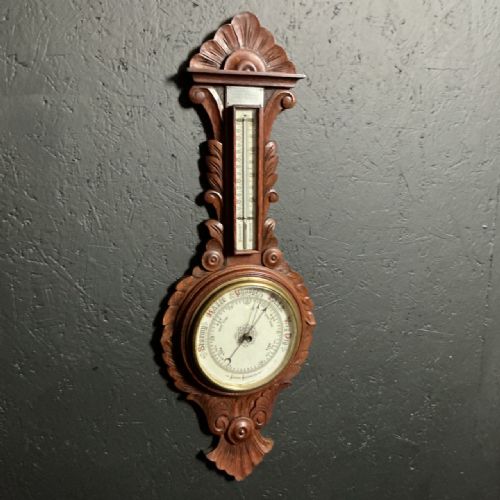
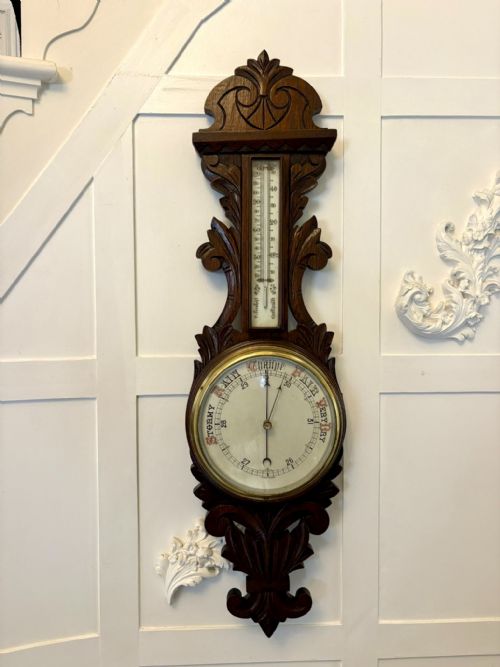
These hanging weather glass pieces are practical scientific instruments housed in handsome wood and brass frames that bring traditional atmospheric measurement into domestic spaces.
Hanging Weather Glass
When you search for hanging weather glass, you are looking at functional barometers designed to be mounted on walls or suspended within domestic interiors. These instruments measure atmospheric pressure to help forecast local weather conditions.
The most common examples encountered on this page date from the Victorian and Edwardian periods, alongside earlier Georgian iterations. They appear primarily as stick barometers, wheel barometers, and banjo barometers.
Makers such as JB Bergna, James Pitkin, J Groce, S P Cohen, Tarone Gally & Co, and George Dollond represent the professional instrument makers whose names appear on these pieces. Their work reflects the standard of scientific craftsmanship across the eighteenth, nineteenth, and early twentieth centuries.
Materials and construction
These instruments rely on durable cabinet woods including mahogany, oak, walnut, and rosewood for their housings. Frames often feature carved ornamentation, bone inlay, mother-of-pearl accents, or brass fittings.
The internal mechanics utilise sensitive glass tubes containing mercury or aneroid capsules linked to silvered metal dials. These delicate components require stable wooden cases to maintain alignment and accuracy over time.
Assessing quality in hanging weather glass
Quality separates mass-produced units from pieces constructed by skilled instrument makers. The precision of the silvered metal dial engraving and the complexity of the wood carving indicate the level of craftsmanship involved.
The integrity of the timber case and the legibility of the maker's signature inscribed on the face determine the desirability of an individual piece.
JB Bergna Newcastle·James Pitkin London·J Groce York·Tarone Gally And Co·George Dollond London
The Hanging Weather Glass Glossary
- Stick barometer
- A tall, narrow instrument containing an open column of mercury that rises and falls with atmospheric pressure. This form represents the more traditional and straightforward design.
- Wheel barometer
- A round dial instrument connected to a siphon tube and pulley system that translates mercury movement into pointer rotation. These often incorporate additional instruments like thermometers on the face.
- Banjo barometer
- A wall-mounted barometer housed in a case shaped like a banjo, featuring a circular dial at the base and a long stem above. This style became popular during the nineteenth century.
- Aneroid barometer
- An instrument that measures pressure using a small, flexible metal box rather than liquid mercury. This mechanism allowed for more compact and varied case designs.
- Silvered metal
- A brass or copper dial treated to give it a bright, silver-like finish which is then engraved with weather scales and maker details. The clarity of this work indicates the piece's standard.
Hanging Weather Glass: Frequently Asked Questions
How do stick and wheel barometers differ?
Stick barometers display the mercury column directly within a tall wooden case, offering a clear view of the physical fluid level.
Wheel barometers translate that same fluid movement through a pulley to turn a pointer around a circular dial, providing a more easily read display.
Where should I hang a weather glass?
These instruments require interior walls away from direct sunlight, heating vents, and exterior doors to ensure stable temperature readings.
Secure mounting is essential to support the weight of the timber cases and protect the delicate glass internal components.
How do I date an oak or mahogany barometer?
Cabinet styles, wood choices, and dial designs help determine the period of manufacture, moving from plain early Georgian cases to heavily carved Victorian oak frames.
Inscribed signatures from makers active in specific cities provide a reliable method for narrowing down the production date.
Do these barometers still work accurately?
Many historical barometers retain functional movements, though mercury instruments require careful handling and professional calibration.
Aneroid mechanisms can often be adjusted to local barometric pressure using a reference point.