

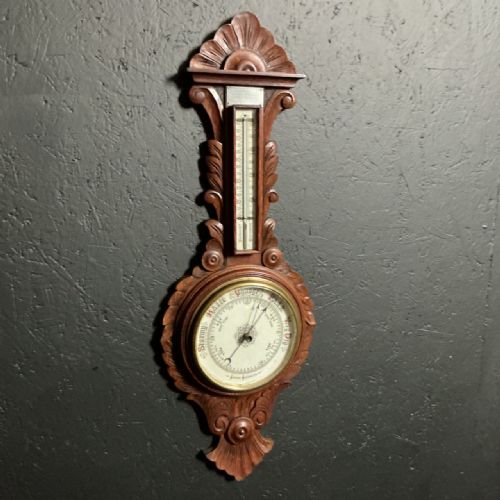


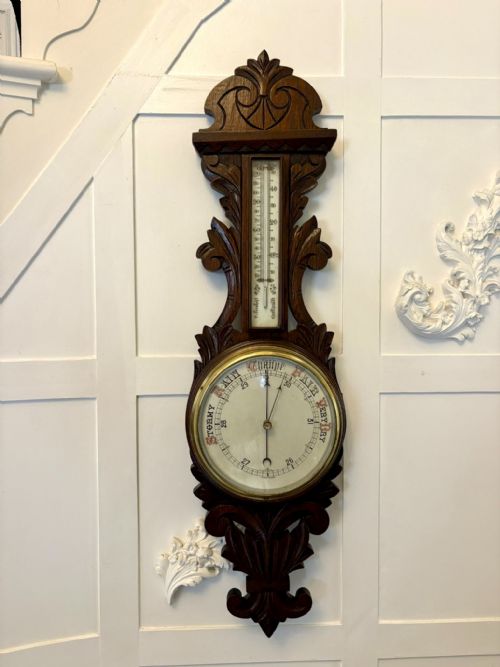


Hanging Glass Barometer
A hanging glass barometer brings atmospheric precision into a room, combining scientific utility with rich timber framing.
Hanging Glass Barometer
When searching for a hanging glass barometer, you encounter instruments designed to display atmospheric pressure through mercury or aneroid movements housed in timber wall cases. The selection spans stick barometers, banjo shapes, and wheel configurations spanning the eighteenth, nineteenth, and early twentieth centuries.
Victorian and Edwardian oak, mahogany, and rosewood examples appear frequently, alongside earlier walnut pieces and Black Forest carved frames. These domestic instruments served both practical forecasting and decorative domestic display in period interiors.
Wall clocks and thermometers occasionally accompany the barometer dials within integrated timber cases, reflecting the multi-functional requirements of period households. The forms range from plain maritime styles to deeply carved architectural mountings.
Construction and materials
Makers housed sensitive glass barometer tubes and metal dials within seasoned timber carcases constructed from mahogany, oak, walnut, and rosewood. Solid woods and finely figured veneers provided stable housings that protected the internal mechanisms from environmental movement.
Carving, bone inlay, and mother-of-pearl embellishment ornamented the surrounds of Victorian and Edwardian wheel and banjo barometers. Silvered metal registers displayed the barometric scales, etched with weather descriptors and calibrated to standard measurements.
Hanging Glass Barometer Retail Price Guide 2026
Typical asking prices for hanging glass barometer among the pieces listed under this phrase on Sellingantiques today, from the lower quarter to the upper quarter. They describe what is for sale here now, not the wider market.
Listings span from the 18th century through the Victorian and Edwardian eras, utilising brass, glass, oak, mahogany, walnut, and rosewood.
Assessing quality and execution
The sophistication of the timber case carving and the choice of figured veneers distinguish finer workshop output from utilitarian domestic pieces. Deeply carved oak frames and richly grained rosewood or walnut bodies indicate higher production standards.
The legibility and engraving quality of the silvered metal dial plate, alongside the inclusion of signed maker details, separate standard instruments from those commissioned from notable instrument makers.
JB Bergna Newcastle·James Pitkin London·J Groce York·Tarone Gally And Co·George Dollond Of London
The Hanging Glass Barometer Glossary
- Aneroid barometer
- An instrument measuring atmospheric pressure without liquid, using an expanding metal capsule connected to an indicator needle. This design became common during the Victorian period.
- Stick barometer
- A tall, narrow instrument enclosing a long glass tube filled with mercury, mounted directly onto a wooden backboard. These offer a direct view of the mercury column.
- Wheel barometer
- A round dial instrument where a float on the mercury column connects to a pulley and pointer. This layout allows for a large, easily read circular face.
- Banjo barometer
- A wall instrument housed in a distinctive symmetrical wooden case shaped like a banjo. It typically incorporates a thermometer and hygrometer alongside the main dial.
- Silvered metal
- A brass or copper dial plate treated with a silver solution to create a matte white finish. Graduations and text are then engraved and filled with dark wax for clarity.
Hanging Glass Barometer: Frequently Asked Questions
How do I set a hanging glass barometer?
Adjust the setting hand to align directly over the current indicator needle using the small brass knob on the front glass. This allows you to track movement up or down over subsequent hours.
Changes in the position relative to your set hand reveal whether pressure is rising or falling, providing the basis for your local forecast.
Where should I hang a barometer?
Select an interior wall away from direct sunlight, radiators, and exterior doors to prevent rapid temperature fluctuations from affecting the mechanism. Stable indoor conditions ensure accurate pressure readings.
Secure the hanging bracket firmly into timber studs or use appropriate wall fixings, as denser wood and glass cases carry significant weight.
How do I tell an earlier barometer from a later one?
Eighteenth-century examples typically feature walnut cases with simple stick configurations and minimal ornamentation. Victorian and Edwardian pieces introduce heavier oak carvings, banjo shapes, and aneroid movements.
Examining the construction methods, dial typography, and timber selection helps place the instrument within its correct stylistic period.
Can antique barometers still be accurate?
Many surviving instruments retain functional movements that respond reliably to atmospheric changes once properly calibrated. Mercury stick barometers require careful handling to avoid air entering the glass tube during relocation.
Anoried mechanisms may need professional adjustment by a specialist to correct internal spring tension over time.