

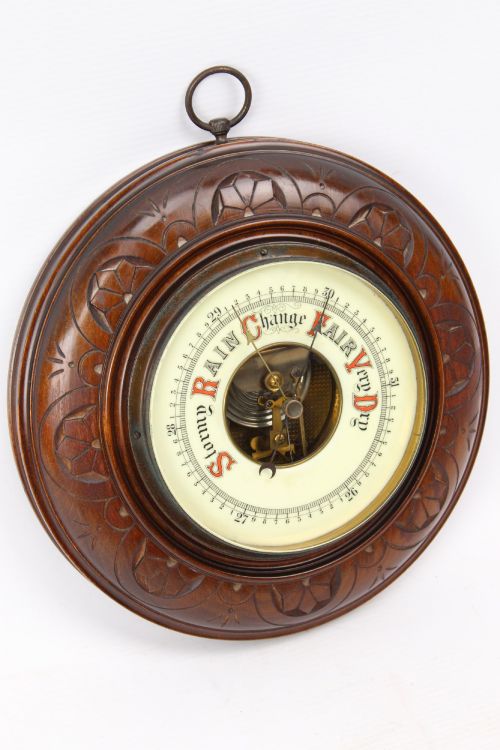
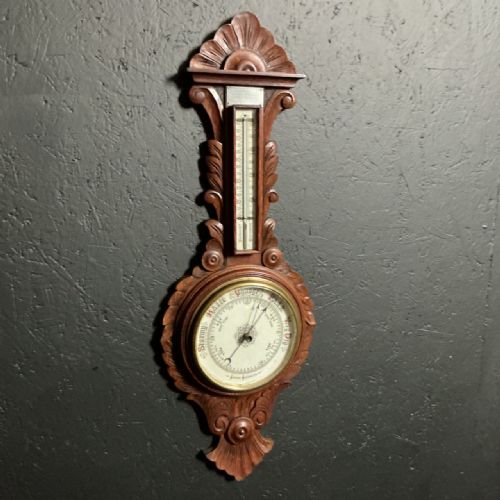


Hanging Dial Barometer
A hanging dial barometer brings mechanical precision and period timber to a wall, recording atmospheric pressure with reliable craft.
Hanging Dial Barometer
A hanging dial barometer displays atmospheric pressure on a circular face, offering a practical instrument that doubles as a domestic centrepiece. These pieces range from early wheel barometers to aneroid examples, mounted securely for display in halls and studies.
The versions most commonly met on this page span the Victorian and Georgian eras, alongside Edwardian and Regency examples. Mahogany and oak dominate the timber selection, frequently accompanied by brass bezels and silvered metal dials.
Makers such as Negretti & Zambra and George Dollond represent the higher tier of precision instrument manufacture. Simpler domestic models appear alongside elaborate banjo and stick formats inlaid with boxwood.
Materials and construction
Makers constructed these instruments using dense hardwoods such as mahogany, walnut, oak, and rosewood, often shaping them into banjo or stick profiles. Selected timbers were seasoned and polished to highlight natural grain patterns.
Dials utilised silvered metal for clear legibility, protected behind hinged glass doors set within cast brass bezels. Boxwood stringing frequently provided delicate inlay work on mahogany bodies.
Hanging Dial Barometer Retail Price Guide 2026
Typical asking prices for hanging dial barometer among the pieces listed under this phrase on Sellingantiques today, from the lower quarter to the upper quarter. They describe what is for sale here now, not the wider market.
Current listings feature instruments spanning the eighteenth, nineteenth, and early twentieth centuries, constructed in mahogany, oak, walnut, and rosewood.
Judging quality and craftsmanship
Quality rests in the precision of the dial engraving and the crispness of the timber carving. Finer instruments exhibit superior mechanical finishing within the movement and careful selection of cabinet timbers.
The reputation of the maker shapes the standing of an instrument, with signed examples by established firms commanding greater attention. Proportion and restraint in the casework separate standard utility barometers from ambitious workshop productions.
JB Bergna·Maple & Co·Negretti & Zambra·Pinchetti & Co·Tarone Gally & Co·George Dollond
The Hanging Dial Barometer Glossary
- Aneroid barometer
- A barometer that measures pressure using a flexible metal box rather than liquid mercury. It offers a compact mechanism suitable for domestic wall hanging.
- Wheel barometer
- A dial barometer that uses a mercury-filled siphon tube connected to a pulley and pointer. This layout translates fluid movement into rotational dial readings.
- Stick barometer
- A tall, narrow barometer showing the direct height of a mercury column in a glass tube. These vertical instruments represent traditional scientific measurement.
- Silvered metal
- A brass or copper dial treated with a silver compound to produce a matte white finish. Graduations and maker names are engraved and darkened for clarity.
- Bezel
- The metal ring that holds the protective glass face over the dial. Brass is the standard material for this component.
Hanging Dial Barometer: Frequently Asked Questions
What is a hanging dial barometer?
A hanging dial barometer is a wall-mounted meteorological instrument that displays air pressure changes on a circular face. These pieces combine scientific utility with decorative cabinetwork.
Craftsmen housed the delicate internal movements within wooden cases shaped for domestic interiors.
How do I hang a barometer?
These instruments require a secure fixing point on a sturdy wall, typically utilising a strong screw or bracket suited to the weight of the timber case. Placement should avoid direct sunlight and major heat sources.
Level mounting ensures the internal mechanical linkages operate without binding against the case.
How do I date an antique barometer?
Dating relies on stylistic clues in the woodwork, the shape of the case, and the materials used for the dial and bezel. Georgian and Regency pieces show different proportions compared to Victorian or Edwardian examples.
Signatures or maker inscriptions engraved on the dial provide a direct reference to the active period of the workshop.
Do antique barometers still work?
Many surviving barometers remain functional, though mercury instruments require careful handling and transport to avoid breaking the column. Aneroid movements can often be calibrated to local pressure.
Professional inspection helps ensure internal linkages and tubes remain intact and accurate.