

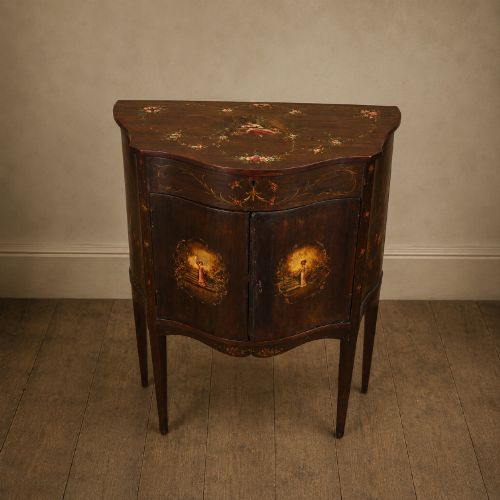


Hand Painted Mahogany Cabinet
These hand painted mahogany cabinet pieces combine rich timbers with delicate brushwork, offering refined storage for any collector.
Hand Painted Mahogany Cabinet
When you search for hand painted mahogany cabinet, you enter a field defined by the intersection of dark tropical timber and fine decorative brushwork. These pieces range from upright display cabinets and vitrines to compact side cabinets and demi-lune commodes.
The versions you meet most frequently on this page date from the Victorian and Edwardian eras, often showing Sheraton Revival or Adam Revival influences. They serve primarily to display china or store domestic treasures while bringing warmth and colour to a room.
Alongside tall display pieces, the category extends to specialised forms such as bijouterie tables, chiffoniers, and cabinets on stands. Each provides a distinct method of housing cherished items within a polished mahogany frame.
How They Were Made
Cabinet makers constructed the primary carcase in solid mahogany, frequently embellishing surfaces with satinwood inlay, kingwood veneers, or glass panels. Brass hardware and ormolu mounts added structural punctuation and decorative contrast to the timber.
Decoration relied on skilled paintwork applied directly to the wood or onto satinwood panels, often depicting floral motifs or classical subjects. Vernis Martin finishes also appear, providing a translucent lacquer effect that emulated French furniture traditions.
Hand Painted Mahogany Cabinet Retail Price Guide 2026
Typical asking prices for hand painted mahogany cabinet among the pieces listed under this phrase on Sellingantiques today, from the lower quarter to the upper quarter. They describe what is for sale here now, not the wider market.
Listings span the nineteenth century, the Edwardian era, and the nineteen-twenties, incorporating mahogany, satinwood, and painted finishes.
What Varies in Quality
The standard of a hand painted mahogany cabinet rests heavily on the crispness of the cabinet making and the fidelity of the revival style. Finer examples display precise joinery, well-figured mahogany, and balanced proportions that reflect rigorous workshop practices.
Painted decoration separates the ordinary from the exceptional, as the skill of the brushwork dictates the visual impact of the piece. Delicate, detailed floral panels executed by confident hands elevate the cabinet far above mass-produced or heavily restored alternatives.
Maple and Co·Hewetson and Thexton
The Hand Painted Mahogany Cabinet Glossary
- Mahogany
- A durable, reddish-brown tropical hardwood prized for its stability and rich grain. It forms the structural foundation for the majority of these cabinets.
- Satinwood
- A luminous, fine-grained timber with a yellowish sheen. It is frequently used for banding, stringing, and painted panels.
- Vernis Martin
- A simulated Japanese lacquer technique developed in eighteenth-century France. It creates a glossy, translucent surface often seen on revival vitrines.
- Sheraton Revival
- A late nineteenth and early twentieth century design movement inspired by the furniture of Thomas Sheraton. It relies on neoclassical restraint, tapering legs, and delicate inlay.
- Demi-lune
- A half-moon shape characteristic of commodes and side cabinets designed to sit flush against a wall.
Hand Painted Mahogany Cabinet: Frequently Asked Questions
What is a hand painted mahogany cabinet?
These are storage and display pieces made predominantly from mahogany and decorated with painted motifs. They typically date from the nineteenth and early twentieth centuries.
Craftsmen often incorporated satinwood panels, glass doors, and revival styling to create decorative furniture for the home.
How do I date an Edwardian display cabinet?
Edwardian cabinets generally date from the period between nineteen hundred and nineteen ten. They frequently feature lighter wood accents, Edwardian floral painting, and Sheraton Revival influences.
Construction details and secondary timbers inside the cabinet offer further clues to the exact decade of manufacture.
Where should I place a vitrine cabinet?
Vitrines with glass panels work best in well-lit rooms where natural light can illuminate the contents through the glass. They suit drawing rooms or dining spaces used for displaying porcelain and glassware.
Positioning them away from direct sunlight protects both the mahogany timber and the delicate hand painted decoration from fading.
How do I care for antique painted wood?
Maintain painted mahogany surfaces by dusting gently with a dry, soft cloth and avoiding harsh chemical polishes. Keep the cabinet away from direct heat sources and dramatic humidity changes to prevent timber movement.
Applying a traditional beeswax occasionally helps nourish the mahogany without harming the painted panels.