


Hand Painted Desk Set
A hand painted desk set brings colour and craftsmanship to a writing surface through porcelain, lacquer and faience.
Hand Painted Desk Set
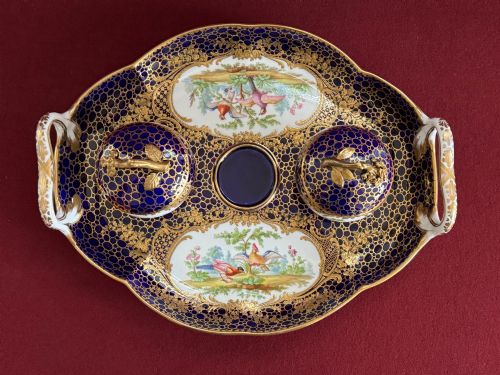
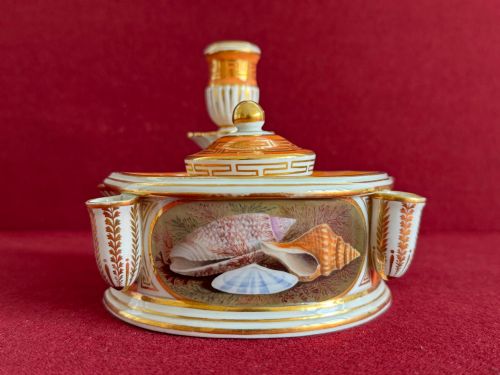
Makers shaped these pieces in porcelain, papier-mache, faience and lacquer, often applying floral or figural decoration by hand. Styles range from Rococo Revival and Chinoiserie to Dutch Delft and French Second Empire.
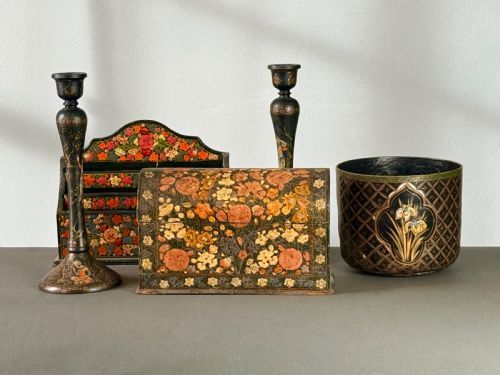
The form adapts from simple desktop inkwells to grand three-piece suites and larger Kashmiri or papier-mache tidies. Pieces span periods from the Georgian era through Victorian times and into the mid-twentieth century.
Materials and construction methods
Potters and artisans formed these pieces using ceramic, porcelain, faience and wood, alongside papier-mache and lacquer bases. Many incorporate brass fittings, gold leaf highlights and inset porcelain plaques.
Painting was applied directly to the glazed ceramic surface or lacquer ground, often depicting botanical scenes, birds or traditional motifs. Firing techniques fixed these pigments permanently before mounting metal lids or stamp boxes.
Schneeballen covers present thousands of tiny applied porcelain petals that demand an exceptionally steady hand from the maker.
Distinguishing quality across examples
Quality rests on the precision of the brushwork and the complexity of the modelled form, such as the intricate floral covers seen on German porcelain. Smoother glazes and finely detailed gilt or brass mounts separate finer sets from simpler items.
The integration of matching components within a set, such as candlesticks and letter racks accompanying an inkstand, elevates the overall execution. Greater depth in the hand painted motifs and well-preserved lacquer or papier-mache surfaces indicate superior workshop output.
Minton Porcelain·Meissen
The Hand Painted Desk Set Glossary
- Inkstand
- A fitted tray or stand holding inkwells, sanders, and pen holders for a writing desk. It forms the central piece of most desk sets.
- Encrier
- The French term for an inkwell or inkstand, commonly found on continental porcelain and faience pieces. These often feature hinged lids and attached pen trays.
- Papier-mache
- A composite material made of paper pulp reinforced with glue or resin, moulded and lacquered. It provided a lightweight yet durable base for Kashmiri desk tidies.
- Faience
- Tin-glazed earthenware produced across Europe, frequently decorated in blue and white. It appears on Dutch and French desktop inkwells.
- Cachepot
- An ornamental pot used to hold a flowerpot, occasionally included in larger lacquer desk and stationery groupings. It shares matching decorative schemes with the associated inkstand.
Hand Painted Desk Set: Frequently Asked Questions
What items belong in a desk set?
A traditional desk set typically includes an inkstand or inkwell alongside complementary accessories such as letter racks, stamp boxes or candlesticks. Larger suites unite these elements through matching materials and hand painted decorative schemes.
Items were arranged on a writing table to keep necessary writing tools close at hand while maintaining a neat appearance. Many sets combined practical inkwells with decorative cachepots or trays.
How do I care for lacquer desk pieces?
Lacquer and papier-mache surfaces require gentle dusting with a soft, dry cloth and protection from direct sunlight and excessive moisture. Avoiding harsh cleaning agents preserves the delicate hand painted decoration.
Keeping pieces away from heat sources prevents the wooden or paper-mache base from warping and protects the integrity of the finish.
Where were these pieces made?
Desk sets originated from various European and international centres, including English potteries, German factories, French ateliers and Kashmiri workshops. Each region utilised distinct materials like hard-paste porcelain, faience or lacquered wood.
Local decorative traditions heavily influenced the final appearance, resulting in styles ranging from Dutch Delft designs to ornate Rococo Revival forms.
How are different periods identified?
Periods are identified through a combination of manufacturing materials, decorative styles and structural forms. Georgian and Regency pieces often display classical proportions, while Victorian items lean towards ornate Rococo Revival or floral designs.
Examining the underside of ceramic pieces or the construction of wooden and papier-mache bases reveals clues regarding the era of production.