



Hallmarked Silver Boat
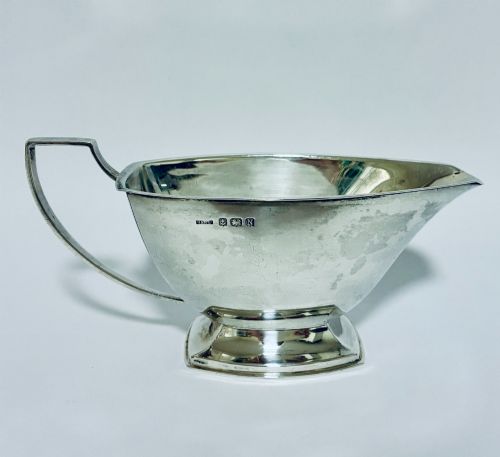
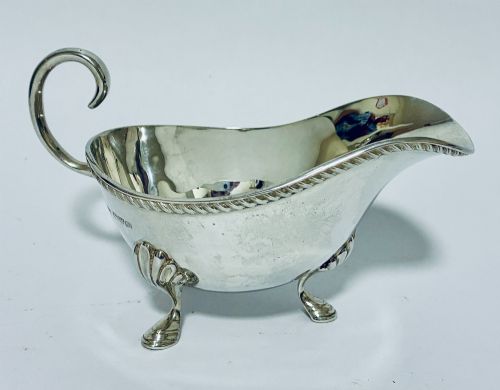
A hallmarked silver boat brings distinct table utility, taking the form of sauce boats, sugar baskets, and centrepiece bowls shaped like marine vessels.
Hallmarked Silver Boat
When you search for a hallmarked silver boat, you are looking at functional serveware that takes a distinct vessel form. These pieces predominantly appear as sauce boats, gravy boats, sugar baskets, and centrepiece bowls.
The versions you are most likely to meet on this page span several decades, crossing Victorian, Edwardian, and Art Deco periods. Makers utilised styles ranging from plain Georgian revivals to distinct Celtic patterns.
Beyond standard table vessels, the category occasionally encompasses novelty silver items such as pin cushions modelled in the shape of a boat. Forms generally rest upon solid feet or formal pedestals.
How they were made
Silversmiths shaped these pieces from sterling silver, employing traditional hammering and casting techniques to achieve the smooth curves of a boat hull. Handles and feet were cast separately and securely attached by soldering.
Makers applied surface ornamentation through chasing, engraving, or applied cast borders, particularly evident in pieces featuring Georgian revival motifs or Celtic style decoration.
Hallmarked Silver Boat Retail Price Guide 2026
Typical asking prices for hallmarked silver boat among the pieces listed under this phrase on Sellingantiques today, from the lower quarter to the upper quarter. They describe what is for sale here now, not the wider market.
Among the serveware and bowls, a solitary silver shoe boat waits quietly to hold pins instead of gravy.
What varies in quality
Quality in a hallmarked silver boat rests upon the weight of the metal and the crispness of the maker's mark. Thicker silver gauge prevents distortion along the rim and handle during daily use.
The refinement of the casting in the handle and feet distinguishes finer examples from simpler production. Proportion and balance dictate how well the vessel sits upon a table surface.
Joseph Rodgers·Walker and Hall
The Hallmarked Silver Boat Glossary
- Hallmark
- The official stamp applied by an assay office guaranteeing the purity of the silver. It typically includes marks for the maker, the standard, the assay town, and the year of testing.
- Sterling silver
- The standard alloy of silver containing ninety-two point five percent pure silver and seven point five percent other metals, usually copper, chosen for durability.
- Chasing
- A metalworking technique where the silversmith hammers decoration from the front to sink the metal and create raised surface designs without removing material.
- Centrepiece bowl
- A large decorative vessel placed in the middle of a dining table, occasionally styled in the form of a boat to hold fruit or floral arrangements.
Hallmarked Silver Boat: Frequently Asked Questions
What is a silver sauce boat used for?
A silver sauce boat serves liquids such as gravy, custard, or melted butter at the dining table. The pointed spout allows for controlled pouring into individual plates.
The wide opening accommodates a ladle or spoon when the sauce possesses a thicker consistency. These vessels form part of formal table service across various historic periods.
How do I date a silver boat?
Dating relies upon reading the hallmarks stamped directly into the silver surface. Assay office marks and specific date letters correspond to official records.
Stylistic indicators such as Art Deco geometric lines or Victorian chased decoration also point toward specific decades of manufacture.
Are all silver boats made of sterling silver?
Most pieces carry hallmarks confirming standard sterling silver composition. Assay office marks guarantee the precise metal purity used by the maker.
Older items generally display distinct town marks and date ciphers that verify their origin and metallic content.
How should I clean silver boats?
Maintenance requires gentle washing with warm soapy water and a soft cloth to remove tarnishing agents. Proprietary silver polishes should be used sparingly to protect engraved details.
Regular handling helps prevent heavy tarnish accumulation on display pieces and functional serveware alike.