





Half Moon Folding Table
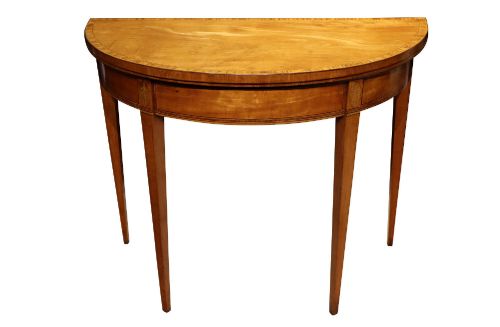
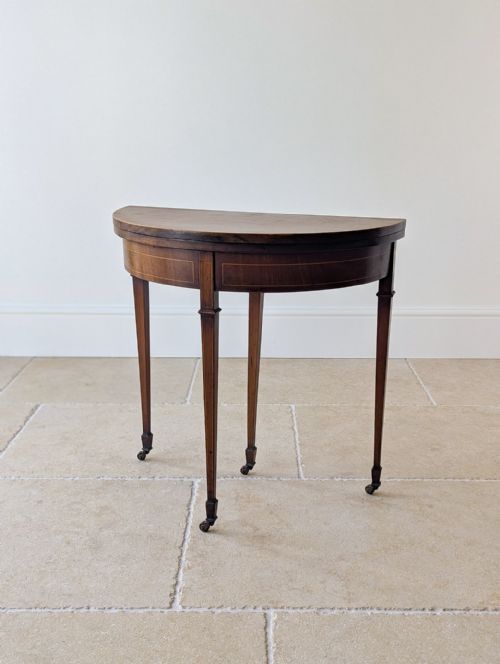
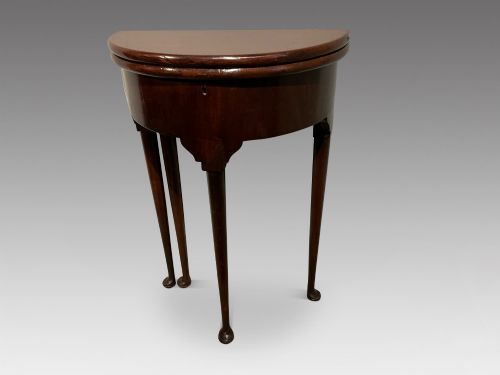
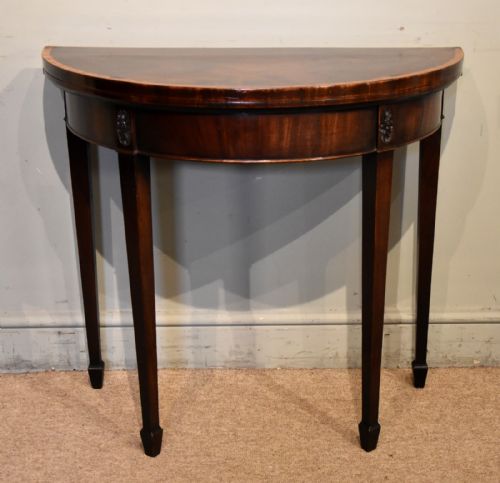
A half moon folding table offers a clever semicircular top that opens to serve card players or take tea before folding back against a wall.
Half Moon Folding Table
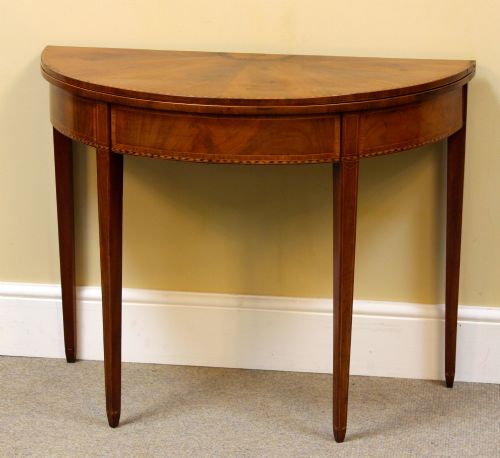
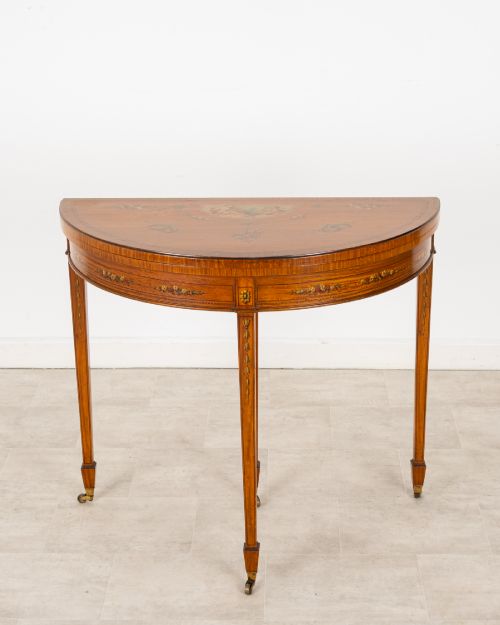
A half moon folding table stands against a wall as a console or side piece before unfolding to reveal a baize-lined surface for cards or a polished timber top for tea. These pieces date across several eras, with Georgian examples appearing alongside Edwardian satinwood pieces and later walnut revivals.
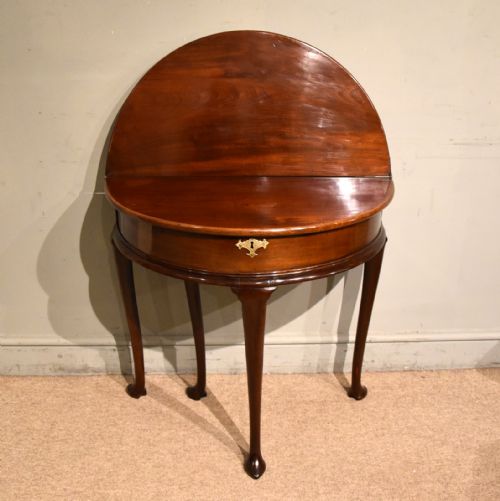
The form relies on a hinged top supported by a swing leg or a gateleg mechanism that pulls out to bear the weight. Card tables dominate the selection, though tea tables and occasional side pieces also occur frequently in the listings.
Materials and Construction
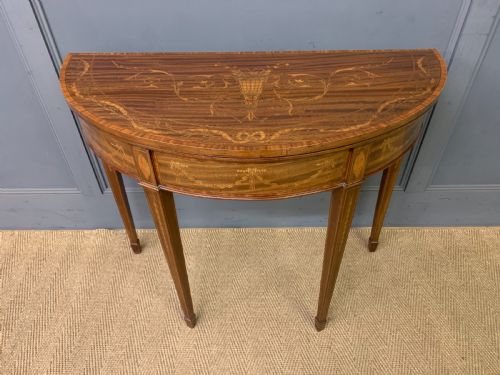
Cabinetmakers utilised solid timbers such as mahogany, walnut, and fruitwood, often applying fine veneers of satinwood or burr walnut across the semicircular top. Crossbanding in contrasting woods and delicate boxwood inlay frame the edges of many surfaces.
Makers integrated clever folding hinges and pivoting rear legs to support the heavy fold-over leaves. Brass mounts and painted Chinoiserie decoration occasionally accent the woodwork on later Edwardian pieces.
Materials appearing across these tables include mahogany, satinwood, burr walnut, fruitwood, brass mounts, and fine boxwood inlay.
Assessing Quality
Quality rests in the crispness of the inlay, the figure of the mahogany or satinwood veneer, and the seamless alignment of the folding top when closed. Superior examples display precise joinery in the swing leg mechanism and harmonious proportions in the curved apron.
The Half Moon Folding Table Glossary
- Demi-lune
- A French term meaning half-moon, describing the semicircular shape of these tables when closed.
- Fold-over
- A table top hinged along the back edge that opens double its closed depth to provide a larger surface.
- Crossbanding
- A strip of veneer laid around the border of a table top with the grain running perpendicular to the centre.
- Gateleg table
- A table with a leg hinged on a swinging arm that pulls out to support a folding leaf.
- Card table
- A specialist table fitted with a folding top, frequently lined with baize or felt for playing games.
Half Moon Folding Table: Frequently Asked Questions
How did people use a half moon folding table?
These pieces functioned as decorative console tables against a parlour wall when folded shut.
When evening arrived, servants or hosts pulled them into the room and unfolded the top to host card games or tea.
How do I tell a Georgian table from an Edwardian revival?
Georgian tables rely on solid mahogany or finely figured veneers with restrained stringing and hand-cut joinery.
Edwardian and later revival pieces often feature painted satinwood decoration or lighter internal framing typical of twentieth-century workshops.
Where should I place this table in a modern home?
A folded table fits neatly in a narrow hallway, landing, or against a living room wall as a console.
Opening the top transforms it into a card table or writing surface whenever extra space is needed.
What is the difference between a tea table and a card table?
Tea tables generally feature plain polished timber surfaces designed to hold porcelain cups and teapots securely.
Card tables usually conceal a lined playing surface beneath the fold-over top for cards and counters.