




Grey Stone Landscape Painting
Grey stone landscape painting captures rugged masonry and weathered architecture through enduring British and European traditions.
Grey Stone Landscape Painting
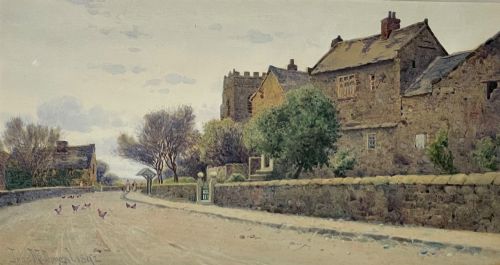
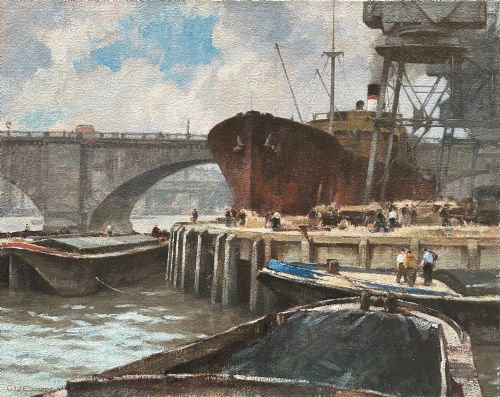
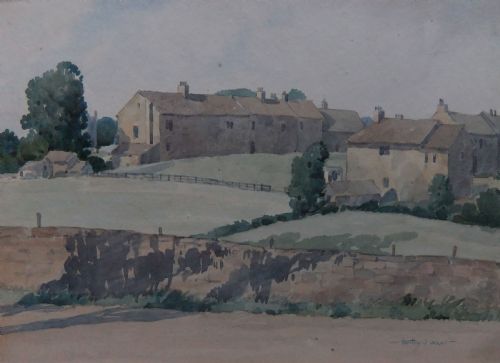
A grey stone landscape painting represents architectural or natural stone settings executed across the eighteenth, nineteenth and twentieth centuries. These works record subjects ranging from rural Yorkshire dales and Welsh castles to Parisian suburbs and Swiss mountain streams.
The selections encountered here span Victorian and Edwardian aesthetics alongside British Impressionism and Mid-Century Modern Realism. Painters utilise mediums including oil on canvas, oil on panel, and watercolour pigment on paper to render muted mineral tones and weathered facades.
Works originate from named artists working within established regional movements, such as the Staithes group, as well as anonymous hands following earlier masters like William Marlow. Each piece preserves a specific topography dominated by historic stonework and atmospheric northern light.
How they were made
Artists deployed watercolour pigment on paper for fluid, translucent effects that capture damp atmospheres and washed stonework. Alternatively, oil paint applied to canvas, board or panel allowed for heavier impasto and richer layering to build the dense texture of masonry.
The application of paint relies on varied brushwork, shifting from precise topographical detail in nineteenth-century watercolours to looser, Impressionist dabs in twentieth-century oils. Support materials range from stretched canvas to robust wooden panels and thick drawing papers.
British regional scenes predominate, capturing Yorkshire landscapes, Welsh castles, and London bridges alongside continental European views.
What varies in quality
Quality rests upon the handling of light and the structural integrity of the composition rather than the mere age of the piece. Superior examples demonstrate a confident command of perspective and tone, successfully rendering the heavy weight and weathered texture of stone.
Works by established regional artists or those with clear provenance show greater artistic ambition in capturing atmospheric conditions. Weaker examples rely on formulaic perspective and thin pigment application that fails to convey the solid presence of geological or architectural subjects.
John McDougal·Cyril Walduck Edwards·Florence Adelina Hess·Rowland Henry Hill·John Frederic Greenwood·Noel Harry Leaver·Willie Stephenson·Ernest Higgins Rigg·Herbert Royle·Stanley Orchart·George Graham·Fred Lawson
The Grey Stone Landscape Painting Glossary
- Watercolour
- A paint consisting of soluble pigment suspended in a water-based solution, applied to paper to create luminous washes.
- Oil on Board
- A painting technique where oil paint is applied directly to a rigid wooden or composite board rather than stretched canvas.
- Staithes Group
- A loose association of painters active in North Yorkshire who embraced Impressionist techniques and en plein air landscape work.
- Impressionism
- A nineteenth-century art movement characterised by relatively small, thin yet visible brush strokes and an emphasis on accurate depiction of light.
Grey Stone Landscape Painting: Frequently Asked Questions
How do I date a grey stone landscape painting?
Dating relies on stylistic markers, framing conventions, and the medium used by the artist. Victorian and Edwardian works often show distinct attention to narrative detail, whereas mid-century pieces favour looser modernist interpretations.
Examining the reverse of the canvas, board, or paper frequently reveals artist signatures, dates, or framer stamps that confirm the period of creation.
Where should I hang a stone landscape?
These paintings suit spaces with balanced natural light that complements their muted mineral palettes and earthy tones. Placing them away from direct sunlight protects watercolours and oils from fading over time.
Pairing a framed Yorkshire dales or alpine scene with traditional or transitional interior decor enhances the architectural depth of the artwork.
Are these paintings original artworks?
The pieces listed comprise original watercolours and oil paintings created directly by the artists rather than mechanical reproductions or prints. Each work bears individual brushstrokes and the distinct texture of the chosen medium.
Signatures, inscriptions, and artist boards provide tangible evidence of their direct creation during periods such as the Victorian era or the twentieth century.
What subjects appear in these landscapes?
Common subjects include Yorkshire dales, Welsh castles, Swiss mountain streams, country houses, and urban bridge scenes. Artists focused heavily on rural architecture, historical masonry, and the natural topography of Britain and Europe.
These depictions offer a historical record of landscapes and townscapes as they appeared to artists working across successive nineteenth and twentieth-century movements.