



Grey Footstool
These grey footstools offer a practical yet decorative addition to period interiors, drawing from centuries of seating traditions.
Grey Footstool
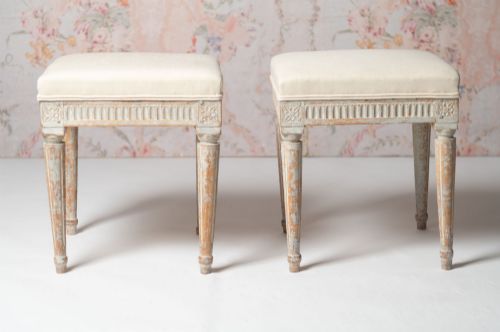
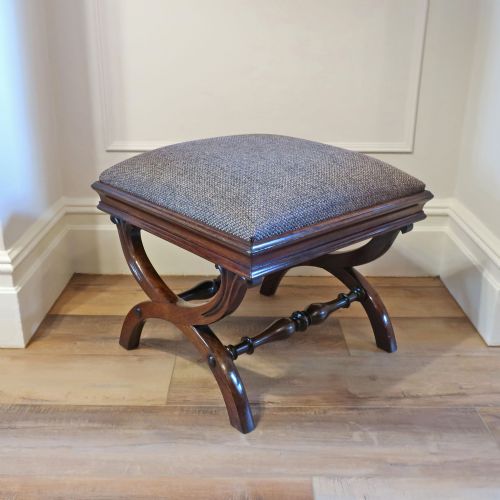
A grey footstool brings together low seating forms from the eighteenth century onwards, spanning distinct regional styles and utilitarian uses. Buyers seeking a grey footstool will encounter pieces ranging from Swedish Gustavian seating to heavy Victorian mahogany stools and decorative French frames.
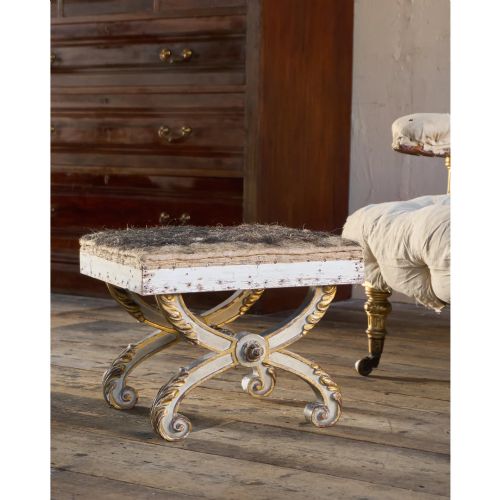
The objects listed here appear as footstools, dressing table stools, music stools, and larger ottomans. Forms vary from simple upholstered blocks to carved wooden frames supported by cabriole legs, lion's paw feet, or X-frames.
Origin and period dictate the character of each grey footstool, with eighteenth-century examples showing lighter painted finishes while nineteenth-century pieces lean towards heavier hardwoods and darker tones.
Construction and materials
Makers constructed these pieces using native and imported timbers, including mahogany, walnut, and painted wood, alongside gilded and giltwood decorative accents. Frames frequently employ traditional joinery techniques hidden beneath upholstery or decorative surface treatments.
Upholstery relies on traditional textiles such as linen and general fabric, applied over padded foundations designed for daily use. Paint and hand-carved details define the aesthetic of French and Gustavian examples, contrasting with the polished wood surfaces of Victorian pieces.
Grey Footstool Retail Price Guide 2026
Typical asking prices for grey footstool among the pieces listed under this phrase on Sellingantiques today, from the lower quarter to the upper quarter. They describe what is for sale here now, not the wider market.
Several footstools double as music stools, proving that Victorians took their piano posture very seriously indeed.
Assessing quality
Quality rests upon the crispness of the hand-carved timber details and the structural integrity of the frame. Superior examples demonstrate thoughtful proportions and robust joinery that withstands centuries of weight.
The choice of primary timber and the execution of painted or gilded finishes also separate standard utilitarian items from finer decorative seating. Original frames retain their structural harmony better than pieces that have undergone extensive rebuilding.
Miles & Edwards
The Grey Footstool Glossary
- Gustavian
- The Swedish neoclassical style characterised by pale painted finishes, restrained carving, and functional elegance.
- X Frame
- A structural design where intersecting diagonal members form the primary support of the stool.
- Cabriole Leg
- A furniture leg that curves outward and then tapers inward, finishing in a decorative foot.
- Ottoman
- A low, upholstered seat or footstool lacking a back or arms, often built on a larger scale.
- Giltwood
- Timber treated with gold leaf or a gold-coloured metallic finish for decorative effect.
Grey Footstool: Frequently Asked Questions
What periods do these footstools come from?
The pieces span several centuries, including eighteenth-century items, Regency designs, and various nineteenth-century Victorian periods. Early twentieth-century additions also appear.
Each era brings distinct proportions and stylistic preferences to the timber frames and upholstery.
How were these stools originally used?
These items served multiple domestic functions, acting as footrests before chairs, dressing table seats, or music stools for piano players. Larger ottomans provided movable seating within formal rooms.
Their versatility allowed them to move easily between bedrooms, parlours, and dressing rooms.
How do I distinguish French styles from English ones?
French pieces often feature hand-carved decorative motifs, painted wood, or gilt finishes associated with provincial and neoclassical design. English examples tend to showcase exposed mahogany or walnut with structural elements like lion's paw feet or cabriole legs.
Comparing the timber choice and carving style quickly reveals the regional origin.