
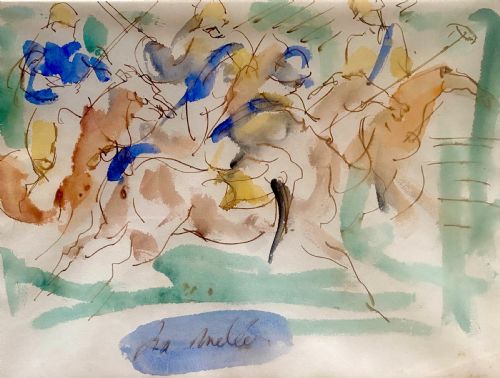


Green Watercolour Horse Art
Green watercolour horse art brings together rural scenes, fairs and sporting life through fluid washes on paper.
Green Watercolour Horse Art
Green watercolour horse art captures equestrian subjects and rural working scenes through the medium of watercolour pigment and ink on paper. Buyers seeking green watercolour horse art find works ranging from Georgian depictions to mid-century expressions.
The selections on this page encompass traditional British sporting art, Victorian pastoral scenes and British Impressionism. Forms include framed artwork and fine art paintings under glass, housed in wood or oak frames.
How they were made
Artists apply watercolour paint and ink onto paper supports, often building compositions through fluid washes of green and earth tones. Works are subsequently protected beneath glass within wooden or oak frames.
Techniques range from traditional British sporting illustration and detailed Victorian fine art to expressionist applications reminiscent of Gen Paul style.
Listings span from the Georgian period through Victorian and Edwardian eras up to nineteen sixty, utilising paper, glass, oak, and watercolour pigment.
What varies in quality
Quality separates through the sureness of the draughtsmanship and the vitality of the brushwork in capturing horses and rural movement. Works by recorded artists demonstrate a firmer command of light and atmosphere than anonymous pieces.
The preservation of the paper support and the clarity of the watercolour pigments dictate the visual strength of each piece. Original framing in period wood or oak further distinguishes the presentation.
John Atkinson·Will Anderson·Robert Hollands Walker·Charles Clifford Turner·Walter Duncan·Alfred George Stevens·Snaffles·John Baragwanath King·Thomas Rowlandson
The Green Watercolour Horse Art Glossary
- Watercolour pigment
- A colourant suspended in a water-soluble vehicle, applied to paper to create translucent washes. It forms the primary medium for these equestrian and rural scenes.
- British Impressionism
- A painting style focusing on light and everyday subjects, visible in late nineteenth and early twentieth-century works. Artists captured outdoor atmosphere rather than rigid studio details.
- Traditional British Sporting Art
- A genre dedicated to equestrian subjects, hunts, and rural fairs, recording historical pastimes. These pieces rely on accurate observation of horses and riders.
- Expressionism
- A modernist style prioritising emotional experience over physical reality, seen in twentieth-century interpretations. Brushwork becomes more energetic and less constrained by strict academic rules.
Green Watercolour Horse Art: Frequently Asked Questions
What periods do these paintings cover?
The works span from the Georgian era through Victorian and Edwardian periods up to the mid-twentieth century.
Most pieces date from the late nineteenth and early twentieth centuries, reflecting traditional British sporting and rural subjects.
How should I frame and hang these?
Keep watercolours away from direct sunlight to prevent the pigments and paper from fading over time.
Ensure the artwork remains sealed behind glass within its wooden or oak frame to protect the paper from ambient moisture.
What subjects appear in these scenes?
Common subjects include polo matches, horse fairs, harvest time, rural cottages, and hunting scenes.
Artists focused on working horses and equestrian events set against West Country, northern, and pastoral landscapes.