

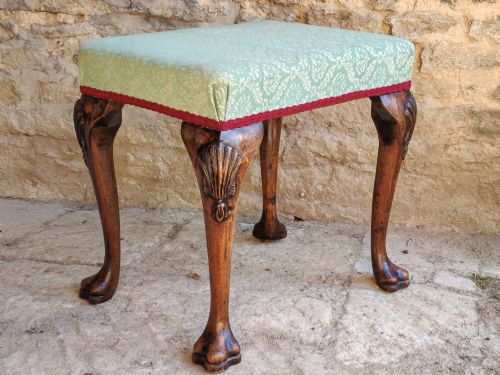


Green Upholstered Piano Stool
A green upholstered piano stool brings character and colour to a music room, combining practical seating with period craftsmanship.
Green Upholstered Piano Stool
When you search for a green upholstered piano stool, you are looking at practical music seats finished in fabric, velvet, or leather. These pieces serve both instrumentalists and those seeking low seating for a dressing table or parlour.
The versions most likely to meet you on this page span the nineteenth century, the Edwardian era, and the nineteen-thirties. They appear in mahogany, walnut, rosewood, and satinwood, reflecting styles from Regency and Victorian to Art Deco and Georgian Revival.
Makers and workshops shaped these forms as revolving stools, music chairs, and dressing stools. Each design addresses the domestic needs of its period, whether through patent mechanisms or simple stationary frames.
How they were made
Cabinet makers constructed the frames using solid timbers such as mahogany, walnut, and oak, often incorporating carved details, inlay, or giltwood. Selected pieces utilise rosewood or satinwood veneers over a sturdy carcass.
Upholsters finished the seats in velvet, woven fabric, needlework, or leather, securing the padding to wooden bases. Patent music chairs integrated mechanical elements to allow height adjustment during performance.
Green Upholstered Piano Stool Retail Price Guide 2026
Typical asking prices for green upholstered piano stool among the pieces listed under this phrase on Sellingantiques today, from the lower quarter to the upper quarter. They describe what is for sale here now, not the wider market.
Some nineteenth-century musicians clearly demanded a revolving seat to swivel away in frustration after missing a sharp.
What varies in quality
The standard of timber selection and joinery separates standard production from finer workshop output. Robust construction in dense hardwoods ensures stability across generations of use.
The sophistication of the upholstery work and the retention of original needlepoint or leather define the character of the piece. Subtle carving and precise inlay indicate greater care by the maker.
Harry & Lou Epstein
The Green Upholstered Piano Stool Glossary
- Mahogany
- A durable tropical hardwood favoured for its rich reddish-brown tone and strength in furniture frames.
- Giltwood
- Timber treated with gold leaf or metallic paint to create a lustrous decorative surface.
- Inlay
- The technique of embedding contrasting woods or materials into the surface of a primary timber for decoration.
- Needlepoint
- A type of canvas work embroidery traditionally used for durable seat coverings.
- Patent chair
- An item incorporating a mechanical device, often allowing height adjustment for musicians.
Green Upholstered Piano Stool: Frequently Asked Questions
How do I date a stool?
Dating relies on identifying the timber, decorative style, and construction methods used by the maker. Victorian pieces often display rich mahogany and carved details, while nineteen-thirties items reflect Art Deco geometry.
Comparing the turning and joinery to dated examples helps narrow down the period of manufacture.
Were these stools adjustable?
Certain period pieces feature patent mechanisms that allow the seat height to change. This adjustment helped musicians find the correct posture for playing.
Other variants remain fixed in height, functioning simply as decorative seating.
How do I live with one?
These stools fit easily beside a piano, desk, or dressing table, adding period character to a room. Their compact footprint makes them useful as flexible extra seating.
Regular dusting and careful placement away from direct heat sources will protect the timber and upholstery.