

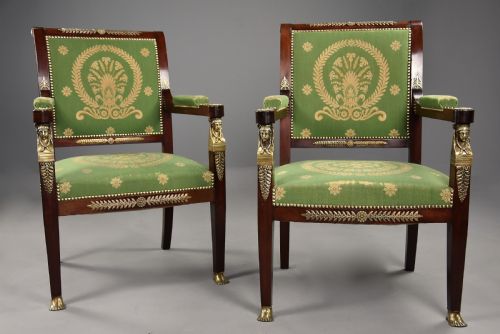
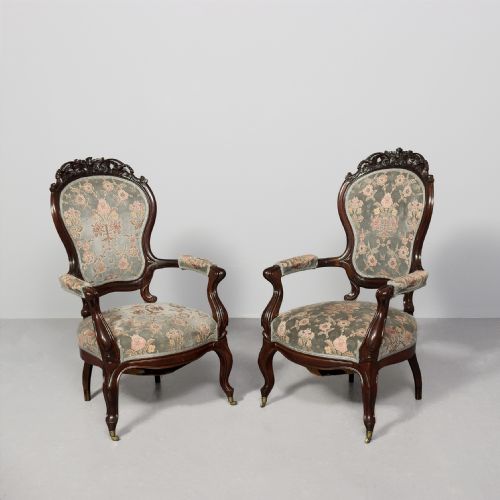


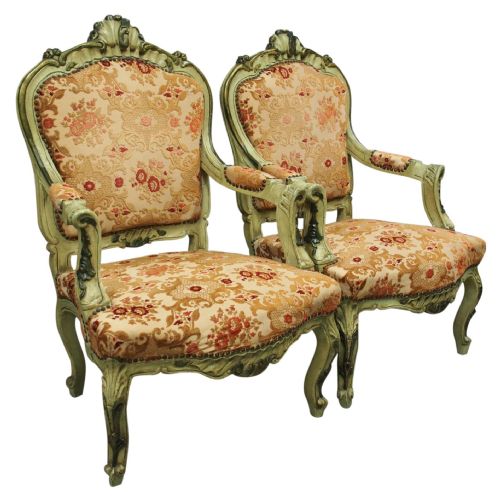

Green Upholstered Fauteuils
Green upholstered fauteuils are open armchairs spanning multiple centuries that bring classic continental seating into modern rooms.
Green Upholstered Fauteuils
When you search for green upholstered fauteuils, you encounter open armchairs shaped by centuries of French and British design. These seats combine exposed wooden frames with upholstered backrests and arm pads, originating as status symbols in European salons.
The versions most common here trace their lineage to revival styles like Louis XV and Louis XVI, alongside Victorian and Edwardian interpretations. Makers constructed these chairs in pairs or as single statements, utilising walnut, mahogany, giltwood, and painted finishes.
The upholstery itself ranges from historical needlepoint and tapestry to rich silks and velvets in various shades of green. These pieces function today as striking library chairs or drawing room seating.
How they were made
Cabinetmakers shaped the structural frameworks from hardwoods such as walnut and mahogany, or carved softer woods to receive paint and gilt. Joints relied on traditional mortise and tenon construction to support the open arms and cabriole or straight legs.
Upholsterers built the padding using traditional stuffing techniques over webbing and springs, securing the outer fabric with decorative brass tacks. Needlepoint and tapestry panels were often worked by hand before being mounted to the chair frames.
Green Upholstered Fauteuils Retail Price Guide 2026
Typical asking prices for green upholstered fauteuils among the pieces listed under this phrase on Sellingantiques today, from the lower quarter to the upper quarter. They describe what is for sale here now, not the wider market.
What varies in quality
The distinction in quality rests upon the crispness of the hand-carved woodwork and the integrity of the timber frame. Superior examples display deep, deliberate carving along the rails and cabriole legs, whereas lesser pieces show shallower, mechanical tooling.
Materials also dictate the tier of the piece, with solid giltwood and figured walnut sitting above standard painted woods. Furthermore, the grade of the textile upholstery - from simple cotton to fine antique needlepoint - shifts the overall character and finish.
The Green Upholstered Fauteuils Glossary
- Fauteuil
- An open-framed upholstered armchair originating in France, characterised by upholstered arm pads and an exposed wooden structure. These chairs typically feature padded backs and seats designed for formal sitting.
- Cabriole leg
- A furniture leg that curves out and then in, resembling the leg of an animal. This form became prominent during the eighteenth century and reappeared in later revival periods.
- Giltwood
- Timber coated with a thin layer of gold leaf or powder. This finish was applied to formal seating to catch the light in grand interiors.
- Needlepoint
- Embroidery stitched on a canvas mesh to create dense, pictorial patterns. Antique chairs frequently utilise this technique for durable seat and back panels.
- Louis XV style
- A design movement drawing on eighteenth-century French curves, asymmetrical motifs, and flowing floral carving. Revival pieces from the nineteenth century frequently adopt these outlines.
Green Upholstered Fauteuils: Frequently Asked Questions
Are these armchairs comfortable to use?
These seats offer structured support through their padded backs and upholstered arm rests. They suit reading and formal sitting rather than deep lounging.
Because the frames are upright and open, they encourage an attentive posture while remaining supportive for daily use.
How do I date a fauteuil?
Dating relies on examining the timber species, the tool marks on the frame, and the style of the carving. Revival pieces often blend historical motifs with nineteenth-century construction methods.
Looking beneath the upholstery and at the joinery helps distinguish mid-nineteenth-century revival work from earlier eighteenth-century originals.
Where should I place a fauteuil?
These armchairs work well as accent seating in living rooms, bedrooms, or studies. Their open wooden frames prevent them from visually crowding smaller spaces.
Pairing matching chairs near a fireplace or window creates a balanced seating arrangement that highlights the carved woodwork.
How do I care for the upholstery?
Maintenance depends on whether the fabric is historic needlepoint, silk, or velvet. Regular gentle vacuuming with a soft brush attachment removes dust without abrading the fibres.
Keeping the chairs away from direct sunlight prevents the green dyes and textiles from fading over time.