
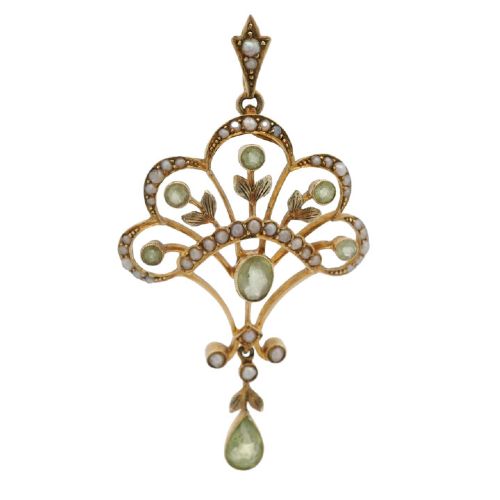


Green Stone Drop Necklace
A green stone drop necklace brings together vibrant minerals and fine metalwork, offering a subtle splash of colour that suits both daily wear and formal occasions.
Green Stone Drop Necklace
A green stone drop necklace centres on a suspended gemstone, most frequently peridot, chrysoprase, or amazonite, held within silver or gold settings. These pieces span several distinct historical movements, capturing the decorative shifts from Victorian and Edwardian design through to Art Nouveau and Art Deco.
The most common examples encountered on this page date from the Edwardian period and the turn of the twentieth century. These typically feature vibrant peridots paired with seed pearls, mounted in fifteen-carat gold or silver pendants that hang delicately from fine chains.
Beyond peridot, the selection encompasses rarer mineral specimens like chrysoprase and amazonite, often set within the handcrafted silver idioms of the Arts and Crafts movement. Formats range from simple single-stone drops to complex multi-gem clusters and enamelled Renaissance Revival assemblies.
How they were made
Goldsmiths and silversmiths utilised traditional hand-fabrication techniques, shaping precious metals into delicate wirework bezels and millegrain edges to secure the central stones. Fifteen-carat and nine-carat gold appeared frequently alongside sterling silver and occasional platinum highlights.
Peridots and chrysoprase stones were faceted or cut into cabochons to maximise their natural luminescence, often complemented by tiny seed pearls strung on silk or wire. Enamel work and multi-gem arrangements added layers of colour and texture in more ambitious workshops.
Ancient Romans called peridot the evening emerald because its vibrant green colour did not fade in candlelight.
What varies in quality
The standard of a green stone drop necklace depends heavily on the crispness of the metalwork and the originality of the components. Hand-wrought Arts and Crafts pieces command attention through individual artistic vision and careful hand-beating of the silver.
Stone selection dictates much of the visual impact, with deeply saturated peridots or well-matched seed pearls elevating the overall harmony of the piece. Integrated maker signatures or specific design attributions further distinguish exceptional examples from standard commercial production.
Liberty & Co·Levinger & Bissinger·Otto Prutscher·Arthur & Georgie Gaskin
The Green Stone Drop Necklace Glossary
- Peridot
- A transparent yellowish-green silicate mineral favoured heavily in Edwardian jewellery design. It provides the bright lime-green tone seen in the majority of these pendants.
- Chrysoprase
- A gemstone variety of chalcedony containing small quantities of nickel, notable for its apple-green colour. It appears frequently in Arts and Crafts metalwork.
- Seed pearl
- A very small natural or cultured pearl, often half-drilled and glued or pegged onto tiny pins. Jewellers used them in clusters around central peridots to create delicate floral motifs.
- Cabochon
- A gemstone shaped and polished as a convex form rather than faceted. This cut suits opaque or translucent stones like chrysoprase and jadeite.
- Millegrain
- A jewellery technique involving a line of tiny bead-like metallic spheres along the edges of a setting. It softens the appearance of platinum or gold and adds a refined texture.
Green Stone Drop Necklace: Frequently Asked Questions
How do I care for a peridot pendant?
Peridot is a softer gemstone than diamond, registering around six and a half to seven on the Mohs scale. Clean the necklace gently using warm soapy water and a soft cloth, avoiding harsh chemical dips or ultrasonic cleaners that might dislodge seed pearls.
Store the pendant separately in a lined box to prevent the metal or harder stones from scratching the delicate green surface of the main drop.
Are these chains original to the pendants?
Many antique necklaces have survived with replacement chains added over the decades to ensure safe daily wear. Finding a matching period chain is uncommon, so inspecting the jump rings and connecting links helps determine if the chain shares the age of the pendant.
When a chain bears matching metal fineness marks or shows identical patination, it is more likely to have travelled with the piece since its creation.
How can I tell an Edwardian pendant from Art Deco?
Edwardian pieces rely on organic motifs, including garlands, bows, and peridots paired with seed pearls in yellow gold or silver settings. The visual weight is light, airy, and frequently symmetrical with scrolling wirework.
Art Deco designs introduce geometric lines, stylized symmetry, and stronger contrasts using materials like platinum, silver, and amazonite or jadeite. The overall silhouette shifts from soft floral curves to sharp angles and stepped arrangements.