






Green Man Desk
A green man desk brings the carved foliage-sprouting face of folklore into nineteenth-century studies.
Green Man Desk
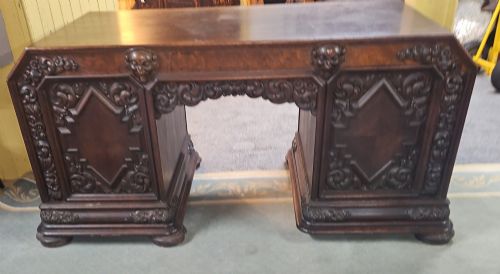
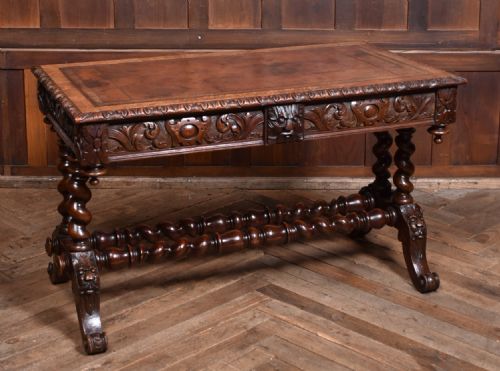
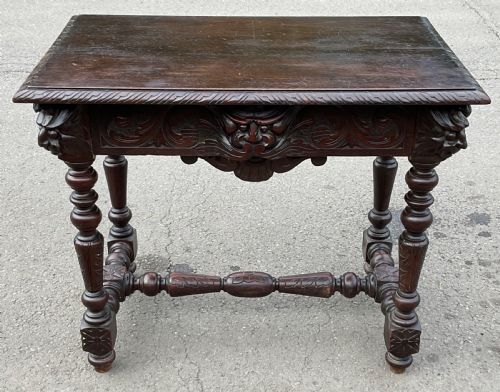
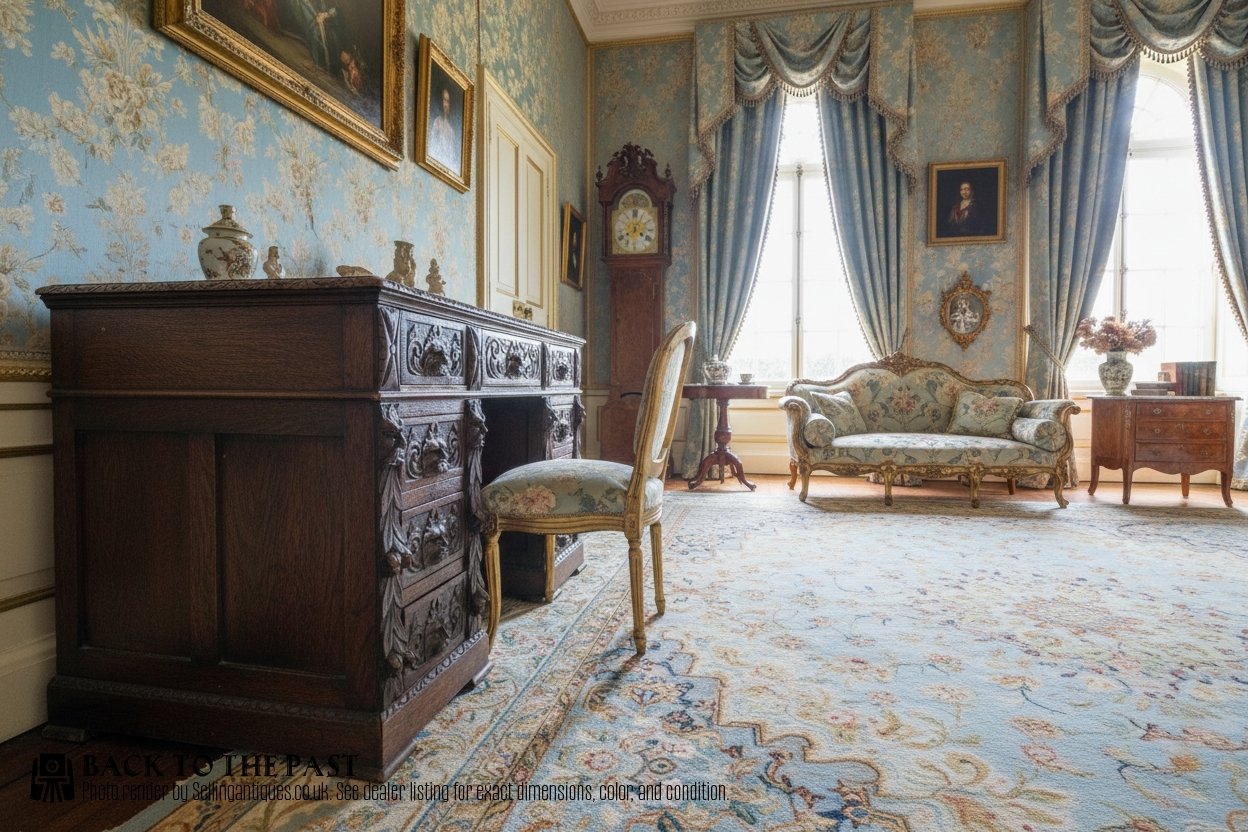
A green man desk is a nineteenth-century writing table or pedestal desk defined by carved forest imagery, most commonly found in solid oak from the Victorian era. These pieces appear as twin pedestal desks, compact kneehole desks, and sloping bureaux featuring the distinct motif of a human face merging with leaves and vines.
The evidence shows a strong preference for Victorian Gothic and Renaissance revival idioms, where heavy timber frames serve as canvases for deep relief carving. Alongside standard pedestal formats, variations include Davenport desks and writing tables fitted with leather inserts and brass hardware.
Buyers seeking this phrase encounter a lineage spanning mid to late nineteenth-century craftsmanship, predominantly executed in dark oak with sculptural drawer fronts and cupboard doors. The face peers out from drawer friezes, pediments, and central cupboard panels with foliate horns or beards of foliage.
Materials and construction
These desks rely heavily on solid oak and occasionally mahogany, chosen for their structural density and capacity to accept deep hand-carving without splitting. Joinery follows robust nineteenth-century standards, with pegged tenons, substantial drawer framing, and heavy timber tops.
Carvers shaped the green man motifs directly into the solid wood rather than applying separate cast ornaments, utilising chisels and gouges to create organic depth. Secondary materials include fitted leather writing surfaces, brass handles, and castors supporting the heavier pedestals.
Some nineteenth-century carvers grew so fond of foliage that even the drawer pulls sprouted small leafy eyebrows.
Evaluating the carving and timber
Quality rests in the anatomical confidence and relief depth of the carving, distinguishing sharp, expressive foliage masks from flat, mechanical factory output. The handling of the wooden grain around the contours of the face reveals the carver's skill.
Heavier pedestal forms with panelled sides and intact original leather writing inserts occupy the upper tier of the range. Secondary details such as heavy brass pulls, working locks with keys, and stable secondary timbers determine the integrity of the piece.
Edwards and Roberts
The Green Man Desk Glossary
- Green man
- A sculptural motif representing a human face surrounded by or sprouting from foliage, symbolizing rebirth and the spirit of vegetation. It forms the central decorative focus of these nineteenth-century desks.
- Pedestal desk
- A heavy freestanding writing table supported by two banks of drawers beneath the work surface. These large pieces often incorporate cupboards displaying prominent foliate carvings.
- Bureau
- A desk featuring a sloping fall-front that opens to reveal internal pigeonholes and small drawers. Victorian examples in this group are typically constructed from carved oak.
- Partners desk
- A large double-sided writing table designed for two people to work face-to-face, equipped with drawers on both sides. These substantial library pieces occasionally feature carved foliate pedestals.
- Gothic Revival
- An architectural and decorative style popular during the Victorian period that revived medieval forms and motifs. It provides the structural and ornamental framework for these carved timber desks.
Green Man Desk: Frequently Asked Questions
What is a green man desk?
A green man desk is a nineteenth-century writing table, usually fashioned from solid oak, featuring hand-carved mask motifs composed of human faces and foliage. These pieces emerged during the Victorian era alongside Gothic and Renaissance revival movements.
Craftsmen integrated the foliate masks into drawer fronts, pedestals, and pediments, turning functional library furniture into sculptural statements.
How do I date a green man desk?
Dating relies on observing construction methods, timber choice, and revival styles pointing to the Victorian period between 1850 and 1900. Heavy oak construction, secondary softwood drawer linings, and cast brass hardware are typical indicators of this timeframe.
Stylistic cues draw heavily from Victorian Gothic and Jacobean revivals, which heavily favoured dark finishes and deep relief carving.
Were these desks used for writing?
These pieces served as functional library and study furniture for writing, correspondence, and estate management. Many include inset leather writing surfaces designed to provide a smooth plane for quill or pen.
Pedestal and partner configurations offered extensive storage in the flanking drawer stacks for ledgers, stationery, and books.
How do I care for a carved oak desk?
Maintain the timber by avoiding direct sunlight and extreme humidity fluctuations that can cause solid oak panels to split. Regular dusting with a soft dry cloth preserves the recessed details of the hand-carved foliage.
Nourish the wood periodically with traditional beeswax rather than modern silicone polishes to maintain the natural warmth of the dark grain.