


Green Glass Ornament
These green glass ornaments bring depth of colour and varied form into a room, spanning Victorian lustre pairs to Art Nouveau vessels.
Green Glass Ornament
A green glass ornament covers a diverse range of decorative objects, from heavy Victorian paperweights and mantel lustres to iridescent Art Nouveau vases and cameo glass pieces. Buyers seeking this phrase encounter items shaped as table ornaments, figures, and decorative spheres originating across the nineteenth and early twentieth centuries.
The Victorian period dominates the selections through heavy glass dumps, mantel lustres, and single lustres that utilise rich shades of green. Art Nouveau and Art Deco examples introduce stylistic shifts towards organic plant forms and animal figures, while Chinese Qing style pieces and early twentieth-century cameo glass offer distinct sculptural variations.
Materials and construction
Makers utilised blown glass, crystal, and frosted glass, often incorporating enamel and gilt details to enhance the visual weight of the pieces. Cameo glass techniques allowed for layered colours, while iridescence was achieved through specialised chemical treatments during hot-working.
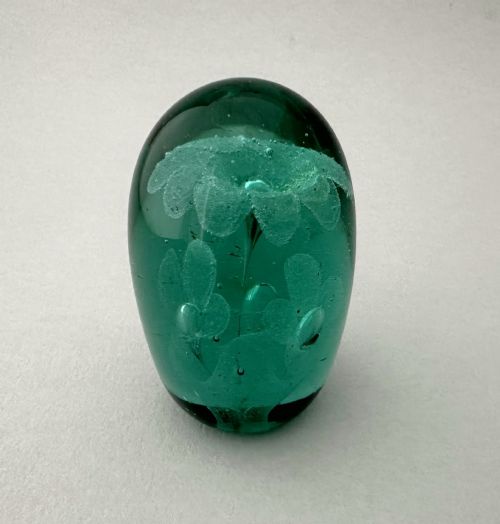
Lustres incorporate applied crystal drops suspended from cut rims, requiring precise glassblowing and metal fitting skills. Paperweights and dumps enclose trapped air bubbles or metallic inclusions within dense masses of molten green glass.
Witches balls were originally hung in windows to trap wandering evil spirits in their shiny glass mirrors.
Assessing quality
Quality rests upon the depth and clarity of the green glass itself, alongside the precision of cutting, gilding, or cameo carving. Pieces by recognised makers demonstrate superior control over form and colour saturation compared to unmarked or utilitarian production items.
Completeness dictates value in matched pairs, particularly with mantel lustres where original crystal drops are frequently lost or replaced. The sophistication of surface treatments, such as the iridescence on Art Nouveau vessels or the crispness of overlaid cameo glass, separates standard decorative items from finer examples.
Emile Gallé·Loetz
The Green Glass Ornament Glossary
- Mantel lustre
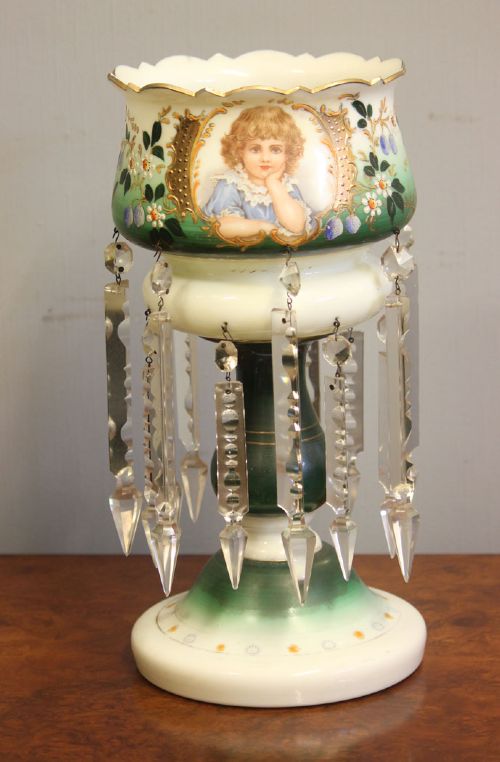
- A decorative glass vase fitted with a ring of hanging crystal prisms designed to catch and refract candlelight. They often appear in pairs intended for display on a fireplace mantel.
- Cameo glass
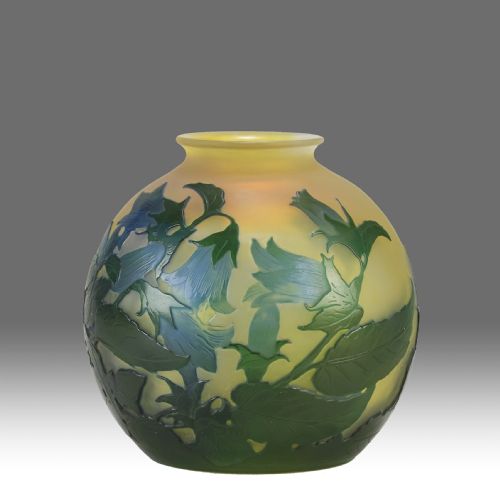
- A luxury glass art technique produced by etching or carving through fused layers of different coloured glass to create a raised design. This method results in high-contrast decorative motifs.
- Dump
- A thick, heavy glass paperweight created from factory waste or end-of-day melt batches, sometimes containing internal floral patterns or air bubbles. These solid masses display deep green hues.
- Iridescent glass
- Glass treated with metallic salts while hot to produce a shimmering, rainbow-like sheen on the surface. This technique defined much of the Art Nouveau glass production.
- Jack in the Pulpit vase
- A nineteenth-century glass vase style characterised by a wide, flaring rim resembling a flower blossom. The sweeping organic form suited the fluid qualities of blown glass.
Green Glass Ornament: Frequently Asked Questions
What are mantel lustres used for?
Mantel lustres served primarily as decorative garnitures on nineteenth-century fireplaces, where their crystal prisms reflected flickering light from nearby candles or lamps.
Beyond their visual function, they demonstrated the household's taste and wealth through the expense of cut crystal and coloured glass production.
What is cameo glass?
Cameo glass is created by fusing two or more distinct layers of glass together, then carving away the exterior layer to leave a raised design against a contrasting background.
This labor-intensive technique gained prominence during the late nineteenth century, championed by artistic glasshouses producing cabinet vases and decorative vessels.
How do I care for antique glass ornaments?
Antique glass ornaments require gentle hand washing in lukewarm water with mild soap, avoiding harsh chemicals that might damage surface gilding, enamel, or iridescence. Lustres with hanging crystal drops should be cleaned with the prisms detached to prevent accidental breakage.
Keep pieces away from direct, intense sunlight and sudden temperature changes to protect the structural integrity of the material.