




Green Enamel Lid
These green enamel lid pieces bring together Victorian, Edo period, and Qing dynasty work in copper, brass, porcelain, and glass.
Green Enamel Lid
When you search for green enamel lid, you encounter lidded ginger jars, biscuit barrels, trinket boxes, and teaware from various global origins. The selection spans nineteenth-century pieces incorporating materials like glass, porcelain, copper, and brass.
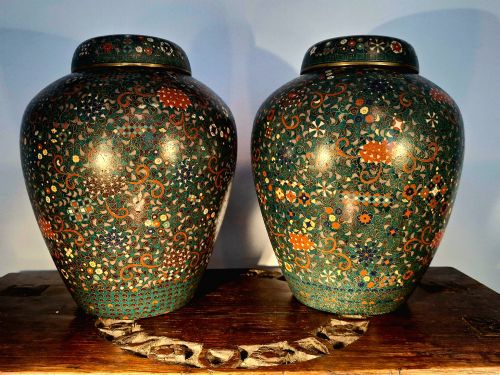
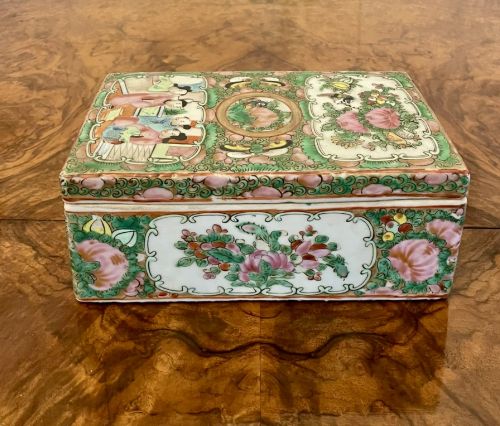
Japanese cloisonne enamel lidded vessels from the Edo period and Chinese Canton enamel items from the Qing dynasty form a large part of the selection. Victorian glass and porcelain examples with painted enamel decoration also appear.
Buyers will find decorative bowls, vases with covers, and mugs with lids alongside jars and urns. The common thread across these diverse objects is the presence of a lid paired with enamelling and green tones.
How they were made
Maker techniques involve applying enamel to metal bases like copper and brass, particularly in Japanese cloisonne work where wire compartments hold the coloured paste. Chinese Canton and Famille Rose pieces utilise porcelain foundations decorated with painted enamel designs.
Glass biscuit barrels and trinket boxes from the Victorian era combine blown or moulded glass with surface enamel painting and gilding or gold leaf. Firing processes fix the enamel colours onto porcelain, glass, and metal substrates.
Green Enamel Lid Retail Price Guide 2026
Typical asking prices for green enamel lid among the pieces listed under this phrase on Sellingantiques today, from the lower quarter to the upper quarter. They describe what is for sale here now, not the wider market.
Five-claw dragons guard these jars, occasionally wondering why humans keep putting biscuits inside them.
What varies in quality
Quality differences stem from the precision of the enamel work, the complexity of the underlying metal or porcelain form, and the preservation of details like gilding. Pieces featuring intricate multi-coloured enamel patterns alongside green elements show greater artisanal labour.
The integration of the lid with the main vessel and the crispness of motifs such as dragons, floral scenes, or geometric borders distinguish different examples. Intact surfaces with minimal wear to the enamel or gold leaf represent superior condition.
The Green Enamel Lid Glossary
- Cloisonne enamel
- A technique where thin metal wires are affixed to a metal base to create cells, which are then filled with enamel paste and fired. This method produces detailed patterns bounded by fine metal outlines.
- Gaiwan
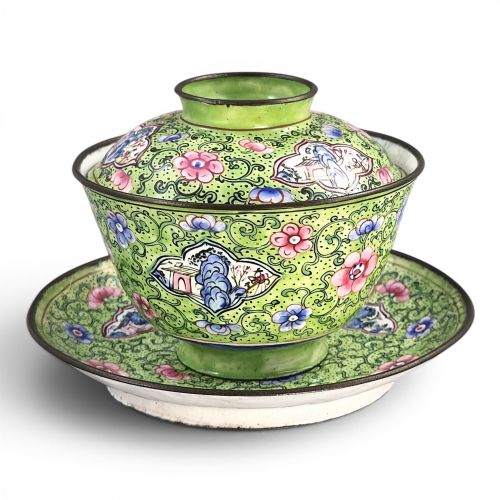
- A traditional Chinese lidded bowl used for brewing and drinking tea, consisting of a saucer, bowl, and lid. Such sets form part of Qing dynasty export ware.
- Biscuit barrel
- A container designed to hold dry biscuits or cookies, typically fitted with a lid and popular during the Victorian period in glass or ceramic. They often featured painted enamel decoration.
- Famille Rose
- A palette of Chinese porcelain enamels dominated by opaque pink or rose colours, introduced in the Qing dynasty. These hues complement green enamel elements on lidded jars and boxes.
- Edo period
- A division of Japanese history spanning from sixteen hundred and three to eighteen hundred and sixty-eight. Metalwork and cloisonne from the late part of this era appear frequently among lidded vessels.
Green Enamel Lid: Frequently Asked Questions
What is a gaiwan tea set?
A gaiwan is a traditional Chinese teaware vessel comprising a bowl, a lid, and a saucer. It functions as both a brewing pot and a drinking cup.
Examples from the Qing dynasty combine porcelain construction with painted enamel decoration in various colours.
How do I care for enamelled glass?
Enamelled glass items require gentle cleaning with a soft, dry cloth to protect the painted surface and any applied gilding. Avoid immersion in water or exposure to harsh cleaning agents.
Displaying these pieces away from direct sunlight helps preserve the vibrancy of the green enamel and other pigments.
What distinguishes cloisonne enamel?
Cloisonne relies on metal wires soldered onto a copper or brass body to form enclosed compartments called cloisons. These areas receive coloured enamel pastes before firing and polishing.
This technique creates distinct linear patterns across lidded jars, bowls, and cups from the Edo period.
How are Qing dynasty items dated?
Dating Qing dynasty pieces involves examining the specific enamel palette, the clay body of the porcelain, and stylistic motifs such as dragons or floral borders. Nineteenth-century examples often reflect export production trends.
Comparison with documented pieces from reigns within the dynasty helps narrow down the period of manufacture.