



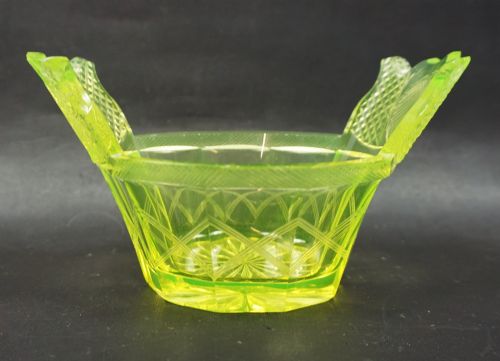


Green Crystal Glassware
Green crystal glassware brings together brilliant light and rich colour, offering vessels ranging from Georgian rummers to Art Deco vases.
Green Crystal Glassware
Green crystal glassware encompasses drinking vessels, vases, bowls, and perfume bottles created across multiple periods from the Georgian era through to the Art Deco decades. These objects serve both decorative and functional purposes, utilising rich green hues combined with the high refractive index of crystal.
The selections available here lean strongly towards twentieth-century production, particularly Art Deco pieces from European makers, alongside earlier English and Bohemian items. Wine glasses, hock glasses, and champagne coupes appear alongside larger vases and decorative dishes.
Forms range from simple blown vessels to layered over-crystal objects and intaglio engraved pieces. Buyers encounter both English craftsmanship from houses like Stuart and Stevens & Williams, and continental output from Val Saint Lambert and Bohemian workshops.
How they were made
Makers utilised lead glass and crystal compositions, adding metallic oxides to achieve various shades of green, from emerald and turquoise to uranium-reactive tones. Blowing and moulding formed the primary body of each vessel while determining the thickness and weight of the piece.
Decoration involved several distinct techniques, including wheel-engraving, intaglio cutting, and over-crystal layering where clear glass cased a coloured core or vice versa. Enamel decoration and gold leaf were frequently applied to the surface, sometimes followed by a secondary firing to fix the pigments.
Green Crystal Glassware Retail Price Guide 2026
Typical asking prices for green crystal glassware among the pieces listed under this phrase on Sellingantiques today, from the lower quarter to the upper quarter. They describe what is for sale here now, not the wider market.
The listings span the Georgian era through to the Art Deco period of the 1930s, featuring both English and continental European production.
What varies in quality
Quality rests in the crispness of the cut or engraved lines and the purity of the crystal matrix free from distracting internal bubbles or streaks. Superior pieces demonstrate precise control over colour saturation, particularly in layered over-crystal vessels where the exterior layer cuts cleanly to reveal the contrasting hue beneath.
The artistry of the design and the reputation of the workshop or designer elevate certain examples above standard production. Signed pieces or documented factory designs display finer proportions and more deliberate handling of surface ornamentation.
Stevens & Williams·Theresienthal·Val St. Lambert·Karl Palda·Stuart·René Lalique
The Green Crystal Glassware Glossary
- Crystal glass
- Glass containing a proportion of lead oxide, which increases the weight, brilliance, and clarity of the material. This composition allows for deeper and sharper cutting.
- Over crystal
- A technique where a layer of coloured glass is cased over a clear crystal body, or vice versa. Portions of the outer layer are subsequently cut away to reveal the contrasting layer underneath.
- Intaglio
- A method of engraving where the design is sunk below the surface of the glass rather than carved in relief. It produces a soft, polished recessed image.
- Hock glass
- A tall-stemmed wine glass traditionally used for white wine or hock. These often feature coloured bowls to enhance the appearance of the drink.
- Uranium glass
- Glass containing small amounts of uranium dioxide, producing a distinctive yellowish-green colour. It glows brightly under ultraviolet light.
Green Crystal Glassware: Frequently Asked Questions
How do I clean green crystal glassware?
Wash pieces by hand in warm water using a mild, non-abrasive detergent. Avoid sudden temperature changes to protect the material from thermal shock.
Dry immediately with a lint-free cloth to maintain the brilliance of the crystal and prevent water spots.
Can I use these wine glasses for dining?
Many historical wine glasses and champagne coupes remain suitable for careful use at the table. Hand washing is essential after each use.
Check the rim and base for any historical chips before filling them with liquid.
How can I tell Georgian glass from later periods?
Georgian pieces often display heavier pontil marks on the base and simpler, heavier forms than later Victorian or Edwardian items. The metal itself frequently shows minor irregularities inherent to early production methods.
Consult the decorative style and cutting depth, as Georgian cutting tends to be broader and less mechanically precise than twentieth-century work.
What is uranium glass?
Uranium glass is a type of glassware that incorporates trace amounts of uranium oxide into the batch for colour. This produces a transparent green shade that reacts under light.
Collectors prize these items for their luminescent qualities and distinct historical period of manufacture, particularly in nineteenth-century Bohemia.