

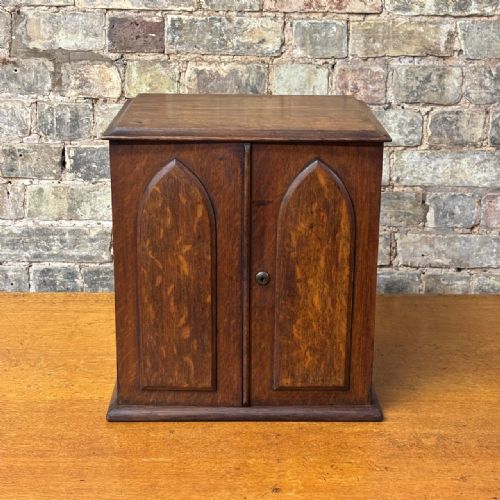


Gothic Wall Cupboard
These gothic wall cupboard pieces deliver medieval gravity to domestic spaces through pointed arches, heavy timber, and dark patination.
Gothic Wall Cupboard
A gothic wall cupboard provides enclosed storage that mounts directly to room surfaces, often featuring pointed arches, tracery panels, and iron hinges. When seeking a gothic wall cupboard, buyers encounter forms ranging from compact key cabinets to larger display shelves and corner cupboards.
The selection spans centuries of revival and vernacular production, taking inspiration from medieval architecture and furniture. Pieces originate from diverse regional traditions, including English oak examples, French provincial cupboards, and Northern European walnut bookcases.
Configuration varies according to function, with some units offering glazed doors for display while others utilise solid wood panels to conceal contents. Corner cabinets and hanging wall shelves adapt the architectural vocabulary to utilise domestic spatial constraints.
How they were made
Makers relied primarily on native timbers such as oak, walnut, and mahogany, frequently selecting quarter-sawn boards to display prominent medullary rays. Secondary woods like beech appear in structural elements, while ebonised wood and limewood serve specific decorative purposes.
Construction techniques combine traditional frame and panel joinery with applied architectural details like barley twist mouldings, carved tracery, and pokerwork. Metalwork hardware, notably brass and forged iron, secures doors and provides operational hinges or latches.
One rustic oak alcove cupboard survived a French manoir cellar before finding its way to the open market.
What varies in quality
Depth of architectural carving and crispness of geometric tracery separate standard production from superior examples. Master carvers render crockets and quatrefoils with dimensional precision that lesser workshops flatten into shallow surface decoration.
Integrity of timber selection and joinery execution dictate structural longevity, particularly where heavy doors hang from wall-mounted frames. The quality of original hardware, such as wrought iron strap hinges and brass escutcheons, reflects the overall ambition of the piece.
John Moyr Smith
The Gothic Wall Cupboard Glossary
- Gothic Revival
- An architectural and decorative style drawing inspiration from medieval forms, prevalent during the nineteenth century. It reinterprets pointed arches, buttresses, and ecclesiastical motifs for domestic furniture.
- Tracery
- Stonework-inspired ornamental stonework patterns translated into wooden panels or glazing bars. It divides windows or door panels into geometric compartments.
- Quarter-sawn
- A method of milling logs radially to produce timber boards with enhanced stability and decorative grain figuring. This cut reveals prominent medullary rays in oak.
- Ebonised
- Wood treated with chemical stains or black finishes to imitate ebony. This technique gained popularity during the nineteenth century for high-contrast decorative furniture.
- Barley twist
- A type of turning resembling a spiralling rope or barley sugar stick. It appears frequently on seventeenth-century furniture and later revival pieces.
Gothic Wall Cupboard: Frequently Asked Questions
How do I hang a heavy oak wall cupboard securely?
Wall-mounted cupboards require substantial fixings driven directly into timber studs or masonry walls to support the combined weight of dense hardwood and stored contents. Internal hanging brackets or reinforced backboards distribute the load safely.
Professional installation prevents structural strain on antique joints and protects plaster walls from failing under eccentric loads.
What is the difference between Victorian Gothic and Aesthetic Movement cabinets?
Victorian Gothic cabinets lean heavily into medieval ecclesiastical architecture with pointed arches, heavy mouldings, and deep relief carvings. They emphasise structural gravity and historical revival.
Aesthetic Movement pieces prioritize artistic arrangement, often incorporating simpler forms, ebonised surfaces, and Japanese-inspired brass hardware rather than direct medieval copywork.
Where were these cupboards originally placed in a home?
Original locations ranged from reception halls and libraries to kitchens and private chambers, depending on whether the unit held keys, books, or display ceramics. Corner cabinets utilised awkward junctions to maximise storage.
Smaller key cupboards hung near entryways for household management, while wall shelves displayed prized porcelain.
How do I clean and feed antique oak surfaces?
Maintenance involves gentle dusting with a soft, dry cloth followed by periodic application of quality beeswax to nourish dry timber. Avoid modern silicone sprays that build up and attract dust over time.
Preserving the original patina requires minimal intervention and stable indoor humidity away from direct heat sources.