


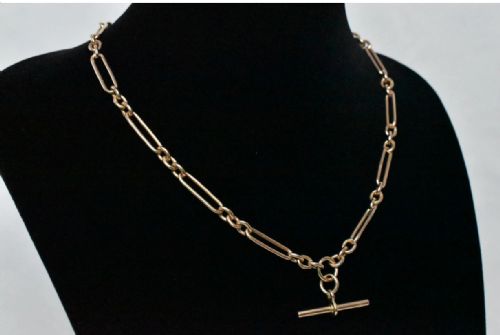

Gold Trombone Link
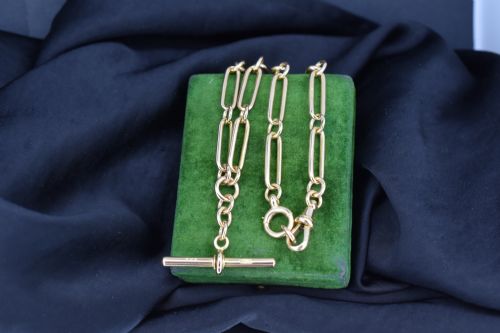
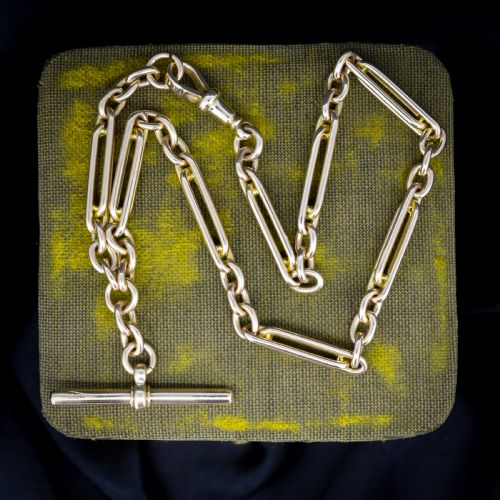
Gold trombone link chains are substantial antique watch chains and necklaces featuring long rectangular links, prized for their strength and distinct architectural rhythm.
Gold Trombone Link
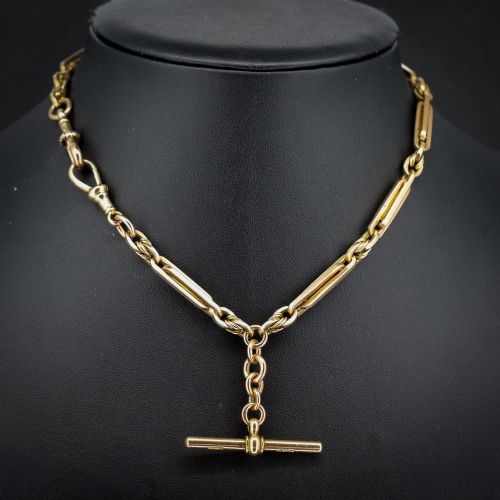
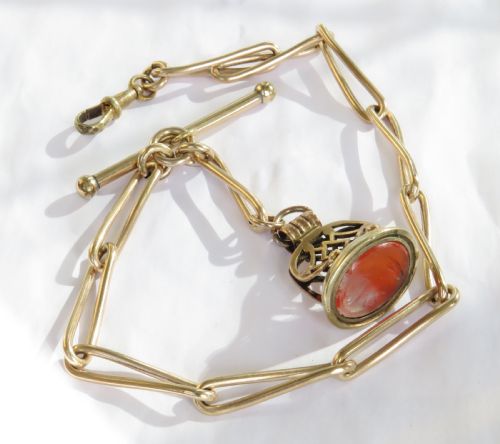
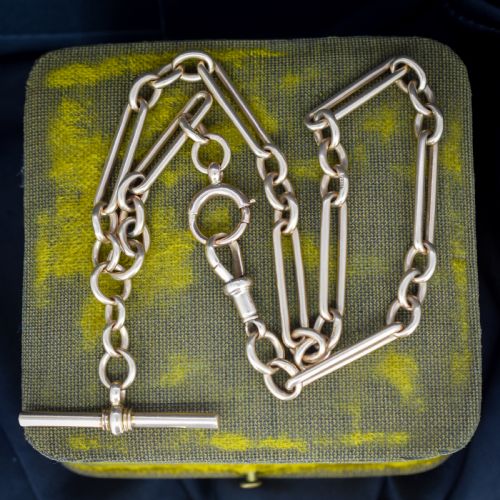
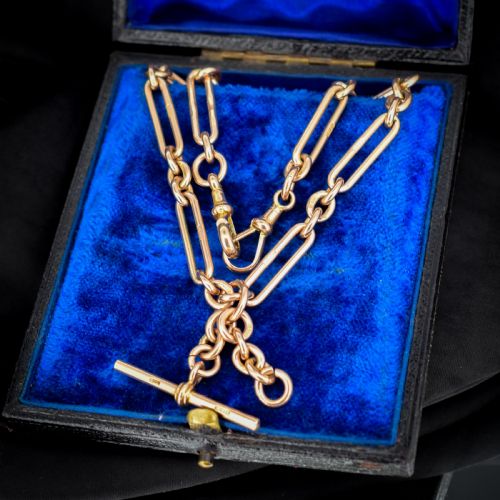
A gold trombone link chain consists of elongated bar links interspersed with smaller circular or fancy connectors, designed originally to secure pocket watches to waistcoats. These sturdy configurations now circulate primarily as necklaces, guard chains, or bracelets.
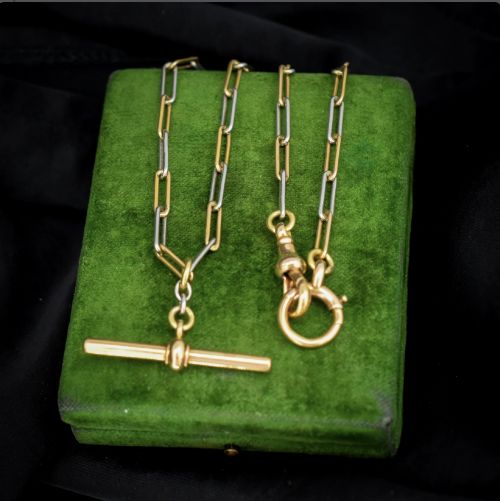
The pieces seen here span from the late Victorian era through the Edwardian period and into the 1920s, reflecting a continuous evolution in practical jewellery design. Most examples retain functional components such as swivel dog clips, bolt rings, and T-bars.
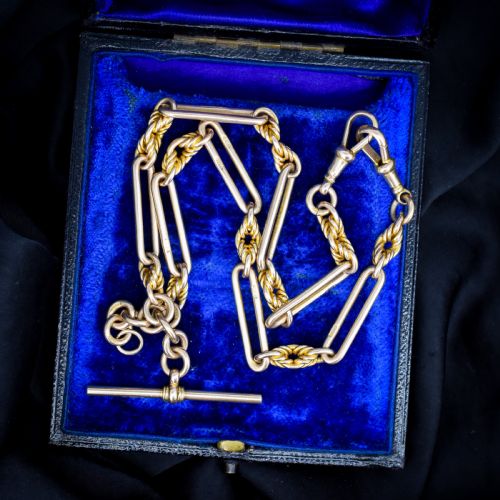
Makers of these chains often paired the signature trombone segments with love knot links, fetter patterns, or carnelian and turquoise fob pendants. Lengths vary considerably, from short pocket watch chains to very long guard chains suitable for doubling around the neck.
Materials and construction
Goldsmiths constructed these chains predominantly from yellow gold, rose gold, and occasionally platinum, utilising purities ranging from 9ct and 10ct up to 18ct, alongside rolled gold alternatives. The metal colour often depends on the period, with rose gold frequent in Victorian pieces and yellow gold prominent in later Edwardian and 1920s examples.
Links were individually formed, shaped, and soldered by hand to create durable geometric patterns capable of withstanding daily wear. Structural hardware like dog clips and T-bars were integrated securely to handle the mechanical demands of pocket watch attachment.
Gold Trombone Link Retail Price Guide 2026
Typical asking prices for gold trombone link among the pieces listed under this phrase on Sellingantiques today, from the lower quarter to the upper quarter. They describe what is for sale here now, not the wider market.
Listings feature 9ct gold, 18ct gold, and rolled gold materials, spanning Victorian, Edwardian, and 1920s periods.
Evaluating quality and distinction
Quality rests heavily on the gauge of the gold and the structural integrity of the individual links. Solid 18ct gold examples demonstrate superior weight and substance compared to 9ct variations or rolled gold pieces, altering how the chain drapes against the body.
The presence of original hallmarks, maker marks, and complete auxiliary fittings like T-bars and dog clips elevates an example significantly. Finer pieces maintain crisp junctions between the long trombone bars and their connecting knots without thinning from historical friction.
The Gold Trombone Link Glossary
- Trombone link
- A jewellery link shaped like a long rectangle with rounded corners, resembling the slide of a trombone. It forms the primary repeating motif in these chains.
- Albert chain
- A pocket watch chain named after Prince Albert, designed to attach a timepiece through a waistcoat buttonhole. They frequently feature a T-bar at one end and a swivel clip at the other.
- Dog clip
- A spring-loaded swivel clasp attached to the end of a watch chain. It allowed the wearer to secure a pocket watch or fob securely.
- T-bar
- A short transverse bar of metal attached to the centre or end of an Albert chain. It passed through a buttonhole to anchor the chain securely to clothing.
- Love knot
- A decorative link formed from intertwined wire loops symbolizing affection. They frequently alternate with trombone links in Victorian and Edwardian designs.
Gold Trombone Link: Frequently Asked Questions
How do I wear a gold trombone link chain today?
These versatile chains adapt easily to modern wardrobes when worn simply as standalone necklaces or layered with other pendants. Many retain their original dog clips, allowing you to attach charms or shorten the drop by clipping it onto intermediate links.
For longer guard chain variants, you can double the strands around the neck for a heavier, layered effect. The historic T-bar can be left to hang as a decorative pendant feature at the front or back.
What is the difference between an Albert chain and a guard chain?
An Albert chain was traditionally shorter and engineered specifically for securing a pocket watch, usually featuring a T-bar at one end and a swivel clip at the other. They are designed to sit across a waistcoat or hang neatly from a belt.
Guard chains are significantly longer continuous lengths of chain, often measuring around seventy centimetres or more. Victorians used them to suspend pocket watches, lorgnettes, or keys securely around the neck.
How can I tell the gold purity of my chain?
British antique chains typically carry hallmark stamps indicating the gold carat, such as 9, 15, or 18, alongside assay office marks like the anchor for Birmingham or crown for Sheffield. Rolled gold pieces are usually stamped with descriptive terms rather than official purity hallmarks.
Examining the metal under magnification helps locate these tiny stamps, which are frequently hidden on the jump rings, T-bars, or dog clips rather than the main trombone links.
What periods do these chains come from?
The pieces available originate primarily from the late nineteenth century through to the 1920s. Late Victorian and Edwardian examples often showcase intricate love knot pairings and warm rose gold hues.
Pieces from the 1920s frequently reflect cleaner lines and brighter yellow gold or platinum combinations. The presence of specific hallmark dates helps pinpoint the exact year of manufacture.