
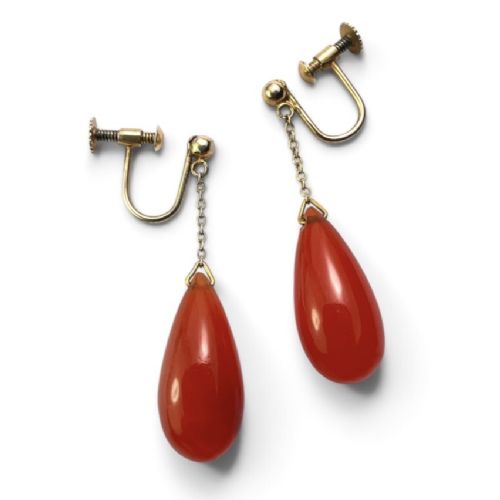
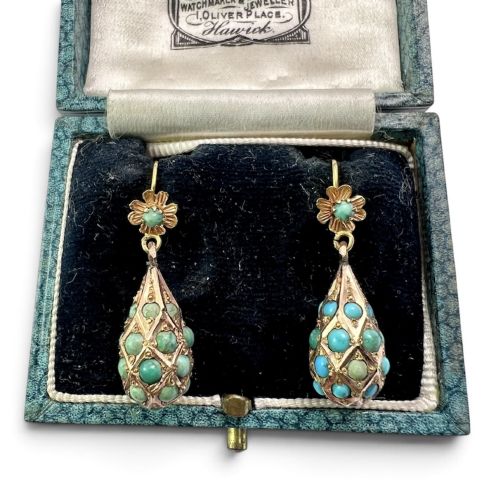
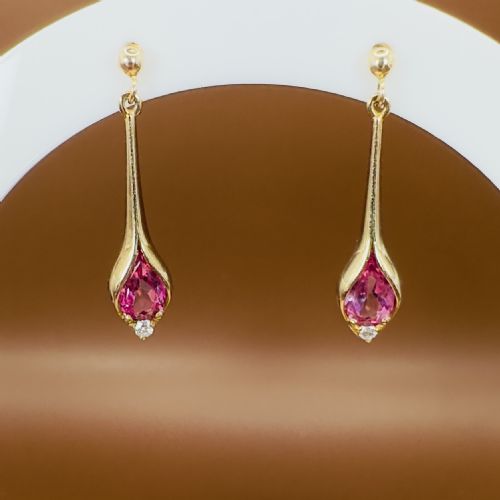


Gold Teardrop Dangle Earrings
Gold teardrop dangle earrings combine graceful movement with classical form, drawing the eye with every turn of the head.

Gold Teardrop Dangle Earrings
Gold teardrop dangle earrings span multiple eras, with Victorian, Edwardian, and mid-twentieth-century designs forming the core of the selection. Buyers seeking this specific silhouette encounter everything from delicate seed pearl clusters to clean modernist lines in precious metal.
The pear shape or teardrop form appears across numerous materials, suspended from simple hooks or paired with stud tops. Examples range from antique chalcedony and shell cameos to faceted gemstones set in nine-carat and eighteen-carat gold.
Materials and construction methods
Goldsmiths utilise nine-carat and eighteen-carat yellow gold, often combining silver for historical diamond settings to enhance the brilliance of the stones. Metalwork techniques involve delicate chain drops, hinged lever backs, and secure prong or bezel settings that cradle the suspended stones.
Gemstones and organic materials such as coral, jade, turquoise, and baroque pearls are shaped into pear cuts and cabochons to create the characteristic downward drape. Metal wirework and soldered connections allow the lower portion of the earring to move independently from the fitting.
Factors determining quality
Distinction in quality relies upon the precision of the stone cutting, the security of the settings, and the overall balance of the drop. Superior examples display harmonious proportions where the weight of the teardrop hangs correctly from the ear wire or stud.
Craftsmanship shows in the finish of the reverse side and the subtlety of the metalwork, whether in Edwardian filigree or Victorian granulation. The selection of materials, from matched natural pearls to finely carved hardstones, dictates the distinction of each pair.
The Gold Teardrop Dangle Earrings Glossary
- Cabochon
- A gemstone shaped and polished with a smooth, convex domed surface rather than faceted. This style highlights the natural colour and internal qualities of stones like jade, turquoise, and opal.
- Day-to-night earrings
- Convertible jewellery designed with removable sections to transform simpler daytime drops into more elaborate evening configurations. These pieces utilise clever mechanisms such as threaded posts or small catches.
- Lever back
- An earring finding featuring a hinged curved wire that clasps shut behind the ear lobe. This secure closure prevents loss during wear.
- Pear cut
- A modified brilliant-cut stone shaped with one rounded end and a tapering point at the other. It forms the classic teardrop silhouette seen across many drop earrings.
- Filigree
- Delicate ornamental work consisting of fine gold or silver wire twisted into intricate openwork patterns. It appears frequently in Edwardian and Victorian metalwork.
Gold Teardrop Dangle Earrings: Frequently Asked Questions
How do I wear drop earrings?
These earrings suit various occasions, moving easily from daytime wear to evening events depending on their scale and ornamentation. Simple stone drops pair well with everyday attire, while larger jewelled designs work best when hair is pulled back to showcase the movement.
Ensure the ear backs or lever closures are secure before wearing them for long periods. Storing them flat in a lined box prevents the dangling components from tangling or sustaining impact.
Are these earrings comfortable for daily use?
Comfort depends largely on the weight of the materials and the style of the fitting. Lighter nine-carat gold and small gemstone drops place minimal strain on the ear lobe during extended wear.
Heavier pairs featuring multiple stones or larger carved elements suit shorter durations or special occasions. Checking the balance of the drop helps determine how the piece will rest against the neck.
How do I date an antique pair?
Dating relies upon stylistic cues, the type of gold alloy, and the construction of the fittings. Victorian examples often feature rich yellow gold and emotional motifs like flowers or hair compartments, while Edwardian pieces lean towards delicate filigree and platinum-topped silver.
Mid-century designs from the nineteen-fifties and sixties introduce bolder geometric shapes and specific gemstone cuts. Examining the back of the setting provides further clues about period manufacturing techniques.
What is the difference between a drop and a dangle?
The terms are often used interchangeably, but a drop earring typically remains relatively stationary just below the earlobe with limited movement. A dangle earring incorporates articulated joints or chains that allow the lower section to swing freely with motion.
Both styles utilise the teardrop silhouette to draw the eye downward. The choice between them comes down to personal preference regarding movement.