

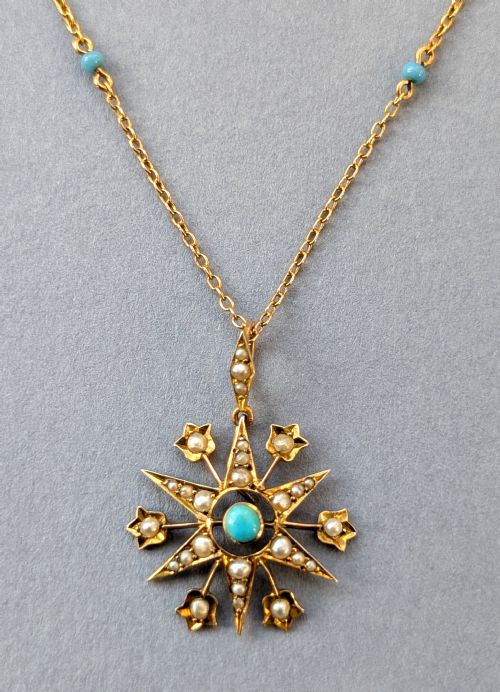


Gold Star Necklace
A gold star necklace brings celestial symbolism to historic jewellery, pairing deep Victorian sentiment with the refined work of later decades.
Gold Star Necklace
When searching for a gold star necklace, buyers encounter pieces ranging from nineteenth-century celestial starbursts to mid-century zodiac charms. The selection relies heavily on Victorian and Edwardian examples set with seed pearls, turquoise, and diamonds.
The common form on this page is the pendant or pendant brooch, constructed in various carats of yellow and white gold. These items often combine star motifs with floral details, garnets, or opals depending on the period of manufacture.
How they were made
Maker techniques rely on shaping yellow and white gold into delicate star, crescent, and celestial motifs. Gemstones such as diamonds, rubies, and sapphires are flush or claw set alongside seed pearls and turquoise.
Many items function dually as pendants and brooches, requiring robust hinged pin mechanisms alongside suspension loops. Materials like shagreen and red rock crystal cabochon appear alongside traditional precious stones.
Gold Star Necklace Retail Price Guide 2026
Typical asking prices for gold star necklace among the pieces listed under this phrase on Sellingantiques today, from the lower quarter to the upper quarter. They describe what is for sale here now, not the wider market.
Listings span the Victorian and Edwardian periods through to the nineteen-fifties and sixties, incorporating yellow and white gold alongside turquoise.
What varies in quality
Quality differences depend on the intricacy of the metalwork and the selection of gemstones, particularly the match and lustre of seed pearls and the cut of old diamonds. Higher-tier pieces utilise fifteen or eighteen carat gold rather than nine carat.
The complexity of the starburst design and the presence of signed maker marks or French hallmarks elevate the standard of the construction significantly.
French Perroud·Hirsch and Oppenheimer
The Gold Star Necklace Glossary
- Starburst
- A radiating design motif popular in Victorian celestial jewellery, often featuring diamonds or seed pearls. It mimics the bright twinkle of a distant star.
- Seed pearl
- A very small, naturally formed or cultured pearl used extensively in clusters and floral patterns during the nineteenth and early twentieth centuries. They add a soft lustre to gold settings.
- Pendant brooch
- A versatile piece of jewellery fitted with both a suspension loop and a pin back, allowing it to be worn on a chain or fastened to clothing.
- Cabochon
- A gemstone shaped and polished with a smooth, rounded convex surface rather than faceted edges. This cut is frequently seen on turquoise and rock crystal.
Gold Star Necklace: Frequently Asked Questions
Can I wear a pendant brooch as a necklace?
Most pendant brooches feature a hidden or fold-down loop alongside the pin mechanism, allowing them to hang securely from a chain.
You can easily transition the piece between a neck chain and a lapel fastening without damaging the historic mount.
How do I date a star pendant?
Dating relies on the gold carat marks, the stone-setting style, and the overall construction of the reverse side. Victorian and Edwardian examples often utilise closed-back settings or distinct pin hinges.
Later mid-century pieces shift towards different gold purities and distinct zodiac or modernist motifs.
What is celestial jewellery?
Celestial jewellery incorporates motifs such as stars, crescent moons, and sunbursts, which carried deep sentimental and romantic meanings in the nineteenth century.
Victorian makers frequently combined these symbols with diamonds and seed pearls to represent guidance and eternity.
Are seed pearls fragile?
Seed pearls are delicate organic gems that require careful handling and protection from cosmetics, perfumes, and prolonged moisture.
Historic pieces benefit from occasional professional checks to ensure the tiny pearls remain secure in their original settings.