


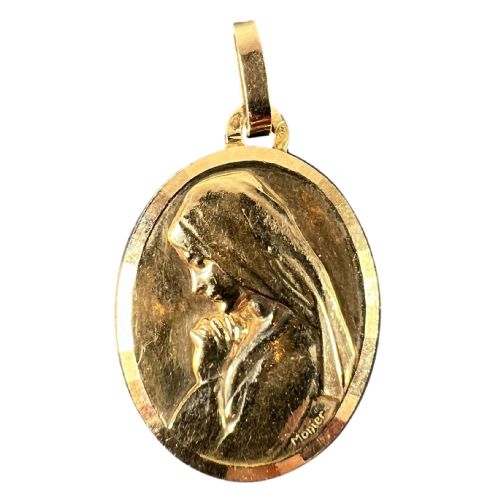

Gold Saint Medal Pendant
These gold saint medal pendant pieces are devotional French jewels offering personal protection and quiet beauty.
Gold Saint Medal Pendant
A gold saint medal pendant brings together centuries of devotional iconography and French goldsmithing, taking the form of circular or oval charms meant to be worn close to the body. When you search for a gold saint medal pendant, you encounter pieces depicting figures such as the Virgin Mary, Saint Christopher, and Saint John the Baptist.
The versions most common on this page originate in France and span the late nineteenth century through the mid-twentieth century. They bridge the aesthetic shifts from Art Nouveau curves to Art Deco geometry while retaining their primary religious function.
How they were made
The workshops relied primarily on 18K yellow gold, alongside variations in white gold, rose gold, and occasional mother-of-pearl inserts. Metal was stamped, cast, and hand-engraved to produce high-relief portraits of religious figures against textured or polished grounds.
Medals often incorporate fine details such as halo rays, Latin inscriptions, and maker signatures punched directly into the reverse or the suspension ring.
Yellow gold dominates the material record, accompanied by select examples in rose gold, white gold, and mother-of-pearl.
What varies in quality
The reputation of the medallist also shapes the piece, with works bearing known signatures exhibiting superior proportions and artistic balance.
Emile Monier·Mazzoni·Guilbert·Vernon·Sellier·Rasumny·Tairac·Dropsy·Perriat·Becker·Charl·Monet·Ruffony·Tricard·OBC·Tschudin
The Gold Saint Medal Pendant Glossary
- Hallmark
- A small stamp impressed into the metal indicating gold purity and country of origin. French pieces commonly use specific guarantee marks such as the eagle head.
- Medallion
- A large circular or oval metal disc bearing a commemorative or religious design. These form the primary body of the pendants found here.
- Pendant bail
- The loop or ring attached to the top of the medal through which a chain passes. Original bails often carry matching hallmarks.
- Guilloché
- A decorative technique where a precise, intricate pattern is mechanically engraved into an underlying metal surface. It adds depth beneath transparent enamel or polished gold.
- Iconography
- The traditional imagery and symbols associated with a specific saint or religious subject. Recognising these attributes helps identify lesser-known figures.
Gold Saint Medal Pendant: Frequently Asked Questions
How do I wear a gold saint medal pendant?
These pieces suspend easily from standard gold chains, sitting close to the collarbone as personal talismans. Many collectors pair them with other antique charms on a heavier chain.
Their substantial weight in 18K gold makes them durable enough for daily wear provided the suspension ring remains secure.
What do the different saints represent?
Each figure carries a specific patronage, such as Saint Christopher protecting travellers or the Virgin Mary offering general intercession and comfort. Figures like Saint Therese and Saint John the Baptist hold distinct meanings for the original owner.
Reading the Latin inscriptions around the rim often reveals the exact prayer or dedication intended for the wearer.
How do I date a French religious medal?
Dating relies upon a combination of the stylistic clues found in the border work and the specific hallmarks stamped onto the gold. Art Nouveau pieces display organic curves, while Art Deco examples favour geometric frames.
Maker signatures also help anchor the piece within a known active working period during the late nineteenth or early twentieth centuries.
Are these medals solid gold?
The pieces recorded here consist of 18K yellow, white, or rose gold rather than plated base metals. This higher gold purity ensures the metal resists tarnish and maintains its rich colour over time.
Assay marks stamped into the gold confirm this standard of metal fineness.