

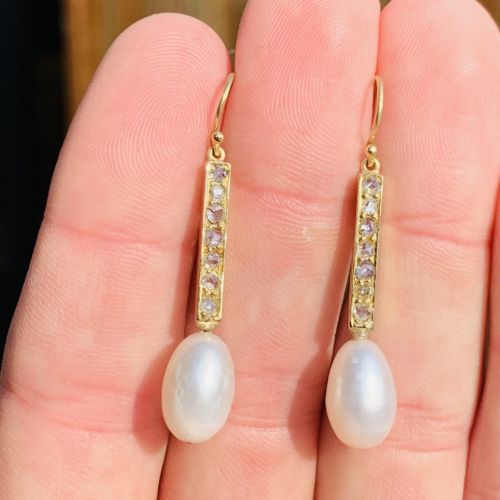
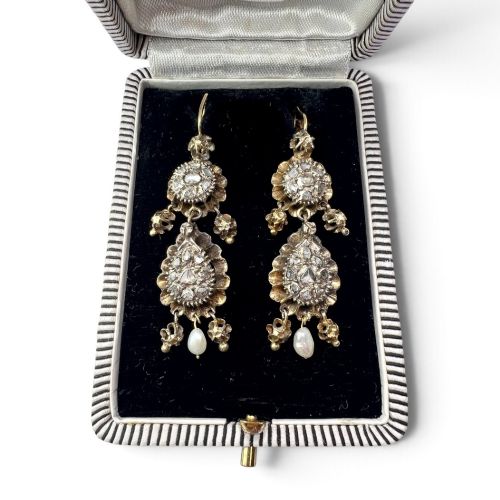


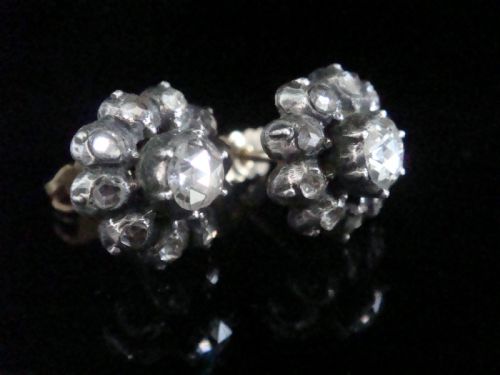


Gold Rose Cut Earrings
These gold rose cut earrings span Georgian, Victorian, Edwardian and Art Deco periods, bringing distinct historic charm to your collection.
Gold Rose Cut Earrings
Gold rose cut earrings comprise antique drop, stud and chandelier designs set with historic stones. You will frequently encounter Victorian and Edwardian examples featuring yellow gold or rose gold combined with silver settings.
The selection ranges from Georgian night and day earrings to delicate Art Nouveau clover studs and elaborate Iberian chandelier pieces. Formats vary from simple cluster studs to elaborate articulated drop earrings incorporating pearls and garnets.
How they were made
Maker's workshops utilised varied metals including yellow gold, 18ct gold, rose gold and platinum, often pairing gold backs with silver collets to enhance the brilliance of the stones. Pearls and bohemian garnets appear alongside diamonds in secure traditional settings.
The defining characteristic is the rose cut diamond, presenting a flat base and a domed crown of triangular facets that capture candlelight rather than modern electric illumination. Construction methods rely on hand fabrication appropriate to Georgian, Victorian and Edwardian periods.
Gold Rose Cut Earrings Retail Price Guide 2026
Typical asking prices for gold rose cut earrings among the pieces listed under this phrase on Sellingantiques today, from the lower quarter to the upper quarter. They describe what is for sale here now, not the wider market.
Listings feature yellow gold, 18ct gold, rose gold and platinum paired with diamonds, natural pearls, baroque pearls and garnets across multiple eras.
What varies in quality
Quality rests upon the proportion and symmetry of the hand-cut stones and the integrity of the original metalwork. Finer pieces demonstrate careful matching of rose cut diamonds and baroque pearls within balanced architectural designs.
Distinction also lies in the preservation of the delicate gold and silver mounts, where minimal alteration and intact original findings elevate the piece. The subtlety of the foil backs and the precision of the cluster work differentiate standard production from superior examples.
The Gold Rose Cut Earrings Glossary
- Rose cut
- A historic diamond cutting style featuring a flat bottom and a faceted dome rising to a point, designed to glow softly in candlelight. This technique precedes modern brilliant cuts.
- Night and day earrings
- Convertible antique earrings featuring a detachable lower section that transforms a day stud into an evening drop earring. They offer versatile wear for different occasions.
- Collet setting
- A metal collar that wraps around the girdle of a stone to secure it in place. This technique is typical of Georgian and Victorian jewellery construction.
- Baroque pearl
- An irregularly shaped non-spherical pearl valued for its organic contour and unique lustre. Such pearls were frequently utilised in Victorian drop earrings.
- Bohemian garnet
- Deep red pyrope garnets mined in Central Europe, commonly set in dense cluster arrangements during the Victorian period. They provide rich colour contrast against gold mounts.
Gold Rose Cut Earrings: Frequently Asked Questions
How do I care for antique earrings?
Store these pieces individually in soft pouches away from moisture and modern cosmetics. Clean them gently with a dry cloth, avoiding harsh ultrasonic cleaners that can damage foil backs or natural pearls.
Secure the hook or screw backs carefully during wear to prevent loss. Regular gentle handling preserves the historic metals and delicate stone settings.
Can I wear them every day?
Antique earrings require considerate wear due to their age and delicate historic construction. Reserve them for gentle daily use or special occasions to protect fragile settings and original gold work.
Take care when dressing or styling hair to avoid snagging drop elements or clasps. Removing them before swimming or sleeping ensures longevity.
How do I date these earrings?
Dating relies upon examining the metal alloys, fastening types, and stone-cutting characteristics evident in each design. Georgian pieces often display closed-back settings, while Victorian and Edwardian examples utilise lighter platinum and gold wire work.
Stylistic motifs like clover shapes, bows, and ivy leaves also point to specific decorative periods. Comparing the construction methods with documented timelines clarifies the era of origin.