


Gold Painted Lacquer Box
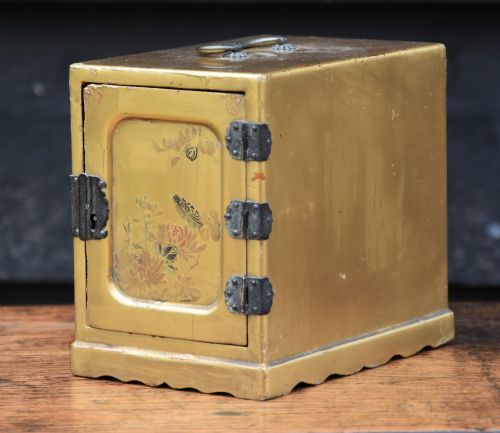
A gold painted lacquer box brings together rich surface decoration and functional storage, offering a compact piece of craftsmanship to hold jewellery or small treasures.
Gold Painted Lacquer Box
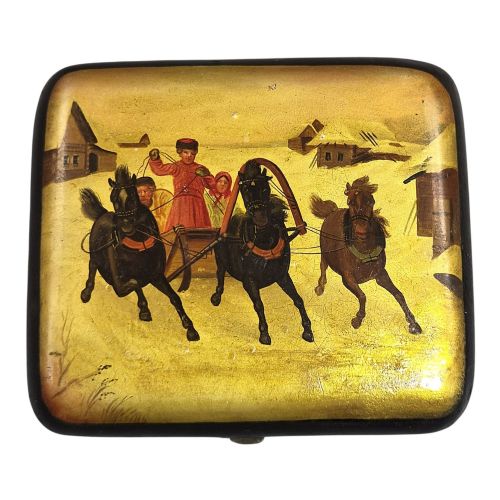
A gold painted lacquer box represents a diverse group of small containers shaped by global traditions, ranging from Japanese Meiji period examples and Chinese export pieces to Russian folk art and English penwork creations. When searching for a gold painted lacquer box, buyers encounter varied forms such as jewellery boxes, cigarette cases, tea caddies, trinket boxes, and table cabinets.
The materials and origins span multiple centuries and regions, including 19th-century Japanese items, Georgian chinoiserie pieces, Edwardian Kashmiri lidded pots, and Regency Brighton Chain Pier boxes. Papier-mâché and wood frequently form the structural base beneath the painted lacquer surface.
Origin details shape the character of each piece, with specific entries pointing to Kashmiri craftsmanship, Imperial Russian workshops, and Qajar cashier boxes. These objects serve both ornamental and practical roles in a modern interior.
Materials and construction methods
Maker construction relies heavily on organic substrates like wood and papier-mâché, coated in layered lacquer and finished with detailed hand painting and gold leaf or gilt ornamentation. Metal elements and brass occasionally appear on hardware fittings or specific cases.
Techniques vary widely by region, encompassing traditional Japanese lacquer application, Russian papier-mâché methods, Kashmiri lidded pot decoration, and English penwork applied to toleware and wood bases.
A solitary tea caddy from 1800 sits quietly among the boxes, perhaps still holding the faint aroma of long-forgotten leaves.
Assessing quality and execution
Quality rests in the precision of the hand-painted detailing and the preservation of the delicate lacquer and gold leaf surfaces across the box or cabinet. Finer examples display crisp execution in traditional motifs, whether following Georgian chinoiserie, Japanese Meiji aesthetics, or Russian folk art styles.
The structural integrity of the underlying wood, papier-mâché, or metal body dictates durability, alongside the smooth closure of lids and drawers on forms like table cabinets and tea caddies.
Vishnyakov Workshop
The Gold Painted Lacquer Box Glossary
- Lacquer
- A durable resin finish applied in multiple coats to a wooden or papier-mâché base. It creates a smooth, protective surface suited for intricate painting.
- Papier-mâché
- A composite material made from paper pulp or reinforced paper sheets mixed with adhesive. It forms a lightweight, mouldable foundation for decorative boxes.
- Chinoiserie
- A European artistic style reflecting Chinese and East Asian motifs. It gained popularity during the Georgian period on lacquered furniture and decorative objects.
- Penwork
- A decorative technique utilising fine ink drawings on a prepared surface, often highlighted with paint or varnish. It appears frequently on Regency boxes and table cabinets.
- Toleware
- Enamelled or lacquered metalware produced in England and Europe. It provides a sturdy metallic base for painted and gilded household items.
Gold Painted Lacquer Box: Frequently Asked Questions
What were gold painted lacquer boxes used for?
These boxes served multiple domestic and personal purposes, holding items such as tea leaves, cigarettes, correspondence, and jewellery. Their decorative finishes allowed them to sit prominently on dressing tables or in reception rooms.
Larger variations like table cabinets and cashier boxes functioned as secure storage for valuables and documents, combining utility with fine craftsmanship.
How do I date an antique lacquer box?
Dating relies on identifying the underlying material, artistic style, and regional characteristics of the piece. Georgian and Regency examples often feature English penwork or chinoiserie motifs, while 19th-century items frequently point to Japanese Meiji production or Russian papier-mâché.
Examining the construction methods of the core body and the formulation of the lacquer provides further clues to the period of origin.
Where were these decorative boxes made?
Production spanned diverse global regions, including Japan, China, Russia, Kashmir, and England. Each region employed distinct materials, such as papier-mâché in Russia, specialised woodcraft in Japan, and metal substrates for toleware in England.
Regional trade and artistic exchange heavily influenced the spread of lacquer techniques across these varied geographies.
How should I care for a lacquer box?
Preserving a lacquer surface requires keeping the box away from direct sunlight and extreme temperature fluctuations, which can cause the finish to crack. Dusting should be done gently with a soft, dry cloth without chemical polishes.
Handling the object carefully prevents damage to delicate gold leaf and hand-painted details.