
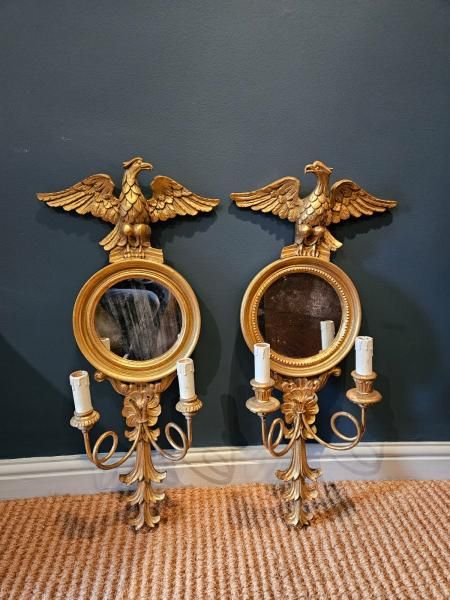


Gold Metal Wall Mirror
A gold metal wall mirror brings immediate light and reflective warmth to a room, drawing the eye with its polished metallic frame.
How they were made
Construction relies heavily on cast iron, brass, and bronze, shaped into rigid frames that support heavy mirror glass. Metal elements are frequently hand embossed, chased, or gilded to produce the characteristic metallic sheen.
Wood and giltwood often provide internal structural backing or core support beneath the metal overlays and gilt brass mounts. Mirror glass is typically bevelled or flat plate, secured within rebated frames designed to distribute the weight evenly.
What varies in quality
The refinement of the casting and embossing defines the upper tier of these mirrors, where crisp detail in the foliage, scrolls, or figural motifs demonstrates superior craftsmanship. Plain pressed metal gives way to finely chased bronze and brass that retains sharp definition across every edge.
Integration of original mirror glass and the preservation of the early gilding or patination dictate the desirability of a piece. Substantial structural integrity in the metal frames and robust backing ensure the mirror hangs securely without distortion.
Current listings span the nineteenth and early twentieth centuries, featuring brass, gilt metal, cast iron, and mirror glass across various revival styles.
Coalbrookdale
The Gold Metal Wall Mirror Glossary
- Girandole
- A branched wall mirror or sconce designed to hold candles alongside the reflective glass. This form multiplies the ambient light within a space.
- Gilt brass
- Brass that has been coated with a thin layer of gold leaf or gilt finish to simulate solid gold. It provides a durable metallic base with a warm decorative surface.
- Cushion framed
- A mirror frame profile that curves outward in a convex, pillow-like shape towards the outer edge. This style creates a pronounced three-dimensional effect on the wall.
- Embossed brass
- Sheet brass that has been hammered or pressed from the reverse side to raise a decorative pattern in relief. This technique allows for ornate surface ornamentation without excessive weight.
- Neoclassical revival
- A nineteenth century design movement that revived classical Greek and Roman motifs such as urns, swags, and symmetry. It emphasises restraint and classical proportion.
Gold Metal Wall Mirror: Frequently Asked Questions
How do I hang a heavy metal mirror safely?
These mirrors require robust wall fixings due to the combined weight of the metal frame and glass plate. Secure the hanging wire or brackets directly into wall studs or use appropriate heavy duty anchors.
Ensure the hanging hardware on the back of the frame is firmly attached to the structural metalwork before mounting the piece at eye level.
Are girandoles designed to hold lit candles?
Girandoles feature integrated arms intended to hold taper candles to illuminate the room alongside the reflective glass. While functional, modern owners often leave them unlit to preserve the antique metal and avoid smoke damage.
Take care if burning candles to catch any dripping wax immediately before it reaches the brass or gilt surfaces.
How do I clean an antique brass mirror frame?
Dust the metal gently with a soft, dry cloth to prevent the accumulation of grit within the embossed details. Avoid harsh chemical polishes that strip away the aged patination and historical finish accumulated over the decades.
Keep glass cleaner away from the metal frame to prevent tarnishing or staining the gilt surface during routine maintenance.
What indicates a nineteenth century date for these mirrors?
Nineteenth century pieces often display hand chased detailing, heavy cast brass or iron construction, and traditional assembly methods on the reverse. The specific style, such as Victorian decorative or Rococo revival, aligns with the manufacturing period noted in the title.
Slight irregularities in the cast metal and the character of the original mirror glass further point to nineteenth century production.