


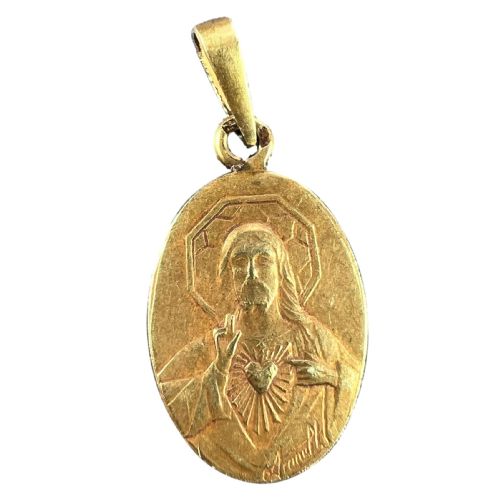


Gold Jesus Medal
A gold jesus medal brings intricate French religious art into everyday wear, offering wearable devotion crafted in gleaming yellow gold.
Gold Jesus Medal
A gold jesus medal is primarily a pendant or charm produced within French religious art traditions. These devotional pieces take the form of pendants, pendants and medals, or pendants and charms, designed to be worn close to the body.
Buyers meet examples spanning several decades, including the 1900s, 1910s, 1920s, 1930s, and 1950s. The common subjects depict Jesus Christ, the Sacred Heart, the Crown of Thorns, Saint Joseph, Saint Therese, Holy Communion, and Madonna and Child pairings.
Stylistically, these pieces draw heavily on French aesthetic movements such as Art Nouveau and Art Deco, alongside explicit ecclesiastical designs. The workmanship bridges personal devotion with distinct period artistry.
Materials and construction methods
The primary material across the inventory is yellow gold, specifically recorded as 18ct yellow gold, 18K yellow gold, 18k yellow gold, and 18ct gold. Occasional pieces incorporate additional elements like rubies.
Medals and pendants are struck or cast with detailed relief work, capturing facial expressions, textual inscriptions, and symbolic iconography such as the Chi Rho or Alpha Omega. Master medallists signed their works directly onto the metal surface.
Some medals bear the tiny signature of a French medallist who spent his days sweating over miniature thorns.
Distinctions in quality and execution
Quality rests significantly on the reputation of the medallist whose signature or mark appears on the piece, such as Paul Brandt, Mazzoni, Tairac, Dropsy, Perriat, Charl, Arnault, Grün, Lasserre, Becker, or Vernon. Named maker attributions elevate the standing of a medal.
The crispness of the relief carving and the depth of the figural rendering determine the visual strength of the object. Softer details or worn surfaces diminish the legibility of the sacred imagery.
Paul Brandt·Mazzoni·Tairac·Dropsy·Perriat·Charl·Arnault·Lasserre·Becker·Vernon
The Gold Jesus Medal Glossary
- Medal
- A flat piece of metal bearing a design or inscription, created to commemorate a person, event, or religious devotion. These objects are fitted with loops to serve as pendants.
- Charm
- A small decorative pendant attached to a bracelet or necklace. In this category, charms frequently share the religious iconography of larger medals.
- Sacred Heart
- A devotional image representing the physical heart of Jesus Christ as a symbol of divine love for humanity. It frequently appears alongside flames, a crown of thorns, or rays of light.
- Alpha Omega
- The first and last letters of the Greek alphabet, used as a Christian symbol representing Jesus as the beginning and the end. This motif appears on specific ecclesiastical medals.
Gold Jesus Medal: Frequently Asked Questions
What is a gold jesus medal?
A gold jesus medal is a small devotional pendant fashioned from yellow gold, typically originating from France during the early to mid-twentieth century. They depict figures and symbols from Christian tradition, including Jesus Christ, the Sacred Heart, and various saints.
These pieces function as both jewellery and personal items of faith. They are designed to be suspended from chains or worn on charm bracelets.
How do I wear a gold jesus medal?
These medals are most commonly suspended from a fine yellow gold chain to be worn as a necklace pendant. Their modest size also allows them to be attached securely to a charm bracelet.
Because they feature detailed relief work on both sides or a finished reverse, they sit comfortably against the skin. Pairing them with other vintage gold chains creates a traditional layered look.
How do I date a gold jesus medal?
Dating relies heavily on the stylistic hallmarks of the piece, such as distinct Art Nouveau curves or geometric Art Deco lines. Maker signatures and French gold assay marks stamped into the metal provide further chronological markers.
The inventory records pieces originating across specific decades from the 1900s through to the 1950s. Comparing the artistic style with known active periods of makers like Paul Brandt or Dropsy helps narrow the date.
What do the different symbols mean?
The iconography reflects specific Catholic devotions and scriptural references. A crown of thorns signifies the suffering of Christ, while the Sacred Heart represents divine compassion.
Other symbols, such as the Chi Rho and Alpha Omega, denote the divinity and eternal nature of Jesus. Portraits of figures like Saint Joseph or Saint Therese invoke specific intercessors.