
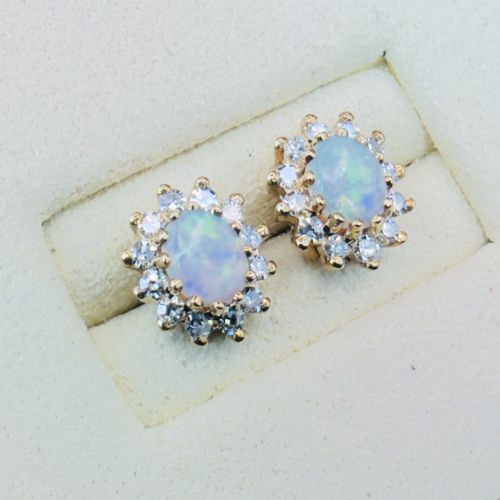


Gold Halo Cluster Studs
These gold halo cluster studs bring a central gemstone encircled by smaller stones directly to the lobe with enduring appeal.
Gold Halo Cluster Studs
Gold halo cluster studs comprise a prominent central stone surrounded by a concentric border of smaller accent gems, usually mounted for pierced ears. When searching for gold halo cluster studs, buyers encounter variations spanning the Victorian, Edwardian, Art Deco, and Mid-Century periods.
The materials paired in these designs range from traditional yellow and white gold settings to silver gilt, framing central stones such as sapphire, emerald, aquamarine, garnet, ruby, and opal alongside diamonds, pearls, or paste.
Examples on this page draw on styles including traditional cluster work, geometric Art Deco lines, and Austro-Hungarian influences. These pieces function primarily as daily wear or evening ornaments depending on their scale and stone choice.
How they were made
Maker techniques rely on mounting precious stones into metals like nine carat and eighteen carat gold, white gold, platinum, and silver gilt. Central gems receive secure settings such as claws or bezels, while surrounding accent stones are closely clustered to form the characteristic halo.
Earring mechanics in the evidence combine standard post and stud fittings with screw backs for non-pierced lobes. Metalwork varies from fine Edwardian wire and basket settings to heavier geometric Art Deco frameworks supporting substantial carat weights.
Listings span the Victorian era through the Mid-Century period, incorporating materials like aquamarine, emerald, sapphire, garnet, opal, and diamond set in yellow gold, white gold, and silver gilt.
What varies in quality
Quality in these clusters rests on the selection and matching of the central gem with its surrounding stones. Fine examples feature well-matched colour saturation in sapphires, emeralds, or aquamarines, paired with cleanly cut diamonds that sit evenly within the halo.
Construction standards appear in the precision of the metalwork, whether handling delicate rose-cut diamond settings or substantial white gold frames. The integrity of the mounting ensures that the central stone and its border remain secure and balanced against the ear.
The Gold Halo Cluster Studs Glossary
- Cluster
- An arrangement of multiple gemstones grouped tightly together, typically featuring a larger central stone encircled by smaller accents. This layout maximises visual impact and light reflection.
- Halo
- A ring of smaller pavé-set or claw-set diamonds or gems surrounding a larger focal stone. It enhances the perceived size and brilliance of the centre piece.
- Cabochon
- A gemstone shaped and polished with a smooth, rounded convex surface rather than faceted. This cut is frequently utilised for opaque or translucent stones like opals.
- Rose cut
- An antique diamond cut featuring a flat base and a dome-shaped crown composed of triangular facets that culminate in a point. It yields a softer, subtle scintillation compared to modern cuts.
Gold Halo Cluster Studs: Frequently Asked Questions
How do I clean vintage cluster earrings?
Clean these pieces gently using warm water, mild soap, and a soft brush to remove everyday debris from behind the settings. Avoid harsh chemical dips, particularly when dealing with softer organic gems like pearls or opals.
Ensure the earrings are completely dry before storing them in a lined box to protect the metal and stone surfaces from unnecessary friction.
Are these earrings suitable for daily wear?
Many sturdy gold and diamond configurations handle regular use well, provided the mountings and settings receive periodic checks by a jeweller. Pieces incorporating softer or more porous gems require greater care to avoid knocks.
Removing the earrings before swimming, sleeping, or strenuous activity preserves the longevity of both the goldwork and the central stones.
What is the difference between screw backs and posts?
Screw backs feature a threaded post paired with a matching backing nut that winds securely down the shaft. This mechanism accommodates non-pierced lobes or offers added security for heavier designs.
Standard posts rely on friction backs or butterflies, which suit modern pierced ears and allow for quick removal.
How can I tell an Edwardian cluster from an Art Deco one?
Edwardian designs generally favour delicate yellow or white gold and platinum work, often incorporating softer floral motifs, millegrain edges, and rose-cut diamonds. They project an airy, lace-like elegance.
Art Deco pieces introduce geometric symmetry, strong lines, calibrated calibre-cut stones, and stark white metal pairings using white gold or platinum.