



Gold Etruscan Revival Pendant
These gold etruscan revival pendants are masterclasses in nineteenth-century archaeological jewellery, offering collectors wearable classical antiquity.
Gold Etruscan Revival Pendant
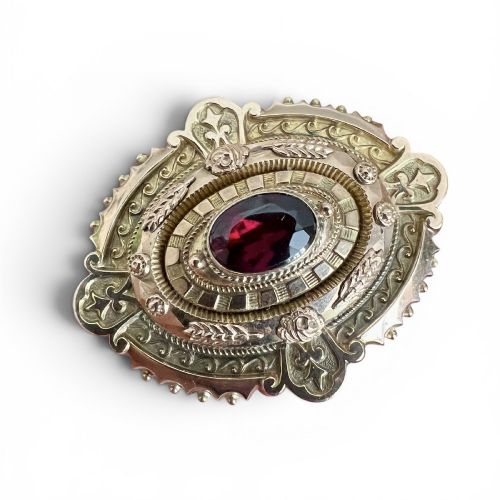
When you search for a gold etruscan revival pendant, you are looking at nineteenth-century masterworks inspired by archaeological discoveries in Italy. The pieces on this page span the Victorian and Edwardian periods, frequently blending pendant and brooch configurations.
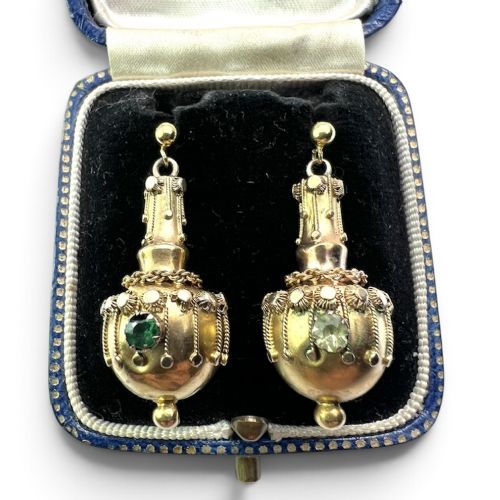
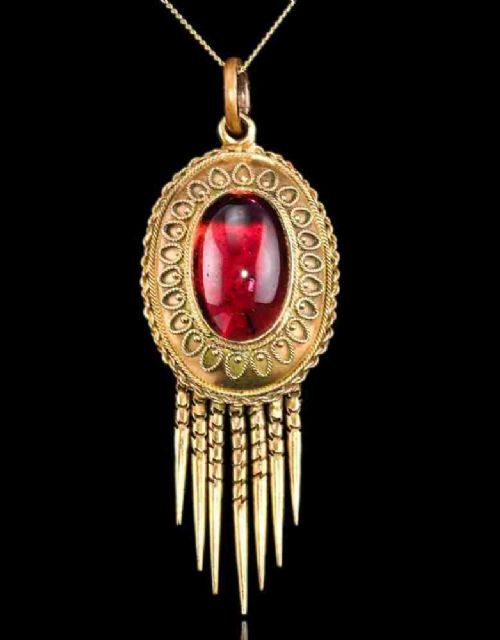
You will encounter designs executed in yellow gold, 15ct gold, and 9ct gold, often incorporating gemstones such as garnet, turquoise, and chrysoberyl. Many examples reflect the Victorian Classical Revival aesthetic, drawing directly from ancient Etruscan goldsmithing techniques.
The forms range from compact drops to large lockets and convertible pendant necklaces. These items showcase the period's intense fascination with antiquity, translating ancient motifs into sophisticated Victorian ornaments.
Materials and construction methods
The construction relies heavily on high-grade gold, notably 15ct and 18ct varieties, shaped into intricate frameworks of wirework and granulation. Artisans soldered microscopic balls of gold onto surfaces in precise geometric patterns, replicating genuine ancient finds.
Gemstones including garnet, turquoise, and chrysoberyl are flush-set or bezel-set within the golden matrices. Enamel and shell cameos also appear as central focal points, anchored securely to gold backplates with integrated suspension loops.
Gold Etruscan Revival Pendant Retail Price Guide 2026
Typical asking prices for gold etruscan revival pendant among the pieces listed under this phrase on Sellingantiques today, from the lower quarter to the upper quarter. They describe what is for sale here now, not the wider market.
The listings on this site feature gold etruscan revival pieces exclusively from the Victorian and Edwardian periods.
Distinguishing quality in revival jewellery
The pinnacle of quality rests upon the precision and scale of the granulation work. Master goldsmiths applied microscopic gold spheres with absolute neatness, whereas lesser examples rely on stamped decoration or clumsier solder joints.
Weight, metal purity, and the integration of desirable stones like turquoise or fine garnets determine the upper tiers. Pieces that function as both a pendant and a brooch demonstrate higher versatility and superior original craftsmanship.
The Gold Etruscan Revival Pendant Glossary
- Granulation
- A decorative technique involving the application of tiny spheres of gold to a metal surface in geometric patterns. This method defines authentic archaeological revival jewellery.
- Etruscan Revival
- A nineteenth-century design movement inspired by the unearthing of ancient Etruscan tombs. It heavily utilises granulation, filigree, and classical motifs.
- Chrysoberyl
- A golden-green gemstone occasionally set into Victorian revival pieces. Its subtle brilliance complements high-karat yellow gold.
- Cabochon
- A gemstone shaped and polished with a smooth convex surface rather than faceted. This cut was favoured in nineteenth-century settings for its antique appearance.
Gold Etruscan Revival Pendant: Frequently Asked Questions
How do I date these pendants?
Most examples date from the Victorian period, aligned with nineteenth-century excavation booms in Italy.
Stylistic cues and gold hallmarks help distinguish the exact manufacturing decade.
Were these pendants also worn as brooches?
Many pieces feature dual-purpose mountings with hidden loops and pin stems.
This versatility allowed Victorian wearers to pin the jewel to garments or suspend it from a chain.
What stones are typically found in them?
Garnet, turquoise, and chrysoberyl frequently appear alongside pearls and enamel.
These materials were chosen for their historic resonance and rich colour contrast against yellow gold.
How should I care for my pendant?
Store the piece in a dedicated lined box to protect the delicate granulation from friction.
Avoid chemical dips that might damage sensitive gemstone settings or antique gold.