




Gold Equestrian Jewellery
Gold equestrian jewellery brings together fine metals and sporting motifs, offering finely crafted pieces like horseshoe brooches and horse head charms for everyday wear.
Gold Equestrian Jewellery
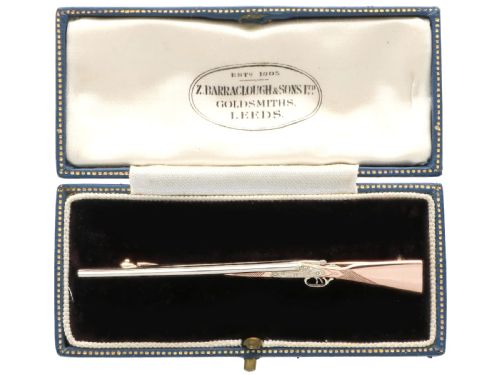
Gold equestrian jewellery encompasses wearable items that celebrate horses, riding, and field sports through precious metals. When searching for gold equestrian jewellery, buyers encounter various forms including stick pins, brooches, charms, and necklaces. These pieces span from the Georgian period through the Victorian and Edwardian eras into the mid-twentieth century.
How they were made
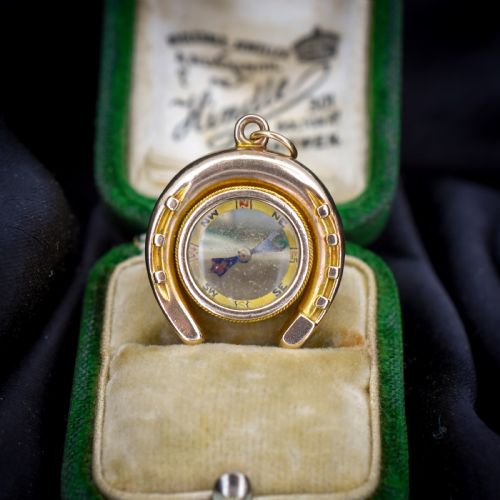
Maker techniques rely heavily on casting and forming yellow gold in varying purities, alongside gold cased metal for specific elements. Goldsmiths constructed delicate settings to house gemstones such as diamonds, garnets, carnelian, and tourmaline within the confines of small brooches and pins.
Lapidary work is prominent, seen in carved cameos, black onyx, and rock crystal elements like Essex crystal that depict animal subjects. Pearl stringing and bead setting secure natural seed pearls and seed pearl clusters along horseshoe frames.
The inventory incorporates items spanning multiple centuries, featuring materials such as nine-carat gold, fifteen-carat gold, eighteen-carat gold, diamond, pearl, turquoise, and garnet.
What varies in quality
Quality rests on the precision of the goldsmith's work and the selection of materials. Finer items display crisp detailing in carved elements, such as horse heads or jockey caps, and secure stone settings.
The choice of metal purity, ranging from lower gold standards and gold cased metal up to eighteen-carat gold and fifteen-carat gold, marks a distinction in the piece's baseline material value. The incorporation of natural stones like diamonds and fine pearls elevates the standing of a brooch or pin.
Chaumet
The Gold Equestrian Jewellery Glossary
- Stick pin
- A long pin with a decorative head worn upright in a cravat or lapel. These often featured sporting motifs like horseshoes and hunting bugles during the Victorian period.
- Essex crystal
- A technique where a convex crystal cabochon is reverse-painted by hand to create a three-dimensional image. These frequently depict animal subjects and sports themes.
- Fob seal
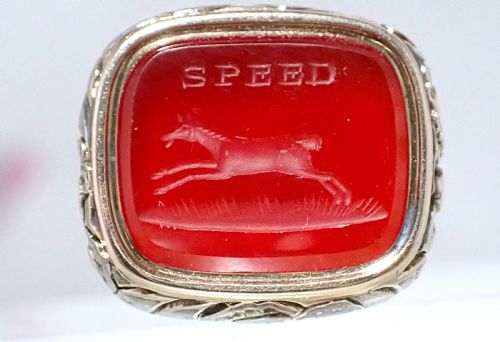
- A small decorative pendant used for stamping wax seals on correspondence. Georgian examples often incorporated carved carnelian and horse motifs.
- Turquoise
- A hydrous phosphate of copper and aluminium valued for its robin's egg blue colour. Edwardian jewellers utilised turquoise en cabochon to accent horseshoe brooches.
Gold Equestrian Jewellery: Frequently Asked Questions
What periods do these pieces come from?
The selection spans from the Georgian era through the Victorian and Edwardian periods into mid-century design. Pieces carry stylistic traits characteristic of their respective decades.
Date markers range across the nineteenth and twentieth centuries, including specific years noted in mid-century charms and pins.
How were equestrian stick pins worn?
Stick pins were traditionally worn in neckties, cravats, or pinned directly to heavy wool lapels. The long pin shaft was secured behind the fabric with a protective cap.
Victorian gentlemen and women utilised them as functional accessories that signaled an interest in equestrian sports and hunting.
What gemstones appear most often?
Natural seed pearls and turquoise feature prominently in Victorian and Edwardian horseshoe designs. Diamonds and garnets are also integrated into larger brooches and pins.
Carved stones like black onyx, carnelian, and tourmaline appear in specific cameos and animal head representations.
Are these items suitable for daily wear?
Many items, such as solid gold charms and sturdy brooches, suit regular wear when handled with care. Delicate items with fine seed pearls or reverse-painted crystal require gentlest handling.
Assessing the security of pin mechanisms and stone settings helps determine everyday suitability.