


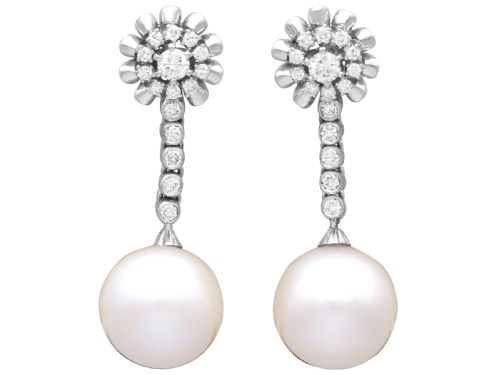


Gold Diamond Pearl Earrings
Gold diamond pearl earrings unite lustrous organic gems with brilliant stones in enduring precious metal settings.
Gold Diamond Pearl Earrings
When searching for gold diamond pearl earrings, buyers encounter a diverse range of historic specimens spanning from the Georgian and Victorian eras through the Edwardian period and into mid-century modern design. Drop earrings and cluster configurations dominate the selections, frequently pairing luminous pearls with sparkling diamonds set in yellow gold, white gold, or silver-topped gold. These pieces showcase how jewellers across centuries combined organic pearls with faceted stones to create balanced, light-reflecting ornamentation.
The selections visible here highlight the enduring popularity of drop earrings, studs, and dormeuse fittings designed to be worn across various occasions. Early iterations often incorporate natural pearls paired with rose-cut diamonds in yellow gold or silver mounts, reflecting the prevalent techniques of their respective periods. Later mid-century examples lean towards clean lines in white gold, utilising cultured or South Sea pearls alongside modern brilliant-cut diamonds.
Materials and construction
Goldsmiths constructed these jewels using varying purities of yellow and white gold, alongside silver-topped mounts which were traditionally favoured in earlier periods to enhance the white sparkle of diamonds against a dark background. Settings are frequently hand-fabricated or cast, securing diamonds in collets, bezels, or grain settings that highlight the stone facets.
Pearls are incorporated either as central cluster elements, dangling pendants, or button studs, often secured with pins and adhesive appropriate to their era. Metalwork incorporates fine granulation, filigree, and hinged mechanisms such as screwbacks, post fittings, and dormeuse clasps to ensure secure wear.
Several Victorian pairs still retain their original velvet boxes, proving that past owners knew these treasures deserved a proper bedroom.
Assessing quality and craftsmanship
Quality in these jewels rests primarily on the harmony of the design, the matching and lustre of the pearls, and the cut and clarity of the diamonds. Superior examples display thoughtful stone proportioning where the brilliance of the diamonds complements the soft, orient glow of the pearl without overpowering it.
The finesse of the metalwork further distinguishes finer specimens, seen in delicate piercing, secure stone settings, and well-preserved original fittings. Integrity of construction, minimal restoration, and the presence of natural rather than cultured pearls in antique pieces elevate the standing of an item within its period.
Liberty and Co
The Gold Diamond Pearl Earrings Glossary
- Dormeuse
- A type of secure-fitting earring designed originally for sleeping or comfortable overnight wear, typically featuring a hinged lever-back closure.
- Rose-cut
- An antique diamond cutting style featuring a flat base and a domed crown composed of triangular facets arranged in a symmetrical pattern.
- Natural pearl
- A pearl formed organically within a mollusc without human intervention, highly prized in antique jewellery for its unique formation and lustre.
- Cluster
- An arrangement of smaller gemstones clustered closely around a larger central stone or pearl to create a bold visual impact.
- Silver-topped gold
- A manufacturing technique where a layer of silver is soldered over a gold backing, common in 19th-century jewellery to provide a bright white setting for diamonds.
Gold Diamond Pearl Earrings: Frequently Asked Questions
How do I care for antique pearl earrings?
Pearls are organic gems that require gentle handling and benefit from being wiped with a soft cloth after wearing. Avoid exposing them to harsh chemicals, perfumes, or ultrasonic cleaners.
Store them separately from harder gemstones to prevent scratching the delicate nacre surface. Regular inspection of the settings ensures the pearls remain securely mounted.
What is the difference between natural and cultured pearls?
Natural pearls form entirely by chance without human assistance inside wild molluscs, making them exceptionally scarce in antique jewellery. Cultured pearls are grown with human intervention by introducing an irritant into the oyster or mussel.
Both varieties appear across different historic periods represented here, with natural examples being predominant in the earliest centuries.
How can I tell the period of a pair?
Stylistic cues such as the cut of the diamonds, the choice of metal alloys, and the mechanism of the fittings reveal the era of manufacture. Georgian and Victorian pieces often utilise rose-cut diamonds and yellow gold with silver toppings, while mid-century designs favour white gold and uniform brilliant-cut stones.
Examining the construction methods underneath provides further insight into the period of origin.