
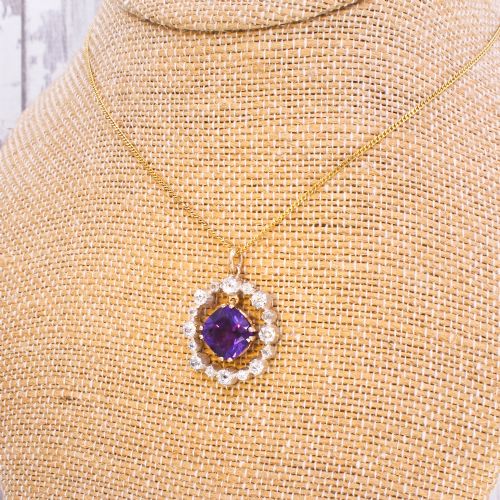
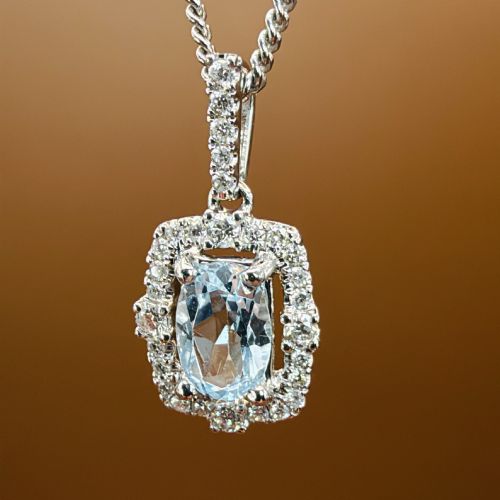
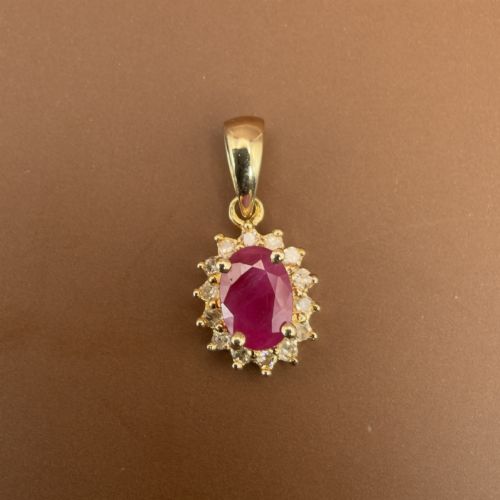


Gold Diamond Halo Necklace
These gold diamond halo necklace pieces bring together central gemstones framed in sparkling stones, offering a timeless design.
Gold Diamond Halo Necklace
A gold diamond halo necklace centres on a principal stone, often amethyst, aquamarine, ruby, emerald, tourmaline, zircon, opal, turquoise, or pearl, surrounded by a border of smaller diamonds. These pendants range from antique Edwardian and Victorian styles to mid-century creations.
The pieces appear primarily as pendants and necklaces suspended on chains, incorporating yellow gold, white gold, silver, and platinum-coloured settings. Buyers encounter both traditional cluster arrangements and specific shaped designs like hearts and squares.
How they were made
Craftsmen set principal gemstones and surrounding diamonds into gold and silver mountings, utilising techniques suited to periods from the Victorian era through the mid-twentieth century. Jewellers employed old cut, rose cut, and modern faceting on stones such as amethysts, emeralds, and aquamarines.
Listings span the Victorian period through the nineteen-fifties and sixties, featuring gold, silver, diamonds, amethysts, and emeralds.
What varies in quality
The distinction rests in the scale and quality of the central gemstone, whether an emerald exceeding four carats or a modest topaz, alongside the matching weight and cut of the surrounding diamonds. The intricacy of the metalwork, from standard yellow gold settings to detailed carved tourmaline or onyx elements, defines the execution.
Provenance and maker attribution elevate certain pieces, such as signed twentieth-century creations by houses like Chaumet, distinguishing them from unsigned traditional cluster designs of the period.
Chaumet
The Gold Diamond Halo Necklace Glossary
- Halo
- A circular or shaped border of smaller diamonds surrounding a larger central gemstone. This framing technique enhances the perceived size and brilliance of the middle stone.
- Cluster pendant
- A pendant design featuring a central gemstone tightly encircled by a ring of smaller accent stones. This style remains prominent across Victorian, Edwardian, and mid-century jewellery.
- Old cut diamond
- A hand-faceted diamond cut popular in antique pieces before the standardisation of modern brilliant cuts. These stones exhibit smaller tables and open culets that catch candlelight.
- Rose cut diamond
- A vintage diamond cut featuring a flat base and a domed crown with triangular facets. This style produces a soft, translucent shimmer rather than intense modern brilliance.
- Carat
- A unit of weight used for measuring gemstones and pearls. Heavier stones generally command greater attention in antique and vintage cluster pendants.
Gold Diamond Halo Necklace: Frequently Asked Questions
How do I wear an antique pendant?
Pendants from the Victorian and Edwardian eras pair well with delicate chains for daily wear or formal occasions. Their versatile scale suits layering or wearing as a standalone focal point.
Consider the metal colour of the setting, whether yellow gold, white gold, or silver, when selecting a matching chain.
How are different periods told apart?
Victorian and Edwardian pieces often utilise rose cut or old cut diamonds set in silver-topped gold or lower-carat yellow gold. Mid-century examples incorporate distinct stone shapes, brighter gold alloys, and occasionally signed maker marks.
Examining the setting techniques and stone cuts provides clear indicators of the era of manufacture.
What stones are used in these necklaces?
Central stones include emeralds, amethysts, aquamarines, rubies, tourmalines, opals, topazes, zircons, and pearls, frequently accompanied by carved elements like onyx horse heads. The surrounding border invariably consists of diamonds.
These varied minerals reflect the diverse stylistic preferences across the nineteenth and twentieth centuries.