


Gold Cabochon Drop Earrings
Gold cabochon drop earrings suspend polished, unfaceted stones from the ear, bringing smooth colour and movement to the face.
Gold Cabochon Drop Earrings
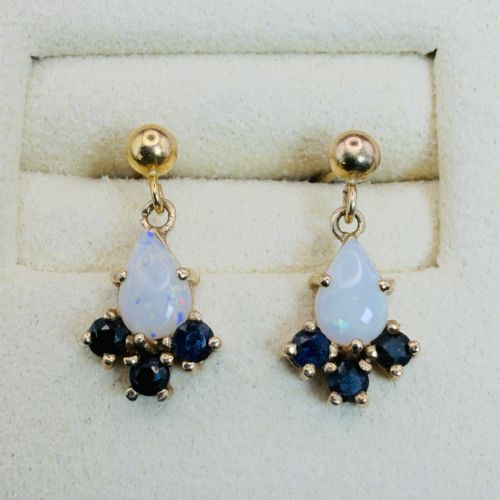
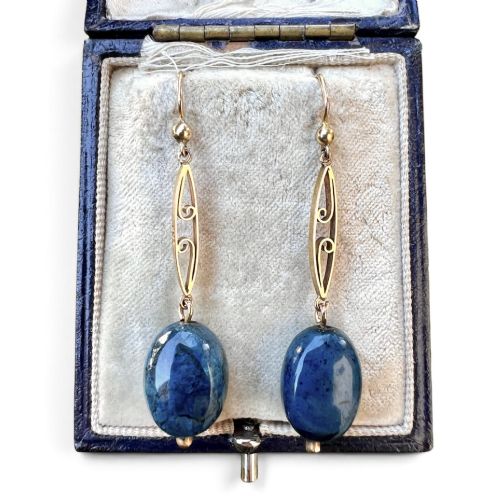
Gold cabochon drop earrings are pendant jewels featuring rounded, domed stones rather than faceted gems, suspended below the earlobe for gentle sway. When searching for gold cabochon drop earrings, buyers encounter pieces primarily from the Victorian and Edwardian eras, alongside mid-century interpretations.
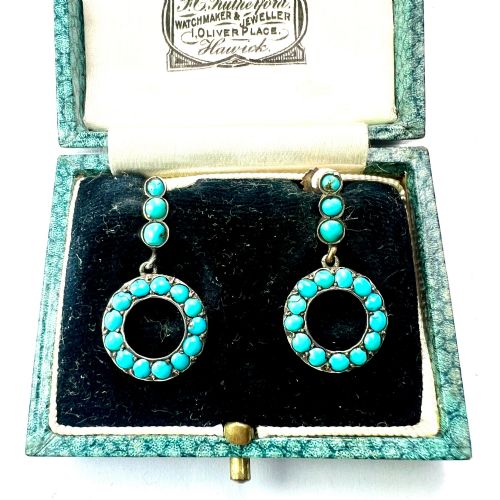
The drops employ various forms such as simple pears, ovals, and teardrops hanging from hooks, studs, or hoops. Gemstones like garnet, amethyst, turquoise, and opal frequently appear shaped as smooth cabochons set within yellow gold mounts.
How they were made
Craftsmen shaped gold into 9ct, 15ct, or 18ct yellow gold settings, often combining silver for historical styles like Etruscan Revival and Victorian turquoise pieces. Stones were carefully cut into smooth, domed cabochons to highlight the natural patterns and inner depths of materials such as banded agate, turquoise, and opal.
Earrings incorporated secure hooks, dangles, and drop mechanisms, sometimes pairing pearls, diamonds, or small accent gems around the central cabochon stone. Construction methods relied on traditional manual metalworking appropriate to periods ranging from the nineteenth century through the mid-century.
Some Victorian earrings manage to dangle with such enthusiasm they practically dance before you've even heard the punchline.
What varies in quality
Quality rests in the selection and polish of the cabochon stone itself, where uniform domes, rich natural colour distribution, and secure bezel settings elevate a piece. The weight and purity of the gold, whether 9ct, 15ct, or higher standard, along with delicate wirework or granulation in revival styles, distinguish finer examples.
Balance and proportion dictate how a drop earring hangs and moves when worn, reflecting the maker's skill in matching the weight of the stone to the length of the drop. Intact original elements and harmonious pairing of natural gems separate standard production from superior historic work.
Le-Gi Italy
The Gold Cabochon Drop Earrings Glossary
- Cabochon
- A gemstone shaped and polished with a smooth, convex domed surface rather than being faceted. This cut is traditionally used for opaque or translucent stones to display colour and pattern.
- Drop earrings
- Earrings that suspend a component below the bottom edge of the earlobe, moving independently as the wearer turns their head. They differ from fixed studs by offering noticeable length and sway.
- Etruscan Revival
- A nineteenth-century design style inspired by ancient archaeological discoveries, characterised by intricate gold granulation and wirework. Pieces from this movement often feature classical motifs.
- Banded agate
- A variety of quartz displaying distinct natural coloured stripes or layers. Jewelters cut these stones en cabochon to accentuate the linear patterns within the polished dome.
Gold Cabochon Drop Earrings: Frequently Asked Questions
What periods do these earrings come from?
The pieces span from the nineteenth century through Victorian and Edwardian eras into the 1930s and 1950s. Styles range from early revival work to mid-century designs.
Each period brings distinct gold purities and mounting techniques, helping to date the craftsmanship accurately.
What stones are used in cabochon drops?
Common stones include garnet, amethyst, turquoise, opal, agate, apatite, and jade. These minerals suit the smooth, rounded cabochon cut.
Opaque and patterned stones take the polish particularly well, displaying natural variations without requiring facets.
How do I wear drop earrings daily?
Ensure the hooks or fastening mechanisms fit securely and comfortably for your ears. Balance the length of the drop against your neckline and daily activities.
Store them individually in a soft pouch to protect the polished stone surfaces from scratching against other items.
How do I identify Etruscan Revival style?
Look for applied wirework, tiny gold granules, and archaeological motifs typical of nineteenth-century revivalism. These details mimic ancient Mediterranean metalworking techniques.
Such pairs often combine gold with turquoise or other historic gem materials in ornate, structured settings.