

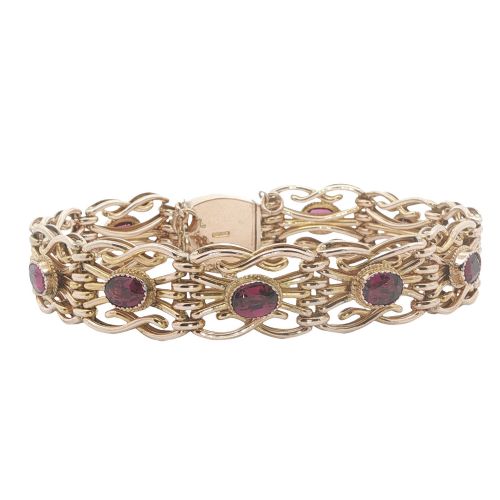


Gold Cabochon Bracelet
A gold cabochon bracelet brings together smooth, dome-cut stones and rich gold work, offering a tactile piece of antique jewellery to wear every day.
Gold Cabochon Bracelet
A gold cabochon bracelet is defined by polished, convex gemstones rather than faceted stones, set into gold links, curbs or bangles. These pieces span from the mid-nineteenth century through the Edwardian era and into the mid-twentieth century.
The versions most commonly found here feature turquoise, moonstone, opal or garnet paired with yellow gold, rose gold or white gold. They range from delicate curb links set with pearls to substantial hinged bangles and stone-set line bracelets.
How they were made
Goldsmiths shaped lower and higher carat golds - including nine carat, fifteen carat, eighteen carat and twenty-one carat - into sturdy curb links, hollow or solid bangles, and flexible settings. Stones were shaped into smooth cabochons by hand, maximising the natural optical properties of moonstones, opals and turquoise.
Settings relied on secure collet mounts and claw work to hold the smooth dome-cut stones firmly within the gold framework, often supplemented by safety chains on Victorian curb links.
Gold Cabochon Bracelet Retail Price Guide 2026
Typical asking prices for gold cabochon bracelet among the pieces listed under this phrase on Sellingantiques today, from the lower quarter to the upper quarter. They describe what is for sale here now, not the wider market.
Materials span turquoise, moonstone, opal, garnet, pearl and diamond set across nine, fifteen, eighteen and twenty-one carat golds.
What varies in quality
Quality rests in the weight and integrity of the gold work, from solid fifteen-carat links to lighter nine-carat settings, alongside the calibre of the cabochon stones themselves. Fine examples display well-matched gems with strong natural colour and clean polishing.
Construction details such as seamless hinge integration, secure box clasps and original safety chains elevate a piece, distinguishing standard production from finer workshop output.
The Gold Cabochon Bracelet Glossary
- Cabochon
- A gemstone shaped with a smooth, convex dome rather than flat facets. This cut is historically favored for stones like turquoise, opal, moonstone and garnet to highlight their internal sheen.
- Curb link
- A type of jewellery chain formed of interlocking, slightly flattened links that lie flat against the wrist. It provides a durable foundation for heavier antique gemstone bracelets.
- Collet
- A band of metal that holds a gemstone in place by encircling its girdle. It is a traditional method for securing cabochon stones in nineteenth-century settings.
- Lovers knot
- A decorative motif formed by tying two threads or metal bands into a knot symbolising attachment. It appears frequently in Edwardian fine jewellery designs.
Gold Cabochon Bracelet: Frequently Asked Questions
How do I care for a turquoise bracelet?
Turquoise is a softer, porous stone that absorbs oils, cosmetics and water easily. Wipe it gently with a soft, dry cloth after wearing and avoid submerging it in liquids.
Keep the bracelet stored separately in a lined box to prevent the gold and stones from scratching against other items in your collection.
Are these bracelets suitable for daily wear?
Many antique bracelets are robustly constructed, particularly heavier curb links and bangles from the Victorian and Edwardian periods. However, softer gems like opals and turquoise require care to avoid sharp impacts.
Checking the clasp and any safety chains periodically ensures the piece remains secure during regular use.
How can I tell the difference between periods?
Victorian pieces often feature substantial yellow gold curb links and heavier stone settings, sometimes paired with intricate safety chains. Edwardian designs lean towards lighter rose gold, delicate moonstones and romantic motifs like knots.
Later mid-century pieces introduce white gold and structured line settings alongside diamonds and opals.
What is the difference between a bracelet and a bangle?
A bracelet is flexible, constructed from linked segments, chains or mesh that drape around the wrist. A bangle is rigid, formed as a solid or hinged circular band that slips over the hand or opens at a clasp.
Both formats appear across the nineteenth and twentieth-century pieces on this page.