


Glass Drop Chandelier Pair
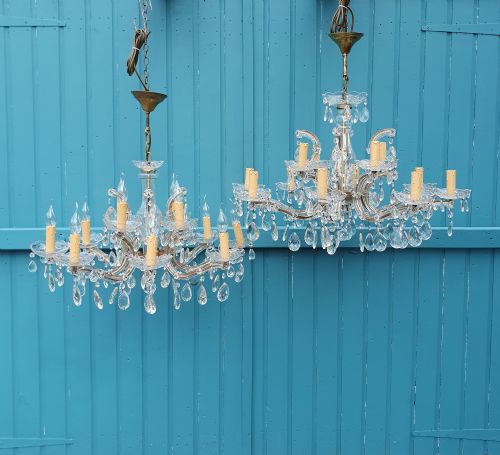
Glass drop chandelier pair options bring dual symmetry and refractive light to a room, which is why interior schemes often start here.
Glass Drop Chandelier Pair
When you search for a glass drop chandelier pair, you are looking at matched sets of hanging light fixtures dressed with prismatic elements. These pieces originate from periods spanning the nineteenth century through the 1930s, incorporating Victorian, Edwardian, and Art Deco aesthetics.
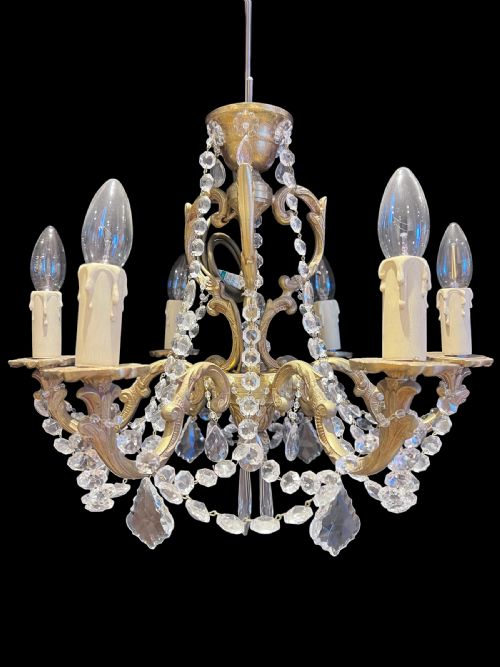
The most common forms you will encounter on this page include French brass and crystal chandeliers, small spike chandeliers, and cut-glass lustres. They range from modest six-light configurations to twelve-arm fixtures and tent-and-waterfall designs.
Makers and manufacturers during these periods utilised brass, gilded bronze, and bronze frameworks to support heavy lead crystal and cut glass. These matched sets provide balanced illumination across grand salons and intimate rooms alike.
Construction and materials
The framework relies on cast brass, gilded bronze, or standard bronze, which provides structural integrity for multi-armed arrays. These metal bodies are shaped into French Rococo, Empire, or Chateau styles before receiving glass components.
Crystal glass, lead crystal, and cut glass elements are hand-hung from the metal armature using wire ties or pins. The individual drops and prisms are shaped to catch and scatter light from multiple bulbs or candles.
Current listings span from the Victorian era and the 19th Century through Edwardian designs up to Art Deco pieces from 1930.
Judging quality in matching pairs
Quality rests primarily in the clarity of the crystal and the weight of the metal casting. Heavy lead glass produces sharper refractive patterns than standard pressed glass, while solid brass or gilded bronze holds intricate chasing better than lighter alloys.
The completeness and uniformity of the glass drops across both fixtures dictate the integrity of the pair. Matching prisms with uniform cutting and minimal edge chipping demonstrate superior original manufacture and careful preservation.
The Glass Drop Chandelier Pair Glossary
- Crystal glass
- A high-clarity glass containing metal oxides that increase refractive index and sparkle. It forms the primary drop and pendant material on finer fixtures.
- Lustre
- A decorative table or mantel ornament featuring hanging glass drops, sharing stylistic traits with chandeliers. They often appear alongside matching ceiling lights.
- Spike chandelier
- A compact hanging light featuring a central vertical spike or shaft draped with glass. These fixtures frequently measure under twelve inches in length.
- Tent and waterfall
- A chandelier design where glass beads form an upper tent shape that cascades down into a wider waterfall of drops. This configuration originates from French workshop traditions.
- Gilded bronze
- Bronze metal coated with a thin layer of gold or gold leaf for a lustrous finish. It provides a durable and ornate framework for crystal elements.
Glass Drop Chandelier Pair: Frequently Asked Questions
Can these antique pairs be rewired for modern ceilings?
Most antique electrical components can be updated by a qualified professional to meet current safety standards. Rewiring preserves the exterior brass or bronze body while replacing degraded internal cables.
Ensure your electrician checks the weight-bearing capacity of your ceiling before hanging heavy multi-arm crystal fixtures. Proper brass hook installations are essential for supporting twelve-light arrangements safely.
What is the difference between Victorian and Edwardian chandeliers?
Victorian designs tend to feature heavier brass structures, elaborate cut-glass lustres, and dense groupings of crystal drops. Their aesthetic leans toward ornate historical revival styles.
Edwardian and 1930s pieces often present cleaner lines, including compact spike chandeliers and lighter tent-and-waterfall configurations. These later fixtures reflect changing interior tastes favouring brighter, less cluttered ceiling arrangements.
How do I verify a matched pair?
Inspect the metal casting details, arm counts, and the exact cut of the glass drops on both fixtures. Genuine matched sets share identical dimensions, patination on the brass or bronze, and manufacturing flaws.
Slight variations in hand-cut crystal are normal for antique pieces, but the overall silhouette and mounting construction must align precisely.