
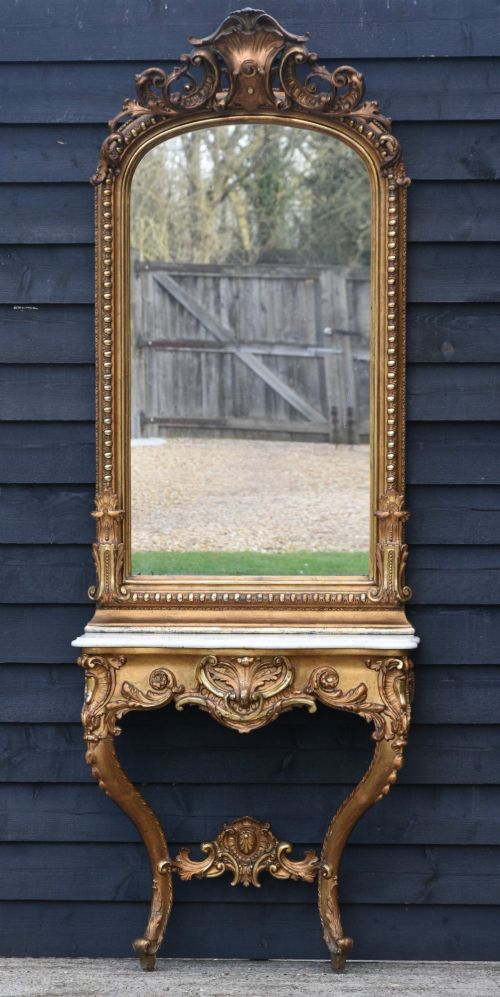
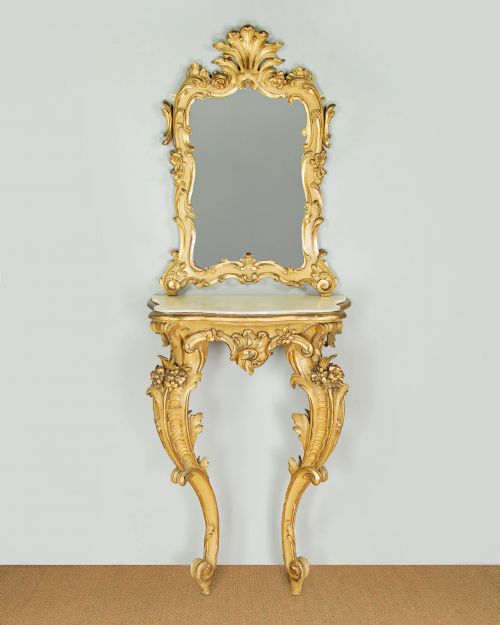

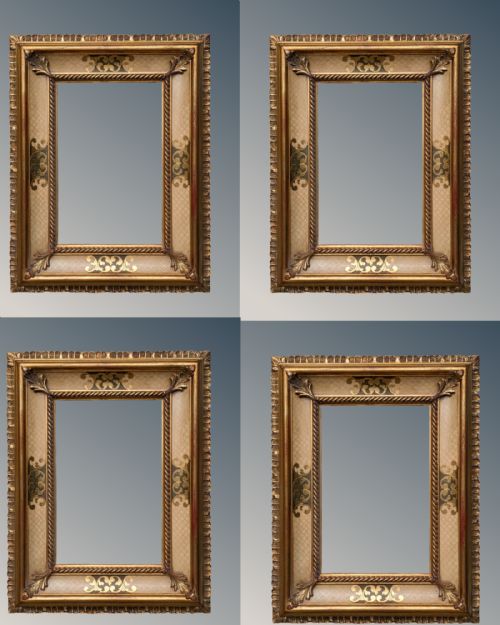


Giltwood Mirror Set
These giltwood mirror set pieces bring ornate French and Italian grandeur to a room, offering paired console tables and matching wall glasses that transform interior spaces.
Giltwood Mirror Set
A giltwood mirror set combines a carved wooden frame finished in gold leaf with a matching console table, creating a unified decorative scheme. These combinations frequently appear from the nineteenth century onward, reflecting historic European revival movements.
The selections on this page span several distinct stylistic revivals, including Rococo, Italian Renaissance, and Neoclassical designs. Buyers encounter console tables paired with pier mirrors, trumeau mirrors, and matching wall glasses.
Origins stretch across France, Italy, and Sweden, showing how different regional workshops interpreted classical ornament. Pieces range from small wall-mounted consoles with shelves to substantial marble-topped tables paired with tall vertical mirrors.
Materials and construction methods
Makers shaped timber frames from woods such as pine or hardwood, applying layers of gesso to build up intricate relief ornaments before gilding. This plaster ground allowed carvers to achieve crisp scrolls, foliage, and architectural moulding.
The finishing process relied on the application of fine gold leaf or metallic gilt, which was polished to catch the light. Many console tables incorporated heavy marble tops, secured above the wooden framework to provide a stable display surface.
Some console tables feature shelves hidden right under the main surface, offering a secret spot for stray calling cards.
Judging quality in gilded furniture
Depth and crispness of hand-carving distinguish finer examples from simpler production, particularly where gesso is modelled into scrolls and floral motifs. Sharp definition in the wooden relief indicates skilled craftsmanship rather than hasty moulding.
The condition and application of the original gilding play a primary role in assessment, as does the integrity of the underlying timber. Integrated sets that retain their original matching console table and mirror demonstrate higher desirability than assembled pairs.
The Giltwood Mirror Set Glossary
- Giltwood
- Wood that has been coated with gold leaf or metallic powder over a prepared gesso ground. This finish provides the characteristic metallic sheen seen on historic frames.
- Console Table
- A table designed to be fixed against a wall, frequently supported by decorative brackets or legs. These tables often feature marble tops and companion mirrors.
- Trumeau
- A decorative wall mirror or panel placed between windows or above a fireplace. In these sets, the glass often incorporates painted panels or carved wooden ornamentation.
- Gesso
- A plaster mixture applied to wood frames to create a smooth surface for carving and gilding. Skilled artisans shaped this material to form high-relief decorative details.
- Pier Mirror
- A tall mirror designed to hang in the wall space between windows. These glasses frequently stand directly above a matching console table.
Giltwood Mirror Set: Frequently Asked Questions
How were these sets used historically?
Historically, these combinations graced formal drawing rooms, entrance halls, and parlours of grand European residences. The console table provided a surface for decorative objects while the mirror reflected natural light.
Placed between windows or against principal walls, they created an illusion of greater space and enhanced the candlelight of evening gatherings. Their dual function combined practical surface utility with architectural ornamentation.
How do I style a set at home?
Position the console table firmly against a focal wall with the matching mirror hung directly above it. This arrangement creates a balanced vignette in a hallway, dining room, or living space.
Keep items placed on the marble or wooden table top minimal to let the carved gilding remain the visual focus. Ensure the wall structure can support the weight of both the heavy timber frame and the table base.
How can I tell the period?
Dating relies on examining the construction methods of the timber, the composition of the gesso, and the style of the carving. Nineteenth-century examples often exhibit heavier proportions and specific revival motifs.
Comparing the hardware, glass bevelling, and joinery against known stylistic periods helps establish an approximate date. Regional characteristics from French, Italian, and Swedish workshops also offer clues to origin and age.