

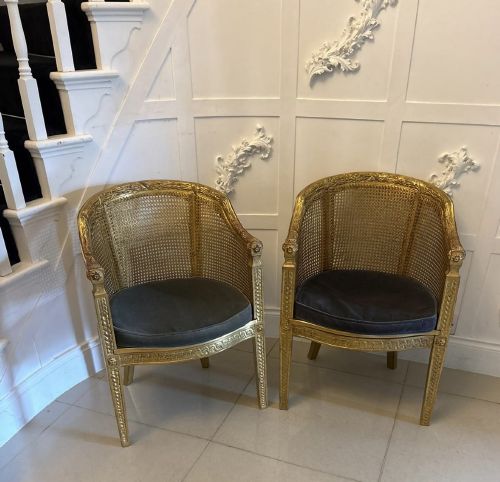


Giltwood Bergere Chairs
These giltwood bergere chairs are heavily gilded timber armchairs offering deep upholstered comfort, shaped frames and classic French styling.
Giltwood Bergere Chairs
When you search for giltwood bergere chairs, you enter a field dominated by nineteenth-century French armchairs, window seats and salon suites. These pieces take various revival forms, chiefly Louis XVI Style and Louis XV Revival, alongside Rococo Revival designs and French Chateau aesthetics.
Most examples found here date from the nineteenth century, stretching from eighteen fifty through to nineteen twenty. You will encounter individual armchairs, matching pairs, sets of four, and larger salon suites complete with footstools or settees.
While many are traditional timber frames covered in giltwood or gilding, some variants incorporate walnut or cane panels. The upholstery ranges from plain velvet and damask fabric to silk parrot designs, reflecting both period commissions and later nineteenth-century tastes.
How they were made
The primary construction relies on timber frames, often walnut or general wood, shaped and joined to form the characteristic enclosed sides of the bergere form. Carvers then decorated these structures with intricate motifs before applying layers of gold leaf or gilding to create the characteristic giltwood finish.
Upholstery techniques combined traditional stuffing with textiles such as velvet, damask fabric, and silk, sometimes paired with structural cane panels on the arms or back. Brass components and marquetry inlay occasionally appear on related suites from the Victorian period.
Giltwood Bergere Chairs Retail Price Guide 2026
Typical asking prices for giltwood bergere chairs among the pieces listed under this phrase on Sellingantiques today, from the lower quarter to the upper quarter. They describe what is for sale here now, not the wider market.
Materials recorded across the inventory include giltwood, velvet, damask fabric, cane, walnut, wood, timber, and brass.
What varies in quality
Quality in these armchairs rests upon the crispness of the timber carving and the integrity of the giltwood surface. Finer examples display deeply sculpted wooden details that retain their original gilded brilliance rather than heavy, flat paint applications.
The proportion and scale of the frame also dictate the calibre of the piece, particularly in revival styles where symmetry and balance are paramount. Furthermore, the original integration of cane panels or the choice of heavy damask and velvet upholstery separates standard production from superior salon seating.
The Giltwood Bergere Chairs Glossary
- Bergere
- An enclosed upholstered armchair with wooden frames and closed sides, popular in French seating design. These seats often feature padded armrests and loose squab cushions.
- Giltwood
- Timber decorated with a thin layer of gold leaf or metallic gilt, creating a bright reflective surface. This finish defines the ornate appearance of nineteenth-century French revival furniture.
- Louis XVI Style
- A neoclassical design aesthetic characterised by straight tapered legs, geometric framing and classical ornamentation. It provides the blueprint for many nineteenth-century gilded armchairs.
- Rococo Revival
- A nineteenth-century design movement favouring asymmetrical curves, naturalistic scrollwork and exuberant floral carving. This style appears frequently on shaped salon chairs and suites.
- Damask Fabric
- A reversible figured textile woven on a jacquard loom, frequently used for upholstery in period seating. Its textured patterns add visual depth to formal armchairs.
Giltwood Bergere Chairs: Frequently Asked Questions
What is a bergere chair?
A bergere is a traditional French armchair featuring enclosed upholstered sides, a solid wooden frame, and a padded seat. They were designed for indoor drawing room comfort rather than formal upright sitting.
Unlike standard open armchairs, the sides are filled in with upholstery or canework to block draughts. They remain popular for adding formal character and comfortable seating to traditional living spaces.
How do I identify Louis XVI style?
Louis XVI style is marked by a return to classical straight lines, symmetrical forms, and geometric restraint. You will typically see fluted tapered legs and carved ribbon or leaf motifs rather than asymmetrical curves.
This aesthetic contrasts sharply with the earlier Rococo revival forms found in the nineteenth century. Look for rectangular or oval chair backs paired with clean structural framing.
Where were these chairs used?
These gilded armchairs belonged in formal reception rooms, drawing rooms, and private salons of nineteenth-century residences. They provided comfortable seating for conversation and reading.
Today, they function well as statement armchairs in sitting rooms or bedrooms. Their ornate giltwood frames make them suitable as focal points rather than casual seating.
What distinguishes giltwood from painted wood?
Giltwood involves applying thin sheets of gold leaf over a prepared base layer on timber, creating a warm metallic sheen. Painted wood simply uses liquid pigment applied directly to the surface.
Under close inspection, giltwood reveals the fine seams and texture of metal leaf. It reflects ambient light differently than flat painted finishes, giving nineteenth-century salon furniture its distinct glow.