



Gilt Shelf Corbel
A gilt shelf corbel brings architectural richness to an interior, offering a decorative support for ornaments, clocks or plants.
Gilt Shelf Corbel
When you search for a gilt shelf corbel, you are looking at ornamental wall brackets designed to carry weight while providing visual ornamentation to a room. The selections span the eighteenth, nineteenth, and early twentieth centuries, capturing historical revivals ranging from Rococo to Baroque.
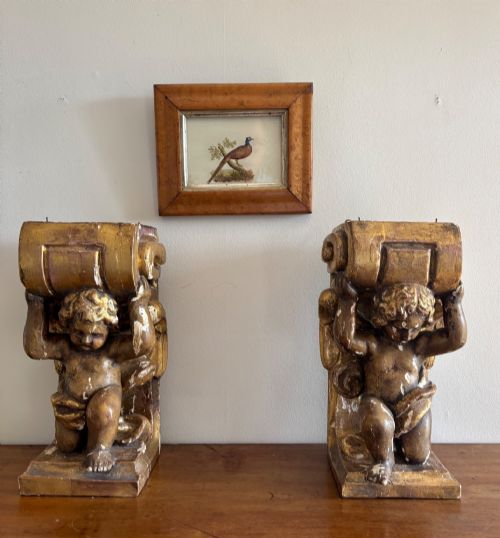
The most common examples you will encounter on this page are carved wood or giltwood wall brackets from the nineteenth century. These items often appear in pairs and frequently adopt Italian or French stylistic influences such as Rococo Revival.
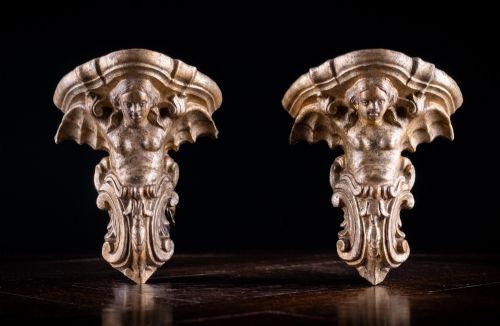
Other variations appearing in the inventory include terracotta winged siren figures, ceramic components paired with ormolu, and ebonised designs attributed to specific makers like Henri Dasson. Wall brackets range from simpler hanging frames of the nineteen-thirties to deeply carved gilded timber supports.
How they were made
Makers fashioned these pieces primarily from carved wood, applying gesso layers before adding gold leaf or general gilding to achieve a luminous surface finish. Ormolu, terracotta, porcelain, and ceramic also appear as structural or decorative mediums in the material record.
Woodcarving techniques define the traditional timber brackets, creating elaborate scrolls, acanthus leaves, and figural elements such as winged sirens. Ormolu mounts involve cast bronze finished with mercury gilding, fixed to timber or ebonised bases to contrast the metallic lustre against dark wood.
Gilt Shelf Corbel Retail Price Guide 2026
Typical asking prices for gilt shelf corbel among the pieces listed under this phrase on Sellingantiques today, from the lower quarter to the upper quarter. They describe what is for sale here now, not the wider market.
The listings on this site feature nineteenth-century pieces alongside eighteenth-century Italian examples, spanning carved giltwood, ormolu, and terracotta.
What varies in quality
Depth and crispness of the carving distinguish finer pieces from simpler commercial output, with superior items showing undercut details and deliberate hand-tool work rather than soft mouldings. The application of gold leaf or gesso reveals the artisan's hand, where burnished highlights contrast against matte textured areas.
Material selection and attribution also elevate certain objects, such as heavy cast ormolu paired with ebonised wood or documented nineteenth-century cabinet work by makers like Henri Dasson. Pairs naturally command greater design cohesion compared to single survivors.
Henri Dasson
The Gilt Shelf Corbel Glossary
- Giltwood
- Timber that has been coated with thin sheets of gold leaf over a prepared gesso ground. This technique creates a durable metallic sheen characteristic of classical decorative woodwork.
- Ormolu
- Finely chased and gilt bronze used for decorative mounts and furniture highlights during the eighteenth and nineteenth centuries. The term derives from the French for milled or ground gold.
- Gesso
- A paint mixture consisting of a neutral binder mixed with chalk, gypsum, or pigment. Artisans apply it to wood surfaces to create a smooth base for subsequent gilding.
- Corbel
- A structural member projecting from a wall to support a weight inside or outside a building. In interior decorative contexts, it functions primarily as an ornamental wall bracket or shelf.
- Rococo Revival
- A nineteenth-century design movement characterised by asymmetrical scrolls, shell motifs, and naturalistic curves. It reinterprets the lightness of eighteenth-century French court taste.
Gilt Shelf Corbel: Frequently Asked Questions
How do I tell nineteenth century pieces apart?
Nineteenth-century items often draw heavily on earlier historical styles, such as Italian Baroque or French Rococo Revival, visible in the carved motifs and heavy gilding.
Examining the underlying timber, gesso preparation, and tool marks helps differentiate nineteenth-century craftsmanship from later twentieth-century reproductions.
Are wall brackets sold as pairs?
Many surviving examples in the record appear as matched pairs, designed to flank doorways, mirrors, or fireplace openings symmetrically.
Single brackets also occur frequently, having survived independently from larger decorative schemes over the decades.
What materials are used in these brackets?
Traditional pieces rely on carved wood finished with gesso and gold leaf to create a classic gilded appearance.
Alternative materials documented in the inventory include terracotta, porcelain, ceramics, and cast ormolu mounted on ebonised wood.