

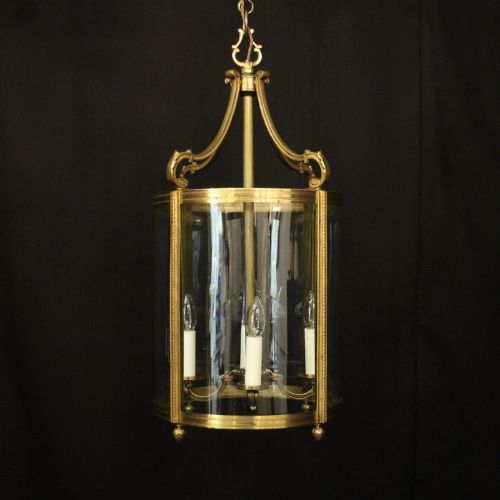


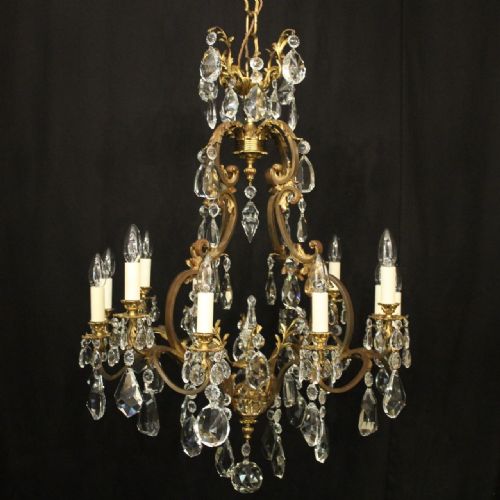


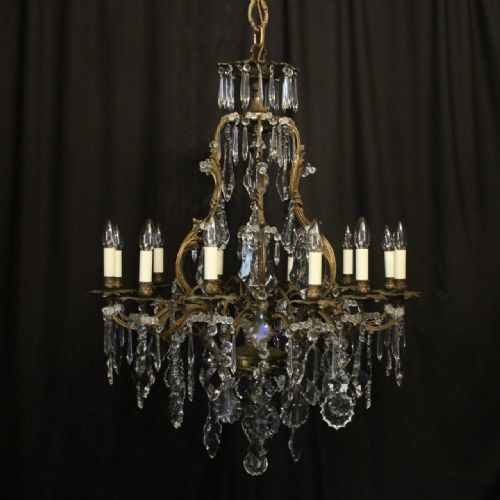


Gilt Bronze Cage Chandelier
These gilt bronze cage chandeliers bring architectural weight and sparkling crystal to high ceilings, rewarding patience in the search.
Gilt Bronze Cage Chandelier
When you search for a gilt bronze cage chandelier, you are looking at substantial hanging light fixtures built around a metal skeleton and dressed with glass or crystal drops. These pieces emerge predominantly in French and Italian designs spanning the late nineteenth century through to the 1930s.
The versions you are most likely to meet on this page take the form of multi-light chandeliers and pendant lanterns with six to twelve lights. They frequently draw upon French Rococo, French Neoclassical, and Italian Baroque styles, often referencing historical interiors like the Palace of Versailles.
How they were made
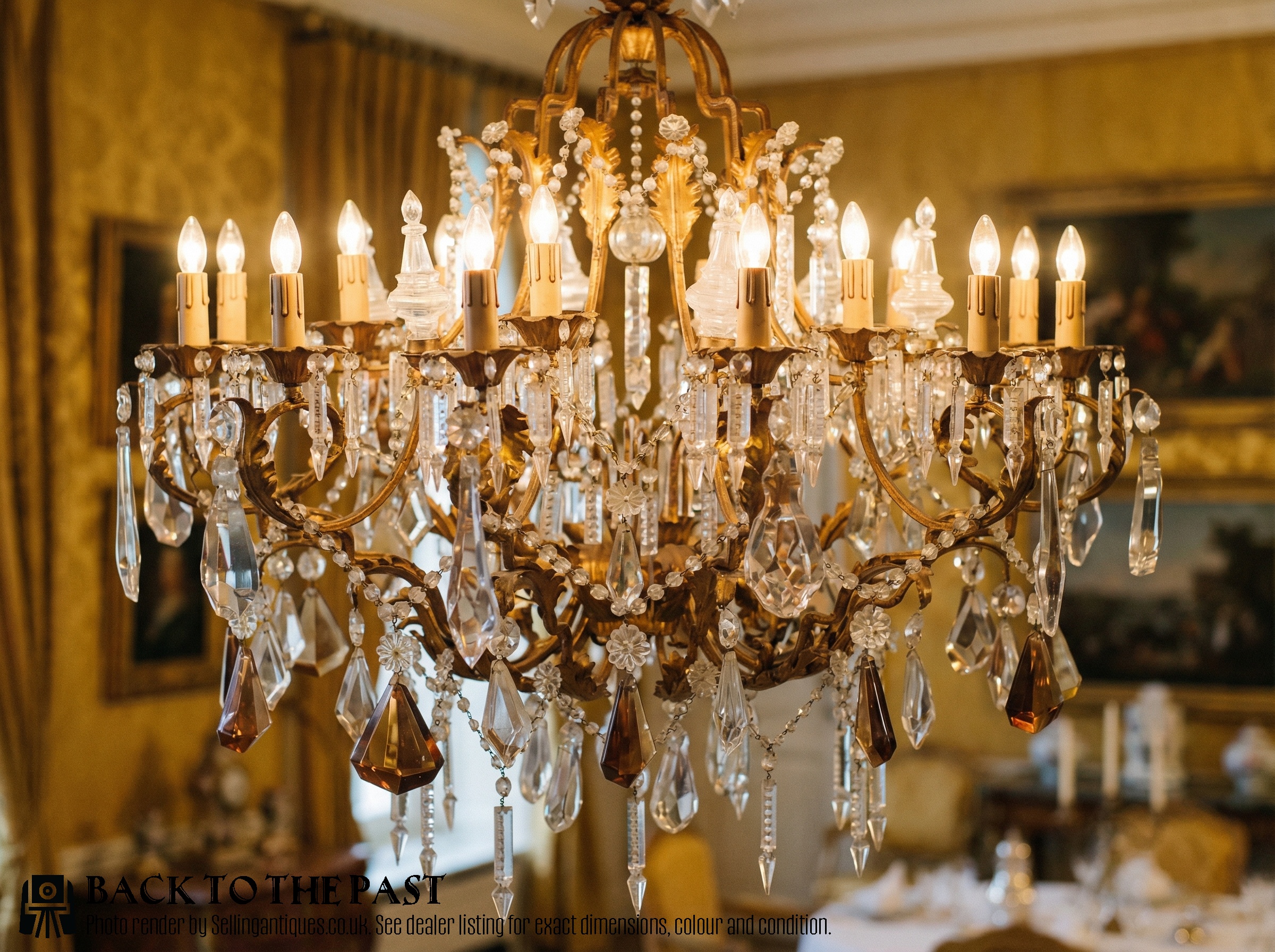
The foundation of these fixtures relies upon cast bronze, ormolu, and gilt metal forming a structured frame, sometimes supplemented by brass components. Artisans then wired these metal armatures to hold arrays of cut crystal, glass drops, and glass covered elements.
Surface finish is achieved through gilding, imparting a rich metallic sheen to the bronze frames that complements the reflective qualities of the hanging crystal and glass components.
One enthusiastic lamp wears coloured crystal alongside its gilt bronze cage, proving that even chandeliers enjoy dressing up in colour.
What varies in quality
Quality in these chandeliers rests on the crispness of the bronze casting and the precision of the gilt work. Heavier frames with deeply chased ornamentation and high-grade cut crystal distinguish the finest examples from simpler metal and glass iterations.
The sophistication of the internal armature and the complexity of the glass dressing, such as hexagonal lantern geometries or integrated coloured crystal elements, also mark the division between standard production and exceptional decorative pieces.
The Gilt Bronze Cage Chandelier Glossary
- Cage chandelier
- A hanging light fixture featuring a metal skeletal framework enclosing the internal lighting components and draped with crystal drops.
- Ormolu
- Finely chased gilt bronze applied as a decorative surface finish on nineteenth-century lighting frames.
- Cut crystal
- High-clarity lead glass shaped with polished facets to refract light across the room.
- Pendant lantern
- A hanging enclosed light fixture, often hexagonal in shape, suspended by a chain from the ceiling.
Gilt Bronze Cage Chandelier: Frequently Asked Questions
What periods do these chandeliers come from?
The pieces listed span from the late nineteenth century through the early decades of the twentieth century. You will encounter items dated from the 1880s up to 1930.
Most examples originate from French and Italian workshops, reflecting historic design vocabularies like Neoclassical and Baroque styles.
What materials are used in these fixtures?
The primary structural materials are gilt bronze, ormolu, and gilt metal, sometimes complemented by brass. These metals form the cage frame that supports the lighting configuration.
Lighting is enhanced through the extensive use of glass, cut crystal, and coloured crystal drops suspended throughout the metal framework.
How many lights do these chandeliers have?
The lighting capacity varies across the available forms, typically ranging from three lights in smaller lanterns up to twelve lights in larger chandeliers.
Medium and large formats commonly feature six or eight lights distributed within the cage structure to illuminate large spaces.
Where were these chandeliers made?
The regional origins represented on this page are predominantly French and Italian. Makers drew inspiration from grand historical interiors such as the Palace of Versailles.
Styles span French Chateau, French Rococo, French Neoclassical, and Italian Baroque traditions.