

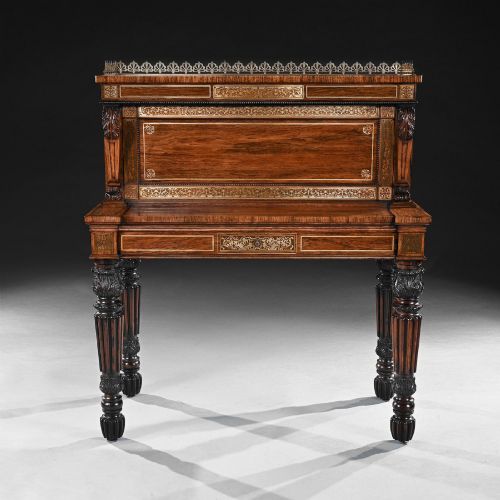
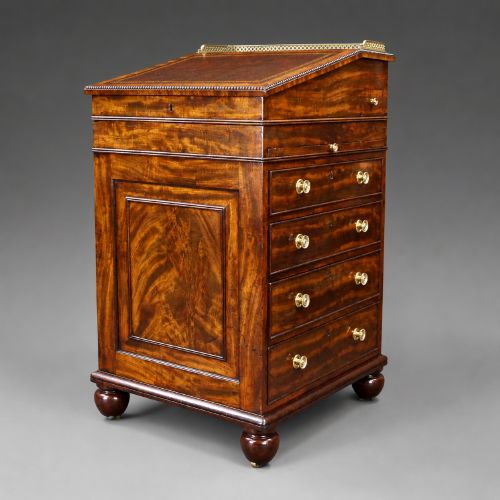
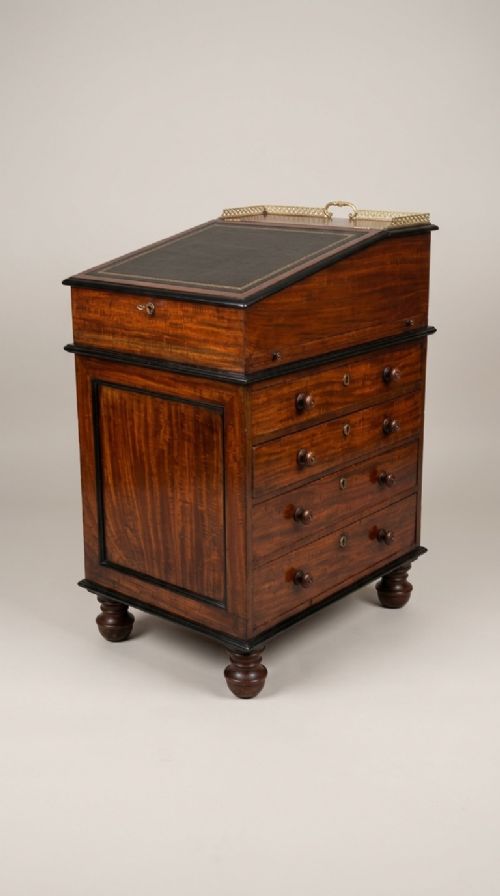

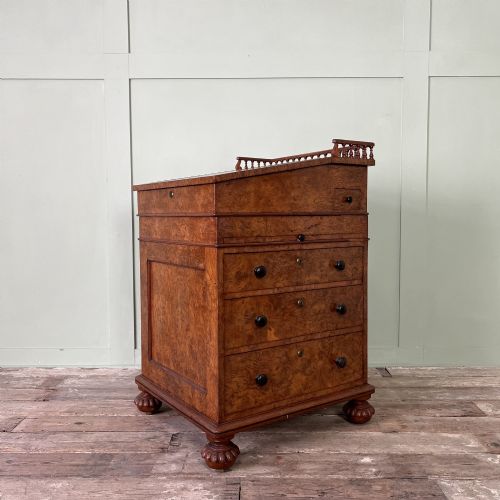


Gillows Davenport
A gillows davenport is a compact writing desk offering clever storage and a sloping leather surface, prized for its refined cabinetwork and practicality.
Gillows Davenport
The gillows davenport is a distinctive form of small desk that combines a sloped writing surface with a pedestal of drawers beneath. These pieces originate primarily from the nineteenth century, encompassing Georgian, Regency, and early Victorian periods.
Makers working within this tradition produced writing tables and desks using timbers such as mahogany, rosewood, burr walnut, and satinwood. The pieces on this page demonstrate the characteristic proportions and cabinetmaking standards associated with the Lancaster and London workshops.
How they were made
Cabinetmakers constructed these desks using dense primary hardwoods including flame mahogany and rosewood, often enhanced by contrasting ebonised wood details. The writing slopes typically feature inset leather panels designed to provide a smooth surface for correspondence.
Metalwork played a functional and decorative role, with brass inlays and mountings integrated into the timber structures. Joinery techniques ensured that the internal stationery compartments and side-opening drawers operated smoothly within a compact footprint.
Gillows Davenport Retail Price Guide 2026
Typical asking prices for gillows davenport among the pieces listed under this phrase on Sellingantiques today, from the lower quarter to the upper quarter. They describe what is for sale here now, not the wider market.
Listings feature nineteen-century pieces constructed from mahogany, rosewood, burr walnut, and satinwood across Regency and Victorian styles.
What varies in quality
Quality in a gillows davenport lies in the selection of timber veneers and the precision of the secondary details. Pieces displaying carefully matched flame mahogany or rich burr walnut demonstrate a higher grade of material choice by the maker.
The sophistication of the internal fittings and the crispness of brass inlay distinguish finer examples from standard production. Cabinetmaking execution across the secondary drawers and the stability of the writing slope indicate the skill involved in the original construction.
Gillow and Co·Gillows of Lancaster·James Winter and Son
The Gillows Davenport Glossary
- Davenport
- A small pedestal desk featuring a sloping writing surface that typically lifts to reveal storage. This form became popular during the nineteenth century for domestic correspondence.
- Flame mahogany
- A veneer cut from the fork of the mahogany tree, producing a distinctive flame-like pattern. Cabinetmakers utilised this timber for its dramatic visual movement.
- Ebonised wood
- Timber treated to imitate ebony, providing dark contrasting details against lighter woods. This technique was common in Regency and Victorian furniture decoration.
- Pedestal
- The box-like lower section of a desk containing drawers. In these pieces, the pedestal supports the writing slope.
Gillows Davenport: Frequently Asked Questions
What is a gillows davenport desk?
A gillows davenport is a small nineteenth-century writing desk featuring a sloping top and a bank of drawers beneath. These pieces were designed to occupy minimal floor space while offering secure storage for writing materials.
The form combines cabinetmaking with practical compartments, making it a functional piece of study furniture during the Georgian and Victorian eras.
How were davenports used originally?
These desks served as private writing stations for correspondence and record-keeping in domestic settings. The sloping top provided a comfortable angle for handwriting.
Internal compartments held stationery, inkwells, and letters, while side drawers kept personal papers organised and accessible from a seated position.
Which timbers appear on these desks?
Workshop production utilised dense hardwoods including mahogany, flame mahogany, rosewood, burr walnut, and satinwood. Cabinetmakers selected these materials for both durability and decorative grain patterns.
Secondary woods and brass hardware supported the primary structure, while leather panels formed the writing surface.
How do you identify a Regency davenport?
Regency examples display specific stylistic markers such as classical proportions, brass inlay, and rosewood or mahogany veneers. Cabinetwork from this period often reflects the design vocabulary associated with early nineteenth-century workshops.
Construction details and secondary wood choices help distinguish these pieces from later Victorian iterations.