


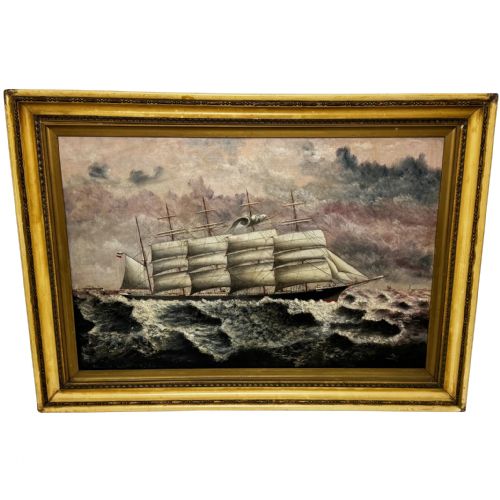


Gilded Framed Ship Artwork
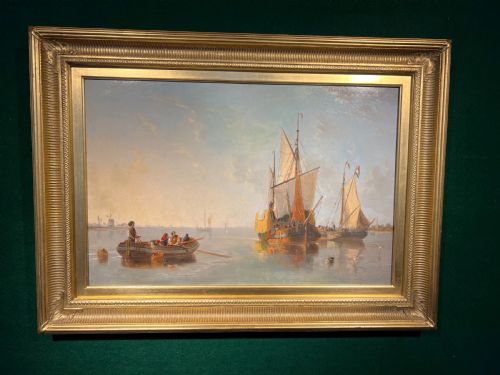
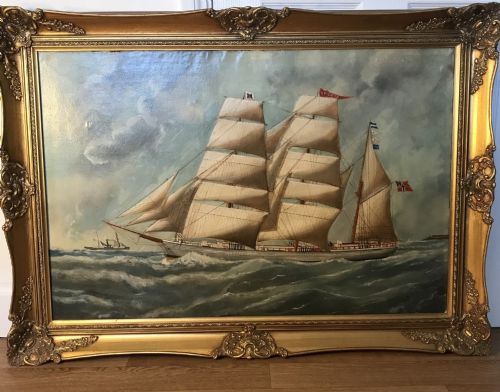
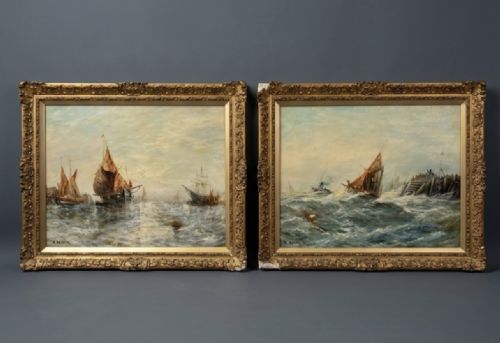
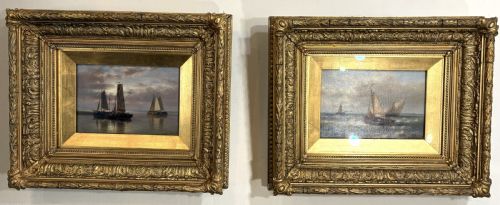
These gilded framed ship artwork selections bring maritime history into a room through oil and watercolour paintings set in ornate gold frames.
Gilded Framed Ship Artwork
When you search for gilded framed ship artwork, you encounter maritime scenes capturing sailing vessels, royal yachts, and steamers across the nineteenth and early twentieth centuries. These works span Victorian and Edwardian periods, presenting coastal views, heavy seas, and naval reviews in oil on canvas, board, and paper.
The objects take the form of framed paintings, watercolours, and pierhead pieces depicting named vessels such as the S.S. Shelley, the Potosi, and the royal yacht off Osborne House. Artists document specific locations including Portsmouth Harbour, the Mediterranean, and the Thames, placing ships within detailed coastal settings.
Most examples originate from nineteenth century production, continuing into Edwardian and later decades with depictions of ocean liners and cruisers. The framing relies on gilt and giltwood surrounds that complement the maritime subjects housed within glass and wood structures.
Materials and construction
Works utilise oil paint on canvas, board, and panel, alongside watercolour on paper. Canvas supports larger compositions of three masted schooners and royal vessels, while boards and panels accommodate smaller maritime studies.
Frames are fashioned from wood finished with gilt and giltwood applications to create gold surfaces. These frames enclose the painted scenes, sometimes paired with glass protection for watercolour pieces.
Ships brave heavy seas and navigate past lighthouses while royal fleets review spectacles on the water.
Judging the work
Distinctions in quality rest upon the precision of the vessel rigging, the handling of water and atmospheric conditions, and the execution of the surrounding frame. Works by recorded artists demonstrate firmer control over maritime architecture and coastal light.
The relationship between the painting and its gilt frame influences overall cohesion, where original or period-appropriate gilding enhances the presentation of historical ship portraits and harbour views.
John Wilson Carmichael·Abraham Hulk I·Daniel Sherrin·Thomas Bush Hardy·John Callow·Richard Brydges Beechey·Charles Dixon·Joseph Heard·William Langley·Ludwig Hermann·John James Wilson·Hubert Thornley·Edward Fletcher·Frank William Scarbrough·Charles Martin Powell·Francis Moltino·Stephen Brownlow
The Gilded Framed Ship Artwork Glossary
- Pierhead painting
- A genre of ship portraiture created for sailors and ship owners, depicting vessels clearly as they entered or left port.
- Giltwood
- Wood carved and coated with gold leaf or gilt powder to create a bright metallic finish on picture frames.
- Barque
- A sailing vessel with three or more masts, having the foremast and mainmast square-rigged and the mizzenmast fore-and-aft rigged.
- Watercolour
- A painting method in which the paints are made of pigments suspended in a water-based solution, frequently utilised on paper.
- Seascape
- An artwork depicting the sea, coastal views, or marine vessels in motion.
Gilded Framed Ship Artwork: Frequently Asked Questions
What periods do these maritime paintings represent?
The pieces span the nineteenth century through the Edwardian era, incorporating Victorian depictions of naval ships and coastal scenes.
Dates extend from the eighteen-fifties into the early decades of the twentieth century, recording historic vessels and harbour views.
How are the frames constructed?
Frames consist of wood finished with gilt and giltwood, providing gold-toned borders that enclose canvas, board, or paper works.
Some watercolours also include glass protection over the painted surface.
What subjects appear in the artwork?
Subjects include three masted schooners, royal yachts, ocean liners, and steamships navigating heavy seas or docked in harbours.
Named vessels and specific locations such as Portsmouth Harbour and the Thames feature prominently across the works.
Are the paintings signed by artists?
Many examples feature signatures or attributions to documented marine artists from the nineteenth and early twentieth centuries.
Attributions connect individual paintings to known painters working within British and continental maritime traditions.